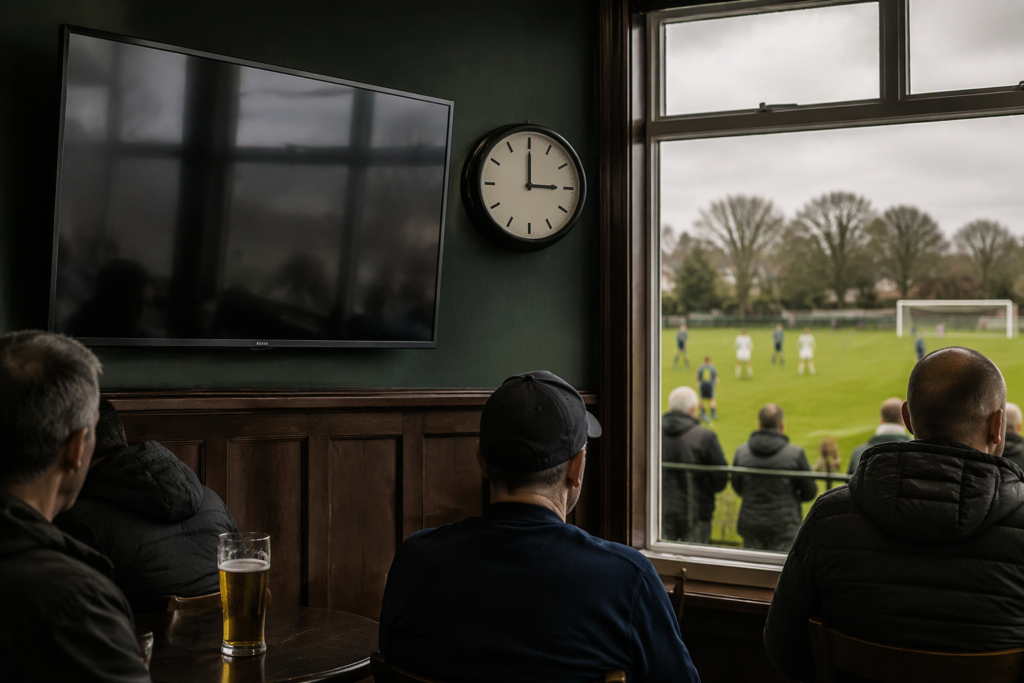
Every Saturday afternoon, a fan in Tokyo, New York, or Sydney can watch any English top-flight match on live television, yet a supporter living five miles from the stadium cannot legally see it at home. That sixty-year-old restriction, known as the 3pm football blackout, is now facing its most serious threat yet.
Broadcasters have run out of empty slots to televise games in the United Kingdom. To keep pushing broadcast income higher, the Premier League and the English Football League (EFL) plan to sit down next year to debate whether the long-standing rule should survive.
Also read: Adam Copeland Bear Fight: AEW Star Kicked Animal Before Match
Any change would transform weekend routines for millions of fans across the country. Yet lower-tier clubs fear that broadcasting every game will wipe out their ticket sales and threaten their survival.
How a 1960s boycott created the rule
The blackout began with a clash over television cameras in 1964. The BBC had just launched Match of the Day on BBC Two, which was then only broadcast in London.
Club bosses panicked about empty stadiums. Burnley chairman Bob Lord barred the BBC cameras from Turf Moor, arguing that televised football would keep spectators at home.
Other clubs tried to block the contract renewal at the end of that season. To resolve the dispute, the BBC agreed to keep the featured Saturday match secret until all matches had finished.
By 1987, UEFA turned England’s defensive tactic into a formal European regulation known as Article 48. The rule allowed domestic associations to declare a two-and-a-half-hour blackout on television broadcasts, provided that half of the matches in the top two divisions kicked off during that period.
England, Scotland, and Northern Ireland are now the only nations in Europe that still enforce Article 48. Other major European leagues do not qualify because their schedules run on different timetables.
In Germany, the Bundesliga plays at 3:30pm on Saturdays, while the second tier plays at 1:30pm. Spain staggers its fixtures into separate slots so every game can air live, Italy divides Serie A and Serie B across Sunday and Saturday, and France scatters matches throughout the weekend.
Squeezing the Premier League TV rights
Money is driving the renewed push to scrap the restriction. The domestic Premier League TV rights recently sold for a record £6.7bn, an increase of 4%.
Reaching that total forced the league to offer 70 extra matches to television networks. In real terms, the broadcast value of each individual live fixture actually dropped.
Broadcasters already show every single fixture that falls outside the traditional Saturday 3pm kick-off window. Only 110 untelevised matches remain per season.
If the top flight wants to generate higher revenue from its next television cycle in 2029-30, it has few options left. The league must either create more inconvenient kick-off times or sell off the Saturday afternoon window.
Other competitions have run into the same barrier. The Women’s Super League previously examined playing matches at 3pm on Saturdays to capture new viewers, but could not get around the broadcast ban.
Meanwhile, Scottish football has already stepped forward to invite bids for every fixture live, signalling that it is ready to televise Saturday afternoon matches.
Non-league football fights for survival
Beyond the financial ambitions of elite clubs, the dispute exposes deep anxiety across non-league football. Senior figures in the National League, which streams matches globally through DAZN, strongly oppose ending the blackout across their 72 clubs.
Their main concern centers on matchday gates. Lower-tier teams depend heavily on transient supporters—season ticket holders at top-flight or Championship sides who attend local grassroots games when their main club plays away.
The 3pm football blackout protects clubs that operate on razor-thin margins. Andy Burnham and Football Supporters’ Association chair Tom Greatrex have both urged caution, warning that rushed changes could fracture the wider English football pyramid.
Nicky Bloom, who chairs Northern Premier League club FC United of Manchester, argued that the sport cannot be viewed solely through the lens of elite clubs.
“For many of those clubs, the income from people coming through the turnstiles, buying a pint or something to eat is what keeps them alive. The 3pm blackout isn’t about nostalgia. It’s about protecting something that matters.”
Bloom warned that these local sides act as vital neighborhood anchors whose disappearance would damage towns far beyond 90 minutes of football.
Rethinking the 3pm football blackout
Not every grassroots team agrees with keeping the gates shut to cameras. A growing minority believes the 3pm football blackout prevents smaller clubs from exploring modern digital audiences.
FC Isle of Man stopped playing at 3pm on Saturdays entirely, allowing the club to stream its matches to fans worldwide. Other outfits, such as Dorking Wanderers and Hashtag United, have argued that lifting the blackout could bring fresh commercial income and reduce awkward match schedules.
At eighth-tier Ashington FC, director Brian Shotton acknowledged the complex trade-off. His club draws crowds of around 400 and sees ticket sales jump by 25% whenever Newcastle United play away, yet widespread unauthorized streaming already pulls spectators away.
The blackout rules also face logistical strain. Because broadcasters shift so many high-profile fixtures for television, fewer than half of top-flight and second-tier games kick off at 3pm on certain weekends. On 28 November, for instance, only two Premier League matches and seven Championship fixtures take place in the Saturday afternoon window.
The Premier League and the EFL will begin formal talks on the blackout next year, giving both competitions time to finalize their joint broadcast proposals before the 2029-30 rights tender opens.
Source: BBC