
A Close Look at the Bayeux Tapestry’s Dramatic Scenes and Historic Detail
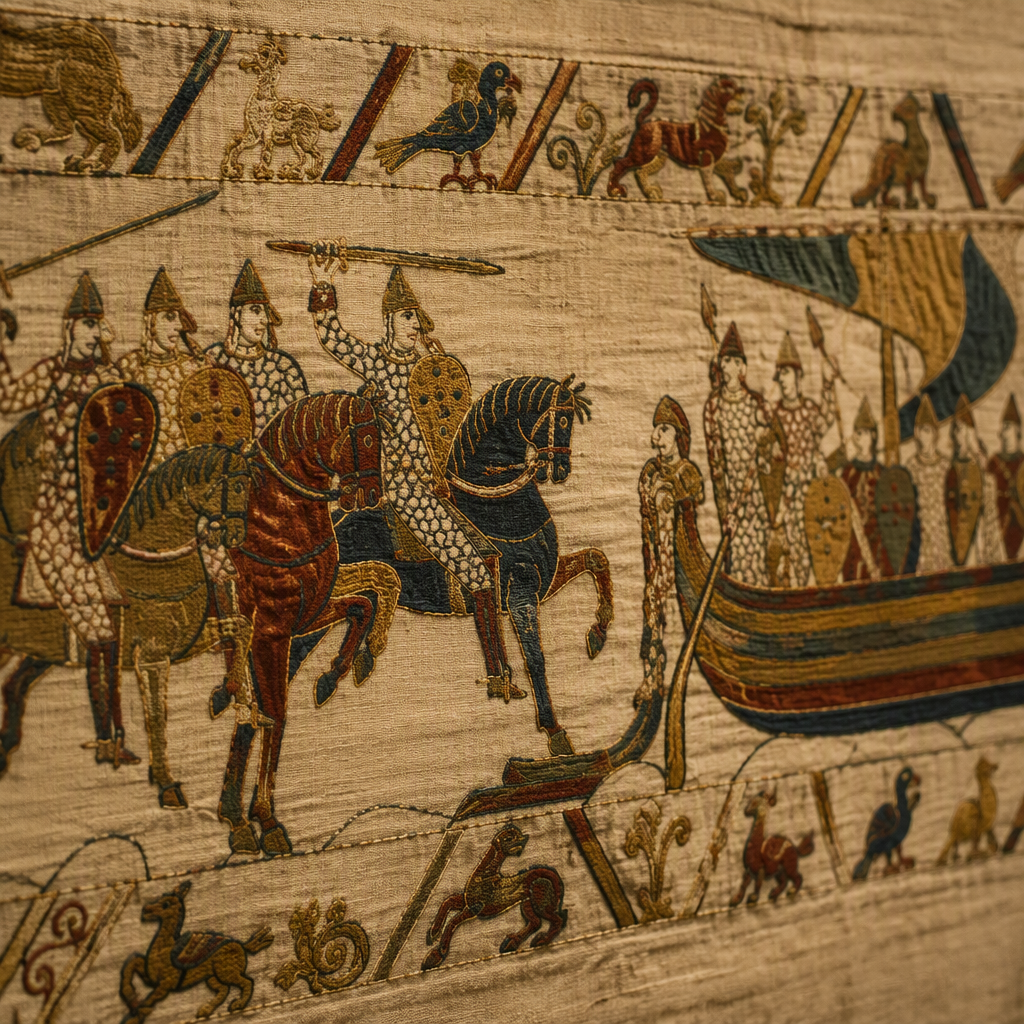
Nearly a millennium after its creation, the world’s most famous embroidered chronicle still delivers visceral storytelling with unmatched clarity. A close look at the Bayeux Tapestry dramatic scenes reveals far more than a simple record of William the Conqueror’s victory over King Harold II in 1066. Stretched across nearly 70 meters (230 feet) of embroidered linen, the textile captures medieval warfare, supernatural omens, psychological tension, and raw human ambition in cinematic detail.
Crafted in the late 11th century—widely believed by historians to have been commissioned by Bishop Odo of Bayeux and stitched by English needleworkers—the work survives as an indispensable primary source for medieval Europe. Today, housed in Normandy, France, it continues to draw researchers and spectators eager to dissect its intricate panels.
Also read: Ainsley Earhardt and Sean Hannity Celebrate Upcoming Wedding at Mar-a-Lago
From Oath to Omen: Key Moments in the Visual Narrative
The visual saga begins years before the clash on Senlac Hill. The embroidery sets up the geopolitical conflict between Harold Godwinson, Earl of Wessex, and Duke William of Normandy with careful dramatic pacing.
One of the earliest critical panels depicts Harold taking an oath on holy relics before William. The composition places Harold between two shrines, hands outstretched in solemn commitment. The dramatic tension is immediate: Norman viewers recognized this moment as a sacred covenant, while Anglo-Saxon audiences would view his later coronation as an agonizing breach forced by circumstance.
Soon after Harold takes the English throne, the drama shifts from earthly politics to celestial intervention. Scene 32 presents crowds pointing skyward in horror at the sudden appearance of Halley’s Comet, rendered with blazing fiery streamers. Directly beneath, an agitated Harold sits on his throne, leaning forward as a ghostly fleet of ghost-ships appears in the border below—a terrifying premonition of the Norman invasion fleet.
The Battle of Hastings: Chaos and Climax Embroidered in Thread
The final third of the textile delivers an unflinching depiction of the Battle of Hastings on October 14, 1066. Here, the Bayeux Tapestry dramatic scenes reach their peak intensity, ditching conventional medieval order for kinetic violence.
The embroiderers used colored wool yarns—principally terracotta, blue-green, buff, and sage—to depict crashing cavalry charges and the defensive Anglo-Saxon shield wall. In one sequence, horses tumble headfirst down a steep bank, throwing riders into a ditch where combatants fight hand-to-hand with axes and spears.
The climax arrives with the death of King Harold. The tapestry portrays a warrior clutching an arrow piercing his eye, followed immediately by a Norman horseman cutting down an armed figure with a sword. The ambiguity of whether Harold died from the arrow, the blade, or both remains one of the most studied and debated frames in art history.
Subtext in the Margins: What the Borders Reveal
While the central frieze recounts epic state history, the upper and lower borders provide vital thematic commentary. Aesop’s fables, including “The Fox and the Crow” and “The Wolf and the Crane,” run alongside political events, subtly hinting at treachery, flattery, and hubris.
As the combat escalates toward Hastings, the lower border undergoes a grim transformation. The usual decorative animals disappear, replaced by decapitated heads, severed limbs, and fallen soldiers. Figures can even be seen stripping chainmail armor and boots from corpses while the battle still rages above them. Historians frequently point to these harrowing marginal details as evidence that the embroiderers understood the true, brutal toll of conquest.
What Happens Next: Preservation and Modern Display
Preserving a 950-year-old textile requires continuous assessment. The Bayeux Museum is preparing for an extensive conservation project and museum redevelopment, expected to temporarily remove the embroidery from public display before a new, state-of-the-art facility opens later this decade.
Advanced digital imaging and multi-spectral analysis conducted in recent years have revealed hidden repairs, original stitching paths, and underlying charcoal sketches. These discoveries ensure that as scholars and the public continue to take a close look at the Bayeux Tapestry dramatic scenes, new layers of medieval storytelling will continue to emerge for generations to come.