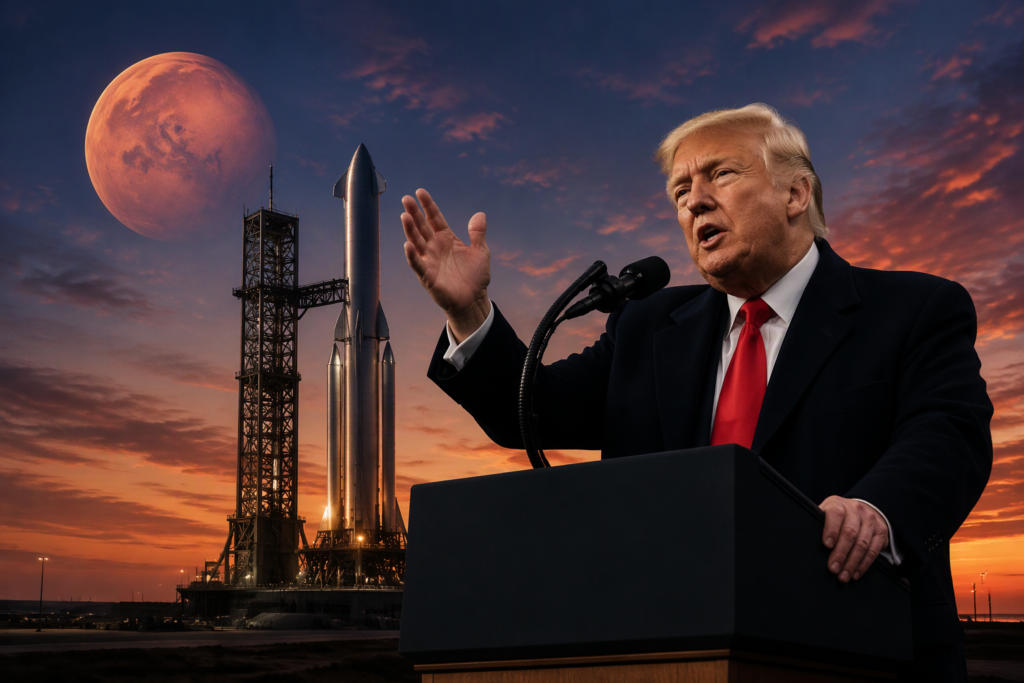

Donald Trump has underscored his vision for deep space exploration, touting a major NASA mission to Mars and reaffirming an ambitious vow to land American astronauts on the Red Planet.
Highlighting the strategic importance of expanding human reach across the solar system, Trump emphasized rapid technological development to support interplanetary travel. The renewed focus signals an aggressive timeline for long-distance space flight and crewed planetary exploration.
Also read: Why Republicans Lost: Key Factors Behind Major Electoral Defeats
Nuclear Propulsion at the Core of Deep Space Goals
Central to the effort is a planned 2028 flight demonstration involving a nuclear-powered spacecraft. Space scientists and aerospace engineers have long recognized nuclear propulsion as a vital leap beyond conventional chemical rocketry.
By generating higher thrust efficiency, nuclear-powered systems can drastically cut transit times between Earth and Mars. Shorter journey durations reduce astronaut exposure to cosmic radiation, microgravity health risks, and system fatigue during deep space transit.
Advancing the Next Major NASA Mission to Mars
The ambitious timeline places the NASA mission to Mars at the center of national space policy. Reaching the Martian surface represents the ultimate frontier in current crewed space exploration, requiring sustained coordination across federal agencies and private commercial partners.
Targeting key flight demonstrations by 2028 will serve as a crucial technical benchmark. Successful testing of in-space propulsion capabilities will determine whether human missions can proceed on schedule in the subsequent decade.
Looking Ahead to Martian Exploration
As development moves forward toward upcoming operational milestones, technical validation and crew safety remain paramount priorities. Trump’s renewed backing injects political momentum into long-term space programs, setting the course for American leadership in the quest to reach Martian soil.
Source: Fox News