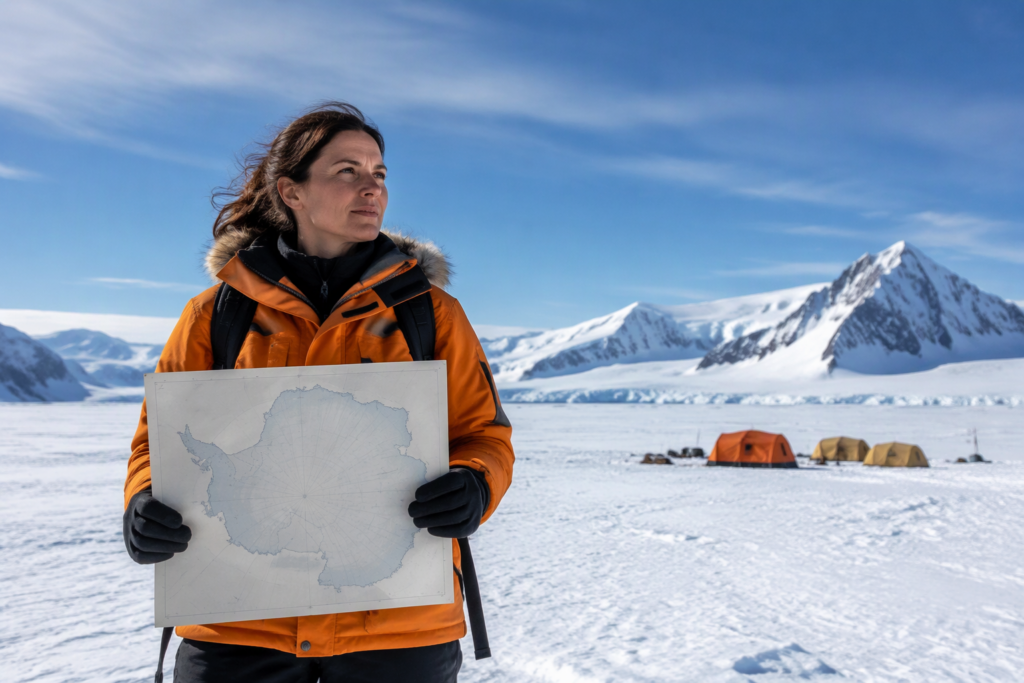

When Canadian ultra-runner Stephanie Case packed her gear for the frozen interior of Antarctica, she carried one guiding thought for her daughter: starting a family does not mean putting your dreams on hold.
The endurance athlete has now made history as the first woman to complete the race, conquering an extreme 160 kilometre race across the coldest continent on Earth. Her milestone at the Antarctic Ice Ultra proved that mothers can take on the most punishing events on the planet and cross the line.
Also read: 49ers Injury Report: Trent Williams Hurting, Mike Evans Out
For runners and parents watching across the world, the achievement shows what determination can produce under extreme pressure. Case set out to change perceptions about female endurance, and her finish offers concrete proof that women can compete and succeed in polar environments.
What drove Stephanie Case into the deep freeze
Before stepping onto the southern ice cap, Case said she wanted to show her young daughter what mothers can achieve even in the toughest places on Earth.
Ultra-distance racing requires grueling training and intense discipline, hurdles that many athletes find hard to balance with early parenthood. Stephanie Case refused to accept that having a child required stepping away from her athletic ambitions.
Instead, she framed the expedition as a lesson for her daughter. She explained that she wanted to prove that “motherhood isn’t the finish line.”
Putting women on the map in Antarctica
Completing the Antarctic ultramarathon placed Case in unchartered territory. No female runner had ever reached the end of the 160-kilometre course before her.
After crossing the line, Case explained that she had put women on the map with her Antarctic record. Her success broke a long-standing barrier in polar endurance sports, giving future female competitors a target to aim for.
Running in Antarctica involves deep isolation, sub-zero cold, and unpredictable winds that test mental stamina as much as physical fitness. Case managed those elements across every kilometre until she reached the finish.
Breaking records in a 160 kilometre race
The course challenged competitors across 160 kilometres of snow and ice, pushing runners through brutal conditions where every step requires intense effort.
As an accomplished Canadian ultra-runner, Case relied on years of trail experience to handle the extreme physical demands of the event. She kept moving through the polar cold until she secured her place in the record books.
Her finish stands out not just for the distance, but for the unforgiving environment in which she achieved it.
Why this finish resonates beyond sports
Case’s record carries a message that reaches far beyond the ultra-running community. By completing the race, she challenged traditional assumptions about what women can pursue once they become mothers.
Her performance demonstrated that having a family can serve as motivation rather than a boundary. Have you ever wondered how many boundaries exist only because no one has challenged them yet?
Attention now turns to the international ultra-running circuit, where race organizers and female athletes will watch whether Case’s milestone inspires more women to register for upcoming polar challenges.
Source: BBC