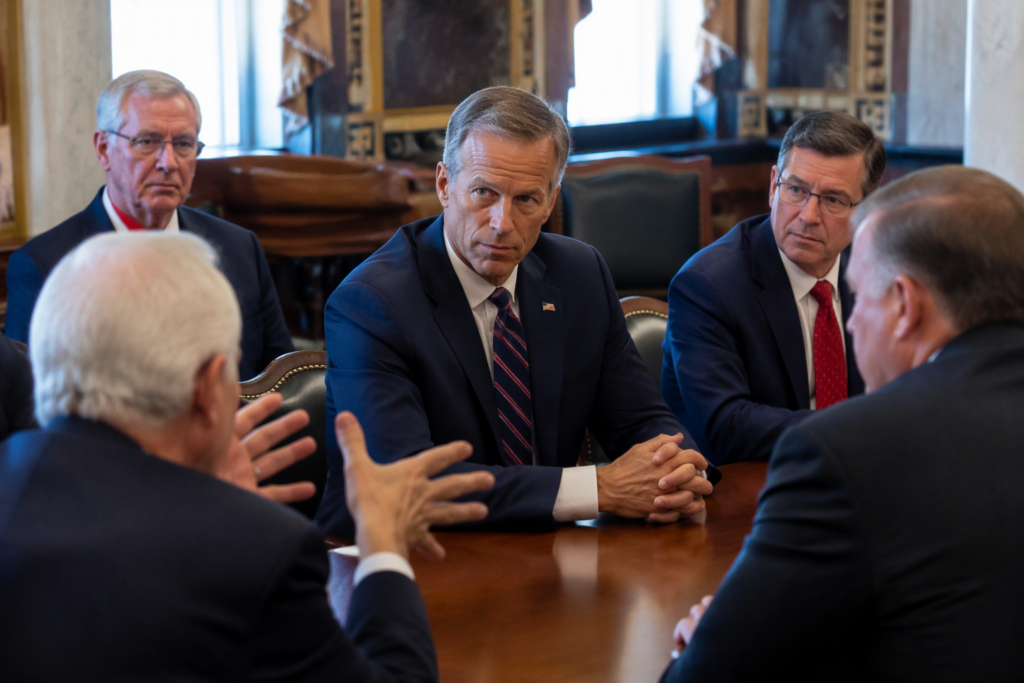
John Thune walked out of the Old Senate Chamber with his gavel still secure, but only after enduring hours of blunt confrontations over who should run the Senate GOP leadership team following bruising election losses.
“I got the job because nobody else wants it,” Thune told reporters after Republicans met behind closed doors to dissect their defeat and debate their next steps.
Also read: Scott Colom Senate Win Flips Mississippi in Historic Upset
The meeting marked the first gathering of Republican senators since Senate Minority Leader Chuck Schumer and Democrats reclaimed the majority. With power slipping from their hands, Senate Republicans had to decide whether to stick with Thune as their top official or delay elections until a rival stepped forward. In the end, no challenger emerged, and lawmakers re-elected Thune and his team by acclamation.
Airing grievances inside the Old Senate Chamber
Multiple lawmakers described the closed-door session as Washington’s political version of Festivus, the fictional holiday defined by an airing of grievances. Rather than quietly accepting the results of Election Night, members spent hours picking through the political wreckage.
Closed-door party meetings over the past two years have occasionally turned into shouting matches, including an earlier dispute between Donald Trump and Louisiana Senator Bill Cassidy over the Iran war. This post-election reckoning took on a different tone, driven by the stark reality of returning to the minority.
North Carolina Senator Thom Tillis acknowledged that the mood was surprisingly controlled given the magnitude of the defeat.
“Now it’s not like you’re looking for the silver lining. It doesn’t exist. It is what it is, and you’ve got to react.”
Tillis noted that while feelings were raw, the lack of denial among members helped keep the discussion grounded. Nobody in the room could dispute that the party faced a serious problem.
The clash between John Thune and Ron Johnson
Despite the eventual consensus, tempers flared during the meeting, particularly between Thune and Wisconsin Senator Ron Johnson. Johnson had been the primary voice demanding a delay in the leadership elections to allow alternative candidates to step forward.
Thune directly challenged his critics, demanding to know what any colleague would have done differently if placed in charge during the campaign.
“I just think that you come through an election like this and everybody’s looking for scapegoats and there’s a lot of blame casting that goes on, and I just wanted to get up and basically defend what we had done and accomplished,” Thune said. He described the back-and-forth as candid and occasionally testy, but insisted lawmakers needed the opportunity to air their views.
Johnson admitted that he repeatedly interrupted Thune during the exchange. He acknowledged being rude in the moment and suspected Thune was unhappy with his behavior, though he insisted there was no lingering personal animus between them.
Johnson explained his push for delay as an effort to ensure real debate, even if intra-party fighting often stirs up grassroots supporters in unhelpful ways. He concluded that the session proved the party was simply fortunate that anyone wanted to take on the burdens of running the minority conference.
Historical precedents for the Senate GOP leadership
Montana Senator Steve Daines defended Thune’s handling of the room, pointing out moments of steady direction during heated exchanges. Daines credited Thune with placing the party’s recent losses into broader historical context.
During the session, Thune reminded senators of past midterm swings that battered incumbent administrations:
- Ronald Reagan lost eight Senate seats in his final midterm in 1986.
- Barack Obama lost nine Senate seats during the 2014 midterms.
- Republicans are on track to lose eight seats this cycle, pending the final outcome in Alaska.
Daines argued that those losses fall squarely within regular historical patterns of power shifting back and forth between the two major parties. He credited Thune with using that history to steer members toward unity instead of prolonged infighting.
What happens next for the Senate GOP leadership
Securing the top spot gives Thune authority over a conference that must navigate the final weeks of the year before shifting into the minority. Republicans settled on an immediate plan for a 54-day legislative push through the remainder of the lame-duck session, though disagreements quickly surfaced over who deserved credit for crafting the strategy.
The test facing the new Senate GOP leadership slate is whether this fragile truce holds once Democrats officially take control of the chamber. With key legislative deadlines looming before the current Congress concludes, Thune must keep a fractured conference united while planning how to win back the Senate majority two years from now.
Source: Fox News