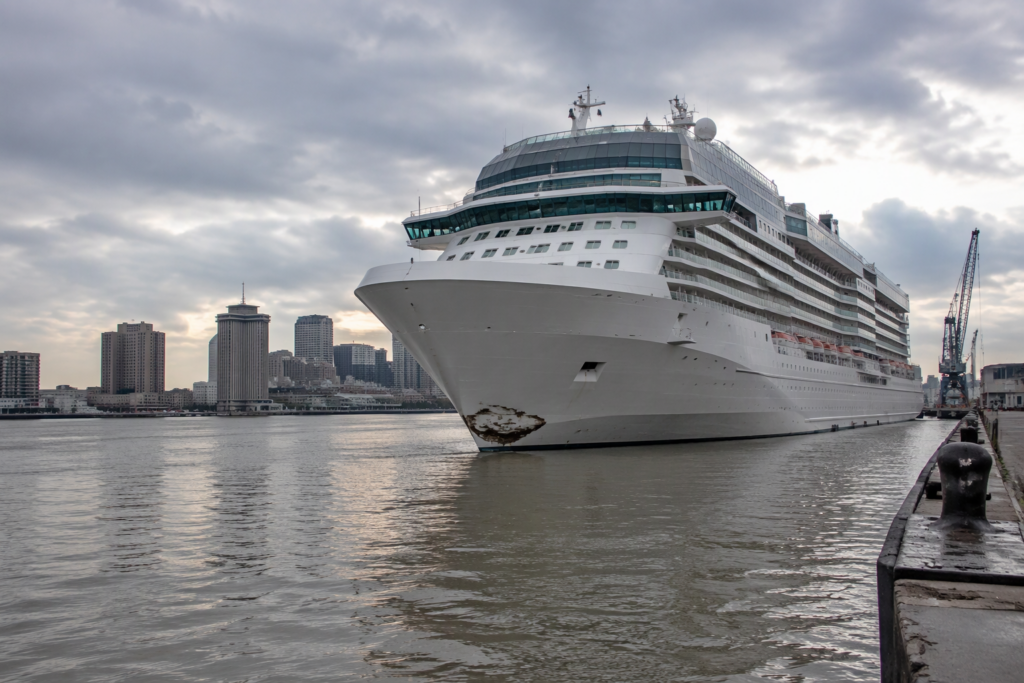
Minutes before an asphalt tanker slammed into a docked riverboat with nearly 130 passengers on board, alarms sounded across the bridge as crew members scrambled to deploy emergency anchors. Those frantic efforts failed to prevent the Friday New Orleans cruise ship collision, which left a paddlewheeler partially capsized and sent 32 people to local hospitals.
The collision brought commercial river traffic to a standstill on one of the busiest waterways in the United States and disrupted the end of an eight-day regional tour. Federal investigators are now focused on why a modern cargo vessel lost control in open water just as it approached a populated city dock.
Also read: Tanker Strikes Cruise Boat on Mississippi River in New Orleans
No deaths or critical injuries were reported among the passengers and crew, and everyone aboard was accounted for following the evacuation. Even so, the crash damaged both vessels, forced port officials to halt ship movements along the riverfront, and left 32 injured passengers recovering from non-critical wounds.
How the American Heritage tipped onto its side
Calls for emergency help flooded New Orleans dispatchers around 1:30 p.m. EST on Friday as the tanker struck the American Heritage. The paddlewheeler, operated by American Cruise Lines, was docked near the riverbank after finishing an eight-day voyage along destinations in Louisiana and Mississippi.
About 129 passengers were aboard alongside the vessel’s crew when the impact occurred. The collision punctured the riverboat, which immediately began taking on water. Port of New Orleans Chief Melanie Montroll stated that bystanders and emergency teams sprang into action as the boat began to list sharply toward the water.
Passengers rushed to evacuate the vessel as it tipped further onto its side against the wharf. Police boats, municipal responders, and nearby tugboat operators converged on the dock to assist people off the listing deck. Marine authorities immediately suspended all vessel movements on the Mississippi River around the port to keep the search and rescue lanes clear.
Audio recordings reveal emergency orders on the tanker
Data pulled from the tanker’s voyage data recorder revealed that the crew on the Atlantic Asphalt realized they were in severe danger several minutes before striking the cruise vessel. The tanker had been travelling upbound along the river when its path suddenly drifted toward the east bank.
The ship’s automated bridge recording captured warning alarms sounding throughout the cabin prior to impact. Bridge officers broadcast emergency ship-handling commands and issued urgent orders to drop the vessel’s anchors to halt its forward momentum. The river’s current and the tanker’s speed carried it directly into the American Heritage before the anchors could catch.
Investigators from the National Transportation Safety Board spent Sunday reviewing the recorded audio and control logs. Those files show the bridge crew tried repeatedly to arrest the vessel’s slide toward the shore before the hull struck the wooden and metal moorings of the passenger dock.
Why the rudder stayed locked to starboard
Federal officials confirmed that a mechanical failure doomed the ship’s steering system just as it needed to adjust course along the bend of the river. The NTSB explained that the tanker experienced a sudden steering casualty that froze the steering gear at the worst possible angle.
“We are aware that there was an issue with the steering on board and causing the rudder to remain at a starboard position, causing the heading of the vessel to veer towards the east bank.”
Bart Barnum, the investigator-in-charge for the NTSB, explained during a media briefing that the starboard lock forced the vessel straight toward the docked riverboat. While the bridge crew tried to correct the angle, the mechanical linkage or hydraulic response failed to bring the rudder back to amidships or port.
Barnum noted that investigators cannot yet point to a single component failure, as the phrase “steering casualty” encompasses several distinct technical breakdowns. The agency is evaluating whether the issue stemmed from hydraulic pressure loss, electrical power interruption, rudder jamming, or bridge control disconnections.
What the NTSB investigation is examining next
The New Orleans cruise ship collision now shifts into an intensive engineering review as safety officials inspect the Atlantic Asphalt in port. Technical specialists are running physical checks on the tanker’s steering gear, hydraulic lines, and backup backup power feeds to pinpoint the exact failure point.
The NTSB team will interview the bridge team, the pilot on duty, and marine engineers over the coming days while reviewing maintenance logs for the tanker’s steering machinery.
Source: BBC