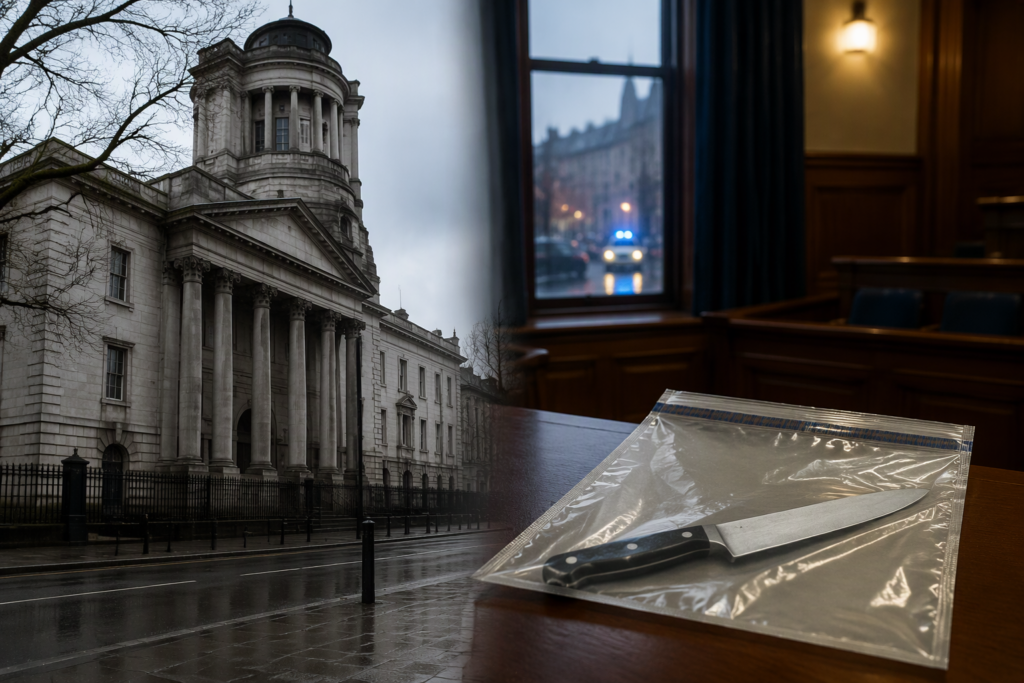
A little girl who was stabbed in the heart outside her school can now communicate only by blinking, fed through a tube in her stomach after forty minutes without oxygen to her brain. On Monday, the man who attacked her and two other schoolchildren learned he will spend the rest of his life in prison.
The Central Criminal Court in Dublin handed down a life sentence to 52-year-old Riad Bouchaker for the attempted murder of three young children and the assault of a childcare worker who put herself in harm’s way to protect them. The November 23, 2023 Dublin knife attack sent shockwaves through Ireland and ignited the most destructive urban unrest the capital had witnessed in decades.
Also read: Estonia Border Closure Planned After Attempted Russian Attack
For the families torn apart that Thursday afternoon, the sentence brings legal finality nearly three years after the violence erupted on Parnell Square East. Bouchaker, an Algerian national and naturalised Irish citizen, was convicted by a jury in July on eight criminal charges stemming from the daylight stabbing.
Devastating injuries outside a Dublin primary school
The violence targeted defenseless children as they stood outside their school. Bouchaker pulled out a kitchen knife and attacked a five-year-old girl, a six-year-old girl, a five-year-old boy, and childcare worker Leanne Flynn, who was in her mid-30s.
The youngest girl suffered catastrophic trauma when Bouchaker drove the blade into her heart. Medical teams managed to keep her alive, but the prolonged loss of oxygen left her with profound, permanent brain damage. Now eight years old, she relies on a wheelchair, cannot speak or swallow safely, and expresses her thoughts solely through blinks.
Flynn suffered serious injuries when she threw herself between the armed attacker and the children under her care. Bystanders on the street rushed in, tackling Bouchaker to the pavement and disarming him before emergency services arrived at the scene.
How bystanders and a caregiver prevented worse tragedy
During the confrontation, members of the public struck Bouchaker to subdue him, inflicting head injuries that later required hospital treatment. Police and prosecutors credited those quick reactions with preventing further loss of life.
Outside the courthouse following sentencing, senior investigating officer Garda Superintendent Colm Murphy paid tribute to everyone who ran toward the danger rather than away from it.
“I just want to take this opportunity to acknowledge the actions of those that immediately reacted to the situation as it unfolded, in particular to Leanne Flynn, who undoubtedly her actions on the day saved lives.”
Murphy emphasised that the courage shown by Flynn and the passersby halted what could have become an even deadlier assault on the school group.
What the jury heard inside the Central Criminal Court
The trial featured testimony from more than 80 witnesses, ranging from shocked eyewitnesses and forensic specialists to first responders and police investigators. Bouchaker entered formal pleas of not guilty to three counts of attempted murder and three counts of assault causing harm.
He also denied one charge of intentionally or recklessly causing serious harm, as well as a count of brandishing a dangerous weapon. Throughout the proceedings, the jury examined both physical evidence and detailed medical evaluations of the defendant.
Judge Tony Hunt told jurors that Bouchaker had undergone surgery for a benign brain tumour two years before carrying out the stabbings. Even so, comprehensive psychiatric and medical examinations confirmed he was fully fit to stand trial.
Judge Hunt instructed the court that there is no suggestion Bouchaker suffered from any mental disorder during the stabbings. That legal finding cleared the path for full criminal culpability and the mandatory life term that followed.
How online falsehoods triggered the Dublin riots
Within hours of the afternoon stabbings, unverified claims and deliberately false details about the suspect’s background exploded across social media channels. Anti-immigration organizers and far-right figures seized on the rumors to mobilize crowds into the city center.
What followed was an unprecedented night of destruction across central Dublin. Angry crowds clashed violently with members of An Garda Siochana, setting police cars, buses, and a tram ablaze while smashing shopfronts and looting retail stores along major thoroughfares.
The unrest forced the Irish government and police leadership to confront deep vulnerabilities in public order management and online regulation:
- Nearly 100 people were arrested in direct connection with the street violence.
- More than 80 individuals faced formal criminal charges for arson, theft, and violent disorder.
- The events triggered intense, protracted political debate over migration policy, policing resources, and viral disinformation.
The trial established that the perpetrator was an Irish citizen who had lived in the country for years, dismantling the false internet narratives that sparked the street fires.
Life behind bars and the road ahead for victims
With his life sentence formally recorded, Bouchaker begins serving his term in the Irish prison system with no immediate prospect of release. Legal authorities have now resolved the criminal case against the man who caused the devastation.
Yet for the young survivor who communicates through blinks, round-the-clock medical care remains a lifelong reality. The ongoing prosecutions of individuals charged in the subsequent street riots continue to move through Dublin’s court system this year.
Source: Al Jazeera


