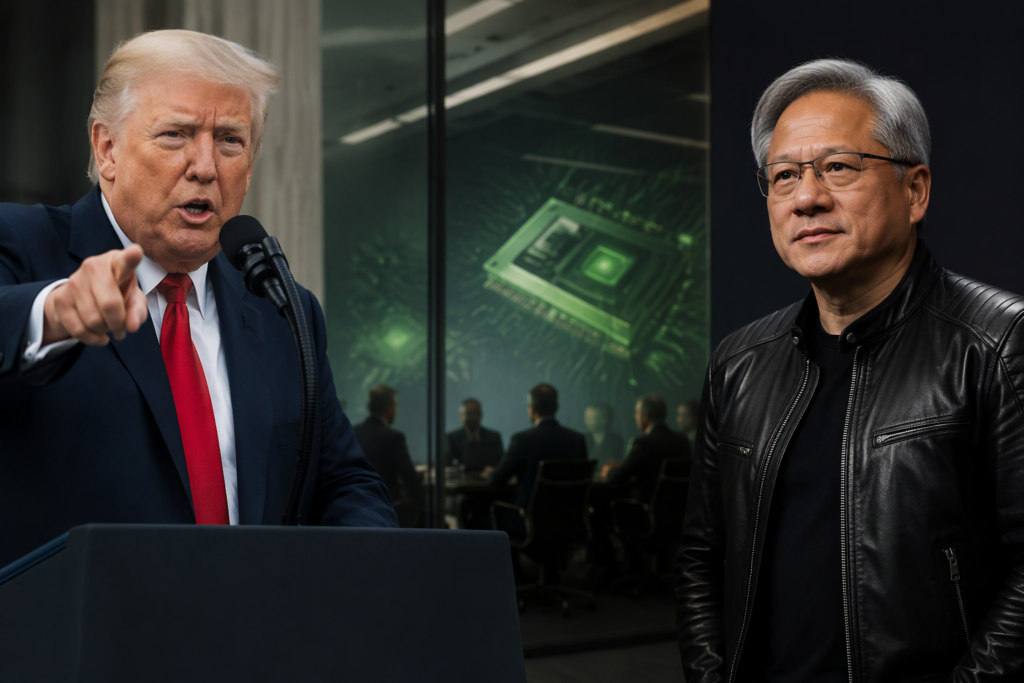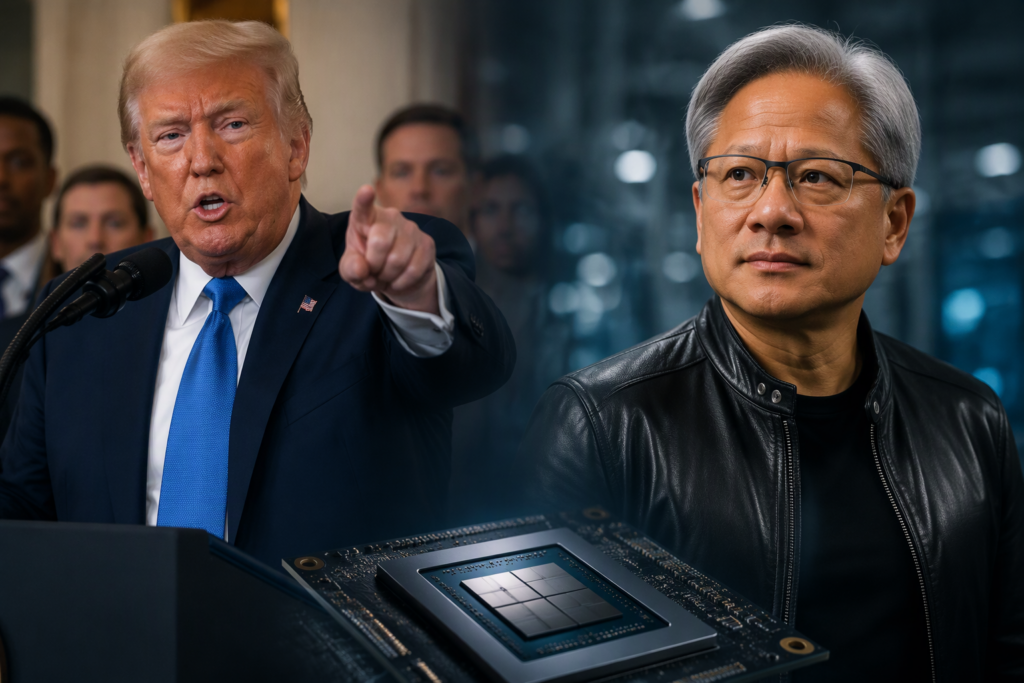
Chinese software engineers looking to train artificial intelligence models will no longer be able to rent computing power across Southeast Asia without direct American approval. The Donald Trump administration issued sweeping new rules on Monday designed to close an offshore loophole, targeting remote cloud access to high-end semiconductors as federal agencies widen their AI chip export controls.
The policy shift addresses a growing practice where Chinese developers bypassed direct trade bans by connecting to overseas servers. Under the updated mandate from the Bureau of Industry and Security, tech suppliers must now secure federal export licences before shipping high-performance semiconductors to five specific nations deemed vulnerable to illicit tech transfers.
Also read: Jensen Huang Resignation Shakes Nvidia After Board Inquiry
For cloud providers, semiconductor vendors, and global investors, the decision immediately reshapes the economics of international data centres. It also signals that Washington intends to police the computational infrastructure supporting artificial intelligence far beyond China’s physical borders.
Why AI chip export controls expanded to five countries
The Bureau of Industry and Security, an agency operating within the US Department of Commerce, singled out Indonesia, Malaysia, Singapore, Thailand and Brazil. Regulators formally classified all five as destinations carrying an unacceptable risk of diversion.
Under the new framework, any company seeking to export advanced semiconductors to facilities in those five countries must first apply for and receive an explicit US government licence. The bureau described the move as a logical extension of existing regulations that already require vendors to obtain special permits before transferring top-tier hardware directly to Chinese companies.
“The United States is the global leader in advanced computing and super intelligence technology and is committed to promoting the global adoption of American technology for legitimate commercial purposes while ensuring that sensitive technologies are not exploited in ways that threaten US national security,”
By placing Southeast Asian hubs and Brazil under strict scrutiny, Washington is targeting third-party server farms that lease out processing time. If an overseas facility hosts American-made hardware, engineers in Beijing or Shanghai will face steep technical barriers when trying to log in from thousands of miles away.
The espionage investigation that forced Jensen Huang out
The regulatory clampdown arrives during unprecedented turmoil at Nvidia, the Silicon Valley titan at the centre of the global artificial intelligence boom. The company’s sales practices and overseas distribution networks have faced intense government review following allegations that former chief executive Jensen Huang had a romantic relationship with a foreign intelligence operative.
According to media reports citing unnamed American officials, China’s Ministry of State Security recruited the woman to gather intelligence. Huang stepped down from his post last week while Nvidia’s board of directors conducts an internal investigation into the matter.
The woman identified as Huang’s former romantic partner is Alice Huang, a former executive at Megaspeed. She has not issued any public statements regarding the allegations.
Officials in Beijing pushed back aggressively against the claims. Chinese government spokespeople denied the espionage reports entirely, dismissing the allegations as groundless and speculative claims created to smear China’s international standing.
Wall Street and Asian exchanges hit by tech selloff
Investors reacted swiftly to the tightening AI chip export controls and the chaos surrounding Nvidia’s executive suite. Technology stocks tumbled on Monday as fund managers calculated the potential financial damage to enterprise hardware sales.
The tech-heavy Nasdaq Composite dropped 2.49 percent, marking its third straight losing session. Nvidia shares slid 4.12 percent on the day, extending a brutal slide that has erased more than 30 percent of its market value over the past month.
Selling spread throughout the broader cohort of mega-cap technology firms known on Wall Street as the Magnificent Seven. Alphabet shares tumbled 4.07 percent, while Amazon fell 3.34 percent by the closing bell.
The downward momentum carried directly into Asian trading floors on Tuesday morning. In Tokyo, Japan’s benchmark Nikkei 225 fell 0.82 percent, while South Korea’s Kospi slipped 1.19 percent by 02:00 GMT, alongside early losses across equities in Hong Kong.
What chipmakers must watch next
Tech vendors now face an immediate compliance hurdle as the licensing mandate takes effect across the designated partner nations. Data centre operators in Singapore and Malaysia must verify whether pending hardware deliveries require immediate federal reviews before shipments leave US ports.
Industry analysts and market participants will be tracking whether the Department of Commerce approves initial licence filings or issues outright rejections for facilities serving foreign clients. Meanwhile, all eyes remain on Nvidia’s board as it prepares findings from its internal probe into the circumstances that prompted Huang’s sudden departure.
Source: Al Jazeera