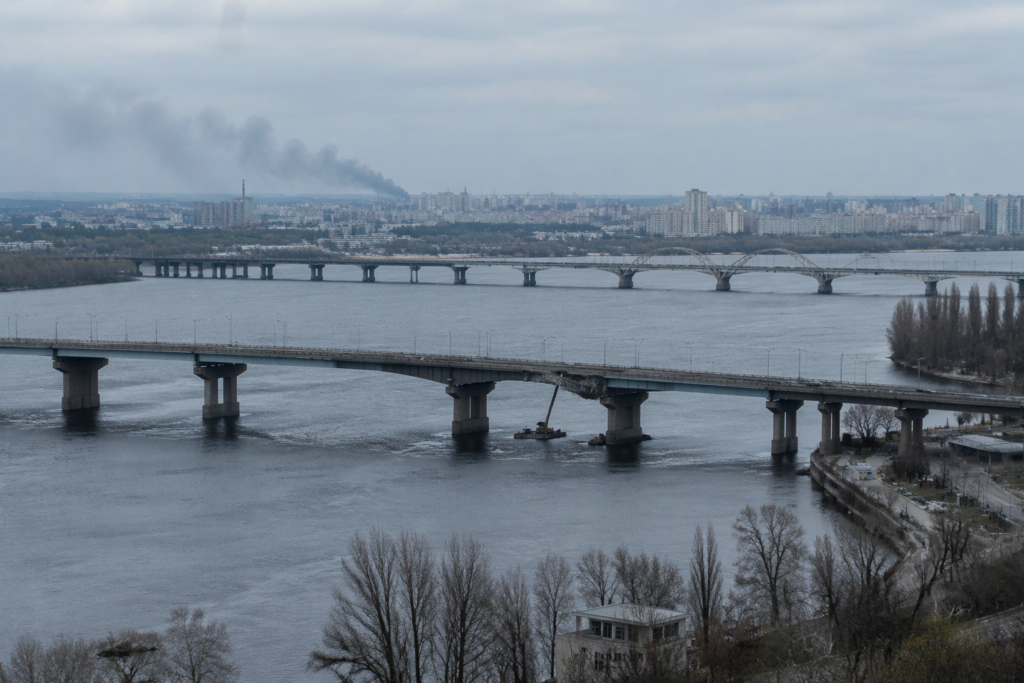
Russian ballistic missiles struck two of the most vital crossings in Ukraine’s capital late Tuesday night, cutting off basic utilities and damaging structures that millions of commuters use every day. Kyiv Mayor Vitali Klitschko confirmed that the Kyiv bridges attack damaged both the Northern and Southern bridges over the Dnipro River, leaving neighborhoods without stable water, electricity, or heating.
The strikes directly threaten the daily movement of roughly three million Kyiv residents who depend on eight main crossings to travel between the eastern and western halves of the city. Klitschko said emergency crews rushed to contain damage to critical infrastructure systems right after loud explosions shook the capital just before midnight.
Also read: Dublin Knife Attack: Riad Bouchaker Jailed for Life
The bombardment landed barely hours after high-level peace talks wrapped up between Ukrainian, American, and European negotiators. President Volodymyr Zelensky had explicitly warned citizens on Monday night that Moscow would retaliate with fresh barrages, pointing to intelligence that Russia is now receiving dozens of ballistic missiles each month from North Korea.
Ballistic missiles target the Dnipro River crossings
The targeted Northern and Southern bridges are vital arteries for the capital’s transport and utility networks. Klitschko said the impacts caused immediate disruptions to municipal services across several districts.
Kyiv relies on its Dnipro River bridges to keep its economy moving and its power grids linked. Russian drone strikes previously targeted several of these same spans in October, but Tuesday’s assault marked an escalation through the direct use of heavy ballistic missiles against city infrastructure.
Engineers began assessing structural damage to the road decks and utility lines as soon as air raid sirens cleared. Municipal teams worked through the night to reroute traffic and restore water pressure to affected homes before morning transit hours.
Fallout from the Kyiv bridges attack across the capital
The timing of the Kyiv bridges attack exposed the vulnerability of urban centers to fast-moving missile barrages. Air defense batteries engaged incoming targets across the Kyiv region, but the sheer speed of ballistic weapons gave residents only minutes to find shelter.
Zelensky addressed the strikes by repeating his urgent call for advanced Western air defense systems capable of intercepting ballistic threats. He noted that Russian forces continue to burn through imported foreign munitions to bypass domestic Ukrainian interception shields.
The destruction in Kyiv also arrived alongside grim news from southern Ukraine. Officials confirmed that the final death toll from a November 2 Russian strike on the village of Kamyshuvakha climbed to 72 people, with four still missing.
Body camera footage recovered from a slain police officer showed civilians running into an underground shelter moments before a secondary blast collapsed the site. Police confirmed the dead in Kamyshuvakha included utility technicians, gymnasium staff, medical workers, and officers responding to the initial blast.
Strikes on the Kerch Bridge and a massive drone barrage
While Kyiv absorbed missile strikes, Ukrainian forces pressed their own long-range campaign deep into Russian-held territory. The Ukrainian military hit the Kerch Bridge for a second straight night, according to Sergei Aksyonov, the Russian-installed governor of occupied Crimea.
Russia built the 12-mile bridge after annexing Crimea in 2014, and Russian President Vladimir Putin personally opened the span in 2018. Ukraine has repeatedly targeted the crossing with marine drones and missiles to choke off military logistics flowing to Russian front lines.
Aksyonov reported the latest Kerch Bridge strike on Telegram, though the extent of the damage remains unclear beneath Russia’s dense maritime and aerial defense network. The assault followed an enormous Ukrainian aerial operation targeting mainland Russia.
The Russian defense ministry claimed its forces intercepted 2,049 drones and four Flamingo long-range missiles across a 24-hour window. Moscow Mayor Sergey Sobyanin reported that around 600 of those unmanned aircraft headed directly toward the Russian capital.
Diplomatic talks face mounting battlefield pressure
The sharp escalation on both sides followed closed-door discussions involving American, European, and Ukrainian officials attempting to arrange direct diplomatic contact between Moscow and European capitals. US envoy Jared Kushner and special envoy Steve Witkoff attended the meetings on behalf of the incoming Trump administration.
Speaking after the session, Kushner said the United States remained committed to securing strong, credible security guarantees for Ukraine alongside a formal path to European Union membership. He also affirmed that Nato must continue as an anchor for continental stability.
Zelensky described the diplomatic session as difficult. Yet he praised the attendance of a unified European delegation, which included representatives from Britain, France, Germany, Italy, Poland, the EU, and Nato.
Kyiv insists that European allies must sit at any negotiating table because Ukraine’s long-term future ties directly to EU accession. For now, Ukrainian leaders refuse Russian demands to surrender sovereign territory in the Donbas, where Russian troops occupy about one-fifth of the nation.
Diplomats are now scheduling a wider multilateral summit for the coming weeks, while repair crews in Kyiv work against the clock to reopen the Dnipro crossings.
Source: BBC


