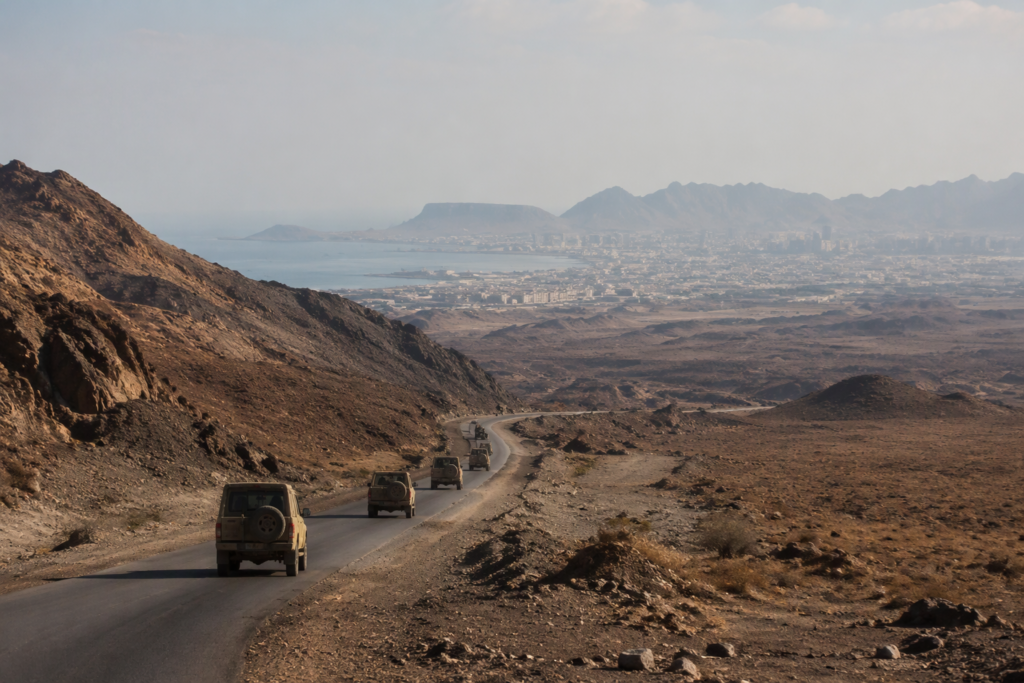
Yemeni government forces unleashed 661 strikes against Houthi targets across multiple battlefronts on Monday, trying to halt a dangerous rebel march that threatens the country’s southern port city of Aden. The intense bombardment killed or wounded 173 fighters as the Yemen army attacks Houthis to stem sweeping rebel advances in the southwest.
This surge in violence matters because Aden serves as the temporary capital of Yemen’s internationally recognised government. If rebel fighters breach the city’s perimeter, the state loses its primary base on the southern coast, altering the balance of power across the Arabian Peninsula.
Also read: Retreat in Yemen Hands Houthis Control of Vital Red Sea Strait
The clashes also risk wider disruption around the Bab al-Mandeb Strait, the narrow passage connecting the Red Sea to the Gulf of Aden where global cargo and oil tankers pass daily.
How the Yemen army attacks Houthis across active fronts
Military spokesperson Colonel Majed al-Nuzaili announced the barrage in a statement on X, outlining the full scope of the government’s response. The push forms the latest phase of the Dawn of Yemen offensive, an operation launched on October 5 to reclaim territory lost to the rebels, including the capital city of Sanaa.
The numbers released by the military show how heavily the ground forces relied on heavy firepower over recent hours:
- 526 artillery strikes pounding rebel positions
- 67 rocket attacks targeting supply lines
- 53 drone strikes against forward units
- 15 coordinated air strikes on fortified outposts
Al-Nuzaili stated that the strikes wrecked or damaged 71 military vehicles and pieces of heavy equipment. The bombardments also struck observation posts, command-and-control centres and fortified bunkers.
State troops fight alongside local fighters from the Popular Resistance to hold positions across Taiz, Marib and al-Jawf provinces. Even so, the sheer volume of artillery fire shows how hard the government is working to slow rebel movement on the southern approaches.
Rebel push cuts Red Sea routes and threatens Aden
Despite the barrage, government troops have suffered serious setbacks on the ground. Houthi units cut off a primary government supply route running along the Red Sea coast, forcing state-aligned units to abandon several forward positions.
Those retreats forced loyalist soldiers away from strategic ground near the Bab al-Mandeb Strait. Frontline commanders pulled their fighters back toward the east, setting up defensive perimeters directly shielding Aden.
Al-Nuzaili stressed that military units will sustain the operation until they secure their designated goals. The military also stated that its units take precautions during artillery and air operations to protect nearby civilians and local infrastructure.
Yet the rebel push into the southwest puts government forces under immediate pressure. Losing access to coastal roads restricts troop rotations and cuts logistics between coastal posts and inland garrisons.
Parliament votes to outlaw the Houthis as terrorists
While artillery duels raged along the southern fronts, political leaders in Aden took direct legislative action against the insurgent group. Yemen’s parliament passed a bill unanimously designating the Houthis as a terrorist organisation.
The state-run Saba news agency reported that the measure outlaws all rebel activities, financial networks and weapons supply chains. The statute establishes legal mechanisms to seize assets, freeze financial holdings and put accused violators on trial.
Lawmakers drafted the measure to impose harsher penalties for war crimes, focusing on landmine placement, assaults on civilian neighbourhoods and missile strikes against commercial vessels in maritime lanes. Government officials want to cut off local funding channels that keep rebel forces supplied on the battlefield.
What happens next for the Presidential Leadership Council
The legislative measure now heads to Rashad al-Alimi, chairman of the Presidential Leadership Council, who must sign the decree into law to enact the penalties. Once enacted, state prosecutors will receive legal authority to freeze commercial assets connected to rebel procurement networks.
For frontline commanders, the immediate test rests on whether the Dawn of Yemen offensive can hold the highway approaches leading toward Aden before rebel fighters dig into their newly captured coastal positions.
Source: Al Jazeera


