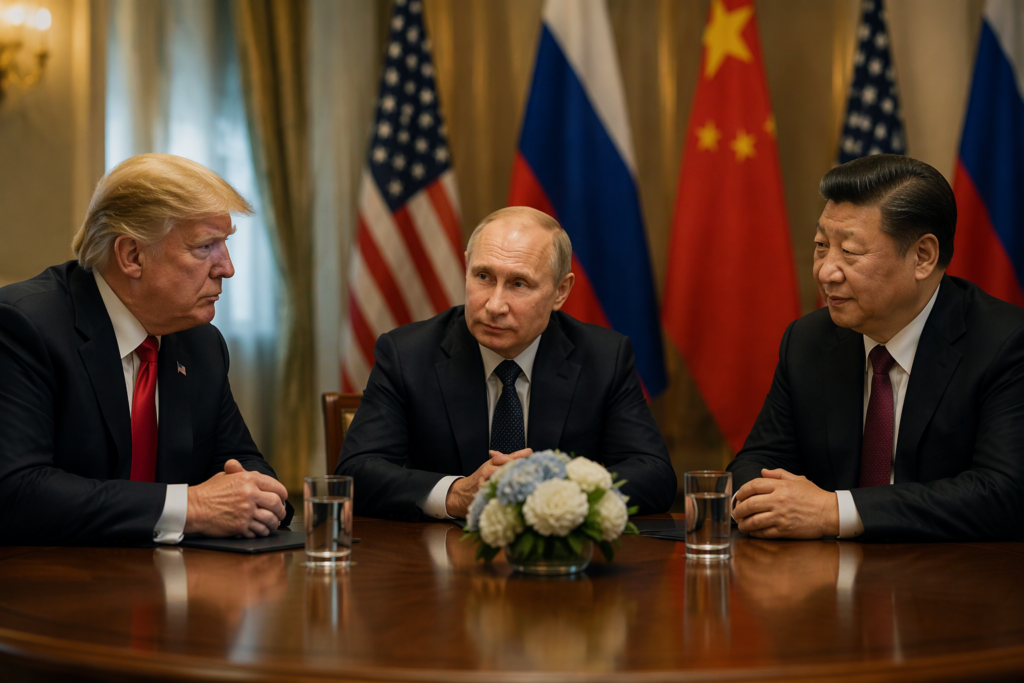
For the first time in history, the heads of the world’s three greatest nuclear powers are sitting in the same room on Chinese soil. The upcoming Trump Putin Xi summit in Shenzhen brings together US President Donald Trump, Russian President Vladimir Putin and Chinese President Xi Jinping for unprecedented trilateral negotiations.
The stakes extend far beyond photo opportunities in China’s tech hub. With major military conflicts raging simultaneously in Eastern Europe and the Middle East, decisions made by these three men could redraw spheres of influence across the globe.
Also read: Inside the Shenzhen AI Hub: What World Leaders Won’t See
For everyday observers and world leaders alike, the summit carries direct consequences for energy markets, international security, and the future balance of trade and technology.
What sits on the table in Shenzhen
President Trump confirmed that the agenda focuses on three explosive crises: global denuclearisation, the war with Iran, and the war in Ukraine. Gathering all three leaders in one room offers a rare channel to address conflicts where their interests collide directly.
Beijing occupies an unusual position between Washington and Moscow. Observers hold out hope that China might use its diplomatic sway to exert pressure on Tehran to cool hostilities in the Middle East. At the same time, Beijing could attempt to position itself as a formal mediator between Russia and Ukraine.
Yet finding common ground will not be simple. Trump wants swift resolutions to foreign wars, while Putin seeks validation for Moscow’s battlefield positions, and Xi aims to cement China’s standing as a dominant global broker.
Zelensky warns of a backroom carve-up
The prospect of three superpowers negotiating behind closed doors has triggered alarm among nations left on the outside. Ukrainian President Volodymyr Zelensky voiced sharp concern about the meeting, warning that the three leaders might attempt to reshape the international order to suit themselves without consulting smaller countries caught in the crossfire.
Zelensky’s objection strikes at the heart of smaller sovereign states’ fears: that great-power diplomacy will bypass the nations actually fighting the wars. If Washington, Moscow and Beijing cut deals over territory, ceasefires, or regional security pacts without Kyiv’s consent, the existing framework of international law faces total collapse.
Whether Trump and Putin would agree to terms that protect Ukraine’s independence remains one of the sharpest questions hanging over the talks.
Tech fallout and the shadow over AI talks
Geopolitics is only half the equation. Trump, Putin and Xi are also set to confront the global economy and artificial intelligence, an area suddenly thrown into turmoil by a corporate espionage scandal in Silicon Valley.
The summit follows the dramatic ouster of Nvidia chief executive Jensen Huang. Huang was forced out of the chipmaker after allegations surfaced regarding an affair with a suspected Chinese spy. That scandal has thrown commercial ties and tech competition into sharp focus right as AI hardware becomes central to national security.
The three powers are competing fiercely for dominance in high-end semiconductor manufacturing, computing infrastructure, and AI military applications. Shenzhen, long regarded as China’s silicon capital, provides an unmistakable backdrop for discussions on technology dominance.
Real diplomacy or domestic distraction?
Despite the high-stakes agenda, skepticism surrounds what the Trump Putin Xi summit will actually produce. Major summits can easily collapse into grand stagecraft designed to project power rather than deliver binding treaties.
Each leader faces intense domestic pressures back home. Standing side by side on a world stage offers all three a chance to show domestic audiences that they dictate terms to their fiercest rivals, regardless of political headwinds at home.
The concrete signal to watch will be whether the three leaders issue a joint statement on Iranian de-escalation and Ukrainian ceasefires when talks conclude in Shenzhen this week.
Source: BBC


