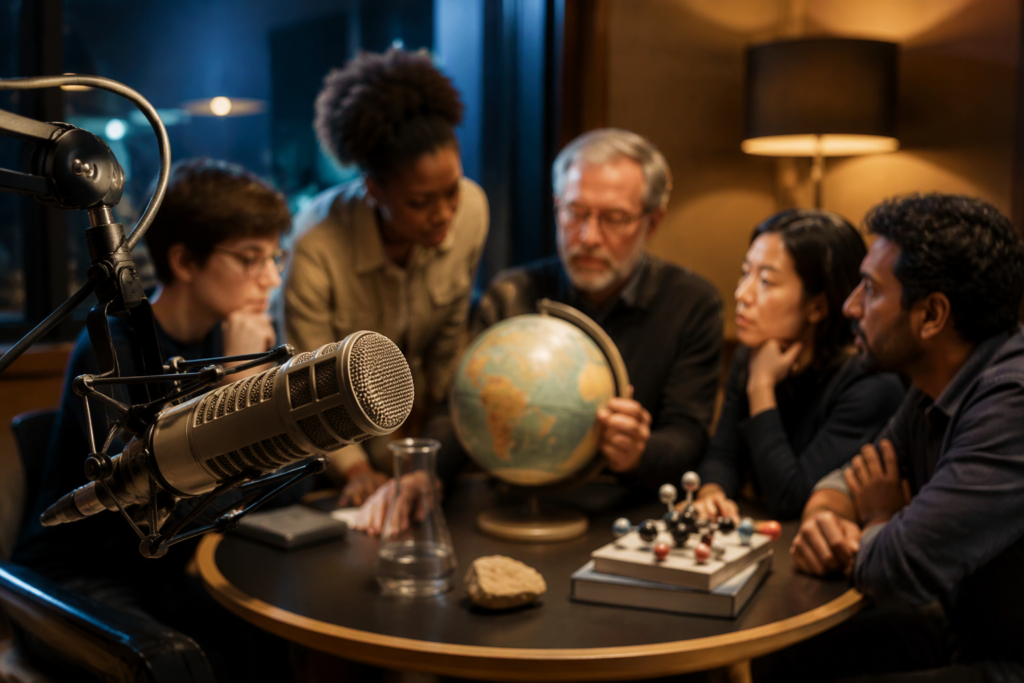
When the BBC World Service launched a radio programme to answer everyday science questions from ordinary listeners in November 2016, nobody knew how long the public’s curiosity would last. A decade later, BBC CrowdScience has crossed the ten-year milestone after answering more than 500 questions sent in from around the globe.
The programme’s premise remains simple: listeners pitch their queries, and a team of curious reporters heads out into the field to track down researchers who can answer them. That process has meant interviewing thousands of researchers across every continent. The questions range from odd household puzzles to deep planetary mysteries, proving that an audience will follow complex science if the question started in their own heads.
Also read: Jesse Watters Questions Slew of Technology Outages
What BBC CrowdScience tackled across 500 episodes
Over the past ten years, the show has covered queries that sound trivial on paper but reveal fundamental physics and biology. Listeners have asked why headphone cables get tangled in pockets, how scientists could calculate the physical weight of the internet, and how fragile butterflies manage to migrate thousands of kilometres across continents.
The production team did not rely on studio discussions to solve these problems. Instead, the programme regularly sent presenters straight into extreme environments where the science happens.
To volcano rims and ocean floors
Answering listener queries forced the show’s hosts out of the recording booth and into difficult terrain. Over the course of a decade, reporters travelled to the edge of an active hurricane, descended toward the bottom of the ocean, and climbed to the top of volcanoes to record audio on site.
These field trips turned abstract concepts into immersive soundscapes. For listeners tuning in across different time zones, the broadcasts brought remote scientific field stations straight into their living rooms and headphones.
How listeners built the tenth anniversary special
For the tenth anniversary broadcast, presenter Anand Jagatia and the production team invited the audience to submit their personal stories and select the best broadcasts from the past decade. The programme examines how specific episodes helped listeners understand the world around them or sparked a fresh interest in research.
The special episode also brings Anand Jagatia together with fellow presenters to discuss their most memorable assignments and the challenges of chasing down answers. Produced by Christine Bennett and edited by Ben Motley, the milestone edition revisits the experiments and conversations that defined the broadcast’s first decade.
What Anand Jagatia and the team plan next
The broadcast team confirmed that listener submissions show no sign of drying up. With an ongoing stream of incoming queries, BBC CrowdScience is already gathering questions for upcoming seasons, with the team preparing to explore the next round of listener questions in regular weekly broadcasts.
Source: BBC