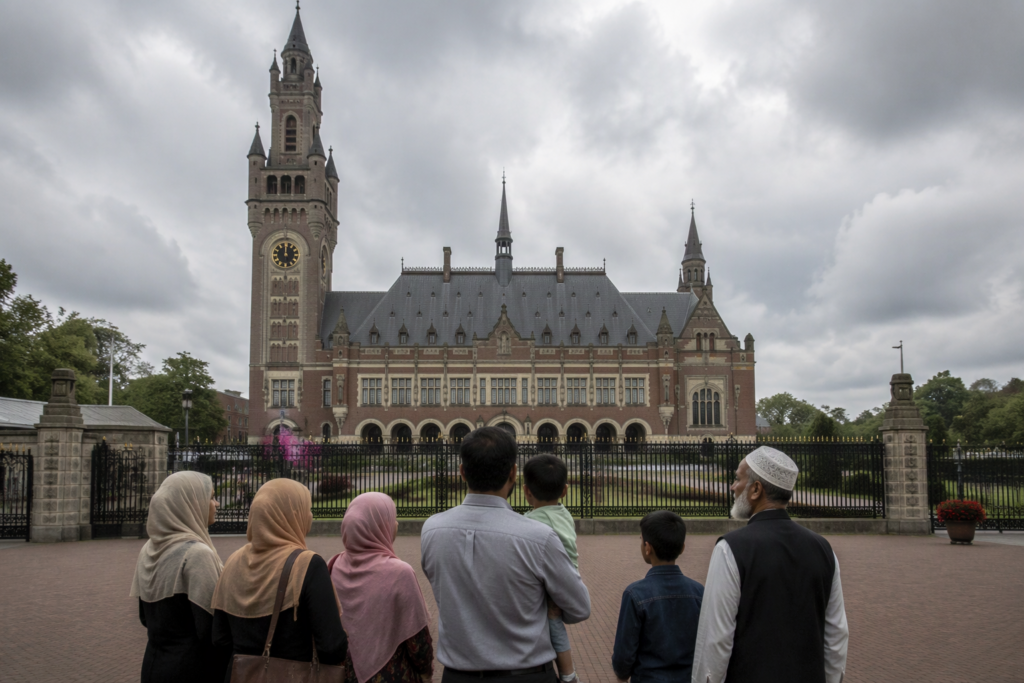
For the first time in history, an international court has convicted an entire state of genocide. The International Court of Justice found Myanmar legally responsible for genocidal acts against its Rohingya minority, establishing unprecedented legal accountability at the highest level of world justice. The landmark Myanmar genocide ruling closes years of hearings over the military’s brutal operations that forced hundreds of thousands of people from their homes.
By determining that the state itself committed genocide, the ICJ verdict alters the legal reality for both civilian and military leaders who governed the country during the atrocities. It formally attaches the gravest crime known to international law directly to Myanmar’s institutions. For Rohingya survivors seeking accountability, the decision provides an official judicial confirmation that their community faced systematic destruction.
Also read: Hussam Abu Safia Detention Extended Six Months by Israeli Court
The first state conviction in international legal history
Never before had the UN’s top court found a sovereign state guilty of committing genocide. Previous genocide trials at international tribunals, such as those addressing atrocities in Rwanda or the former Yugoslavia, prosecuted specific military commanders and political officials. In this ruling, the court addressed the legal responsibility of Myanmar as a nation state under the Genocide Convention.
The Hague genocide case centered on the military campaign launched against the Rohingya minority in 2017. Soldiers torched villages, killed civilians, and forced more than 700,000 Rohingya to flee across the border into Bangladesh. By ruling that these actions were genocidal, the judges established that Myanmar violated its binding international treaties.
Why the verdict shatters Aung San Suu Kyi’s legacy
The ICJ verdict carries severe historical consequences for Aung San Suu Kyi, who served as Myanmar’s civilian head of state when troops carried out the 2017 operations. While she exercised minimal control over the armed forces on the ground, she chose to travel to The Hague in 2019 to lead the country’s initial legal defence. During that appearance, she defended the military’s actions and dismissed independent reporting on the violence, calling media accounts an “iceberg of disinformation.”
Her stance reflected an attempt to preserve a fragile working relationship with the military leadership. That political calculation failed when army commander Min Aung Hlaing launched a coup in 2021, overthrowing her elected government and placing her in prison. Yet her refusal to condemn the atrocities at the time bonded her global reputation permanently to the military’s crimes.
Min Aung Hlaing’s direct responsibility for the 2017 attacks
The commander who directly ordered the 2017 assaults on Rohingya villages was Senior General Min Aung Hlaing. As Myanmar’s current, contested head of state, he remains the figure most culpable for the violence now judged as genocidal. The ruling strikes at a moment when the junta chief has attempted to repair his damaged standing abroad following the devastating 2021 military takeover.
Judges evaluated public statements Min Aung Hlaing made during the peak of the operations in early September 2017. While the court concluded those remarks did not technically constitute genocidal hate speech, the broader military operations he commanded were officially judged as genocide. His forces executed the campaign that breached the Genocide Convention, cementing his personal responsibility in the historical record.
What the Myanmar genocide ruling means across Asia
The Myanmar genocide ruling deepens the junta’s isolation across the West, but its immediate practical fallout remains uncertain. Min Aung Hlaing’s standing among Western governments was already shattered by the coup and the bloodshed that followed. Additional legal condemnation from Europe cannot degrade his standing in Washington or London much further than it already was.
Across Asia, several regional governments continue to pursue normalised diplomatic and commercial ties with the Myanmar military authorities. For these regional partners, a ruling issued thousands of miles away in Europe may not alter economic or geopolitical calculations. The legal finding will nonetheless restrict Myanmar’s delegates at upcoming international forums, forcing diplomats to reckon with the historic verdict at the next UN General Assembly sessions.
Source: BBC


