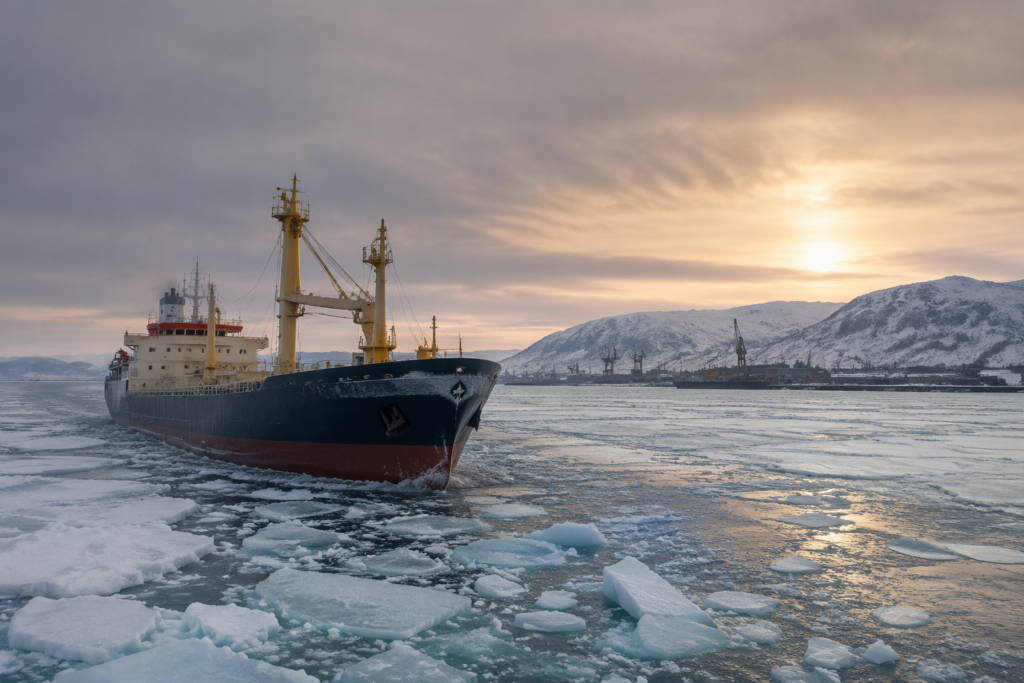
Russian President Vladimir Putin pitched his country’s frozen northern waters to Asian investors this week, offering deep tax cuts to turn the treacherous Northern Sea Route into a viable year-round corridor for global commerce.
Speaking at the Asia-Pacific Economic Cooperation summit in Shenzhen, China, Putin urged regional businesses to back the multi-billion-dollar effort. His appeal comes as Moscow scrambles to route crude and natural gas to Asia following Western energy sanctions and ongoing conflicts in the Black Sea.
Also read: Trump Putin Xi Meeting in China Sets Up High-Stakes Talks
For international cargo carriers dodging attacks in the Red Sea and bottlenecks in the Suez Canal, a shortcut across the top of the world sounds tempting. Yet maritime researchers, economists and environmentalists warn that shifting global supply chains to Russia’s frozen coastline is far more complex than Moscow suggests.
Putin’s tax breaks and the Northern Sea Route push
The shipping lane stretches roughly 5,600 kilometers along Russia’s northern shoreline, extending from the Novaya Zemlya archipelago eastward to the Bering Strait. Historically, commercial traffic could only cross during a brief window of late-summer thaw.
To change that, the Kremlin wants Asian capital to finance ice-class cargo hulls, deepwater ports and rescue facilities. Putin laid out an aggressive incentive package in Shenzhen designed to draw foreign firms into remote Russian projects.
The plan includes exemptions and reductions on corporate profits, property and land taxes, alongside lower payroll levies and subsidised land leases. It follows identical pledges Putin made at the Eastern Economic Forum in Vladivostok two months earlier, where he vowed to create permanent, four-season passage along the northern sea route.
Russian state planners see the corridor as an escape hatch from Western economic restrictions. Because traditional maritime links through Europe are largely shut to Russian fossil fuels, Moscow needs a dependable eastward track to deliver Arctic oil and gas directly to Chinese and Indian buyers.
Can melting ice overcome brutal Arctic realities?
Shrinking polar ice caps have revived commercial curiosity in the passage. NASA satellite tracking confirmed that the layer of frozen seawater over the Arctic Ocean fell to record lows this year, extending the navigable season by weeks.
Beijing rolled out its own complementary “Ice Silk Road” framework in August, linking Chinese ports into the Russian passage. Still, polar shipping specialists dispute whether nature will cooperate with Putin’s industrial timeline.
Andrey Todorov, a maritime researcher at the Netherlands Institute for the Law of the Sea, noted that thinner ice does not eliminate unpredictable drift, poor visibility and extreme cold.
“Harsh climate, low visibility, short windows of navigation opportunities, drifting ice will remain serious obstacles for a large-scale commercial traffic.”
Todorov explained that running vessels along the northern sea route requires specialised ice-strengthened hulls that burn excess fuel and prove commercially inefficient once they hit warmer waters. Highly trained polar crews and ice captains are also in critically short supply worldwide.
Because of those operational limits, Todorov expects the channel to handle mineral shipments out of Siberian mines rather than high-volume consumer container freight. At best, he argues, transit traffic will remain a tiny fraction of the volume moving through traditional southern corridors like the Malacca Strait.
Capital shortages, control worries and political heat
Finances pose an even bigger barrier for Moscow than pack ice. Mounting wartime spending has left the Russian treasury short of the capital required to build modern polar infrastructure from scratch.
Ksenia Vakhrusheva, an adviser at the Bellona Environmental Transparency Center in Vilnius, pointed out that Putin’s outreach reflects acute fiscal isolation. Moscow desperately needs Chinese state cash to dredge shallow waters, install navigational beacons and operate costly nuclear icebreaker fleets.
Yet foreign governments remain hesitant to hand Russian authorities complete leverage over their trade lifelines. The entire passage runs inside Russia’s exclusive economic zone, giving Moscow legal control over passage permits, escort fees and vessel inspections.
Vakhrusheva argues that major Asian economies will avoid placing critical commercial flows under the unilateral control of a single foreign power, no matter how attractive the transit savings appear on paper.
Other regional specialists take a different view. Pavel Devyatkin, a leadership group member at The Arctic Institute, expects China, Japan and South Korea to explore expanded commercial ties along the route, even while weighing the operational dangers.
Those hazards extend well beyond financial balance sheets. Maritime traffic risks in remote waters are compounded by virtually nonexistent emergency response facilities along thousands of miles of Siberian coastline, where a single tanker hull breach could devastate Arctic marine ecology.
Environmental fallout and Greenland friction
Environmental groups point out that heavy marine traffic could accelerate polar melting. A 2024 study published in the journal Ocean and Coastal Management found that increased commercial transport through polar lanes deposits heavy loads of black carbon onto snow and ice fields, accelerating melt rates while disrupting marine mammal migrations.
The commercial race is also inflaming territorial competition across the Arctic basin. While Russia and China align their trade blueprints, the United States has moved aggressively to counter their northern footprint.
United States President Donald Trump renewed demands for Washington to secure Greenland to block Russian and Chinese dominance across the polar rim. In September, American, Danish and Greenlandic officials signed an agreement at the United Nations General Assembly in New York to expand the US military footprint across the strategic island.
The agreement settled immediate diplomatic friction among Western partners, but it solidified the Arctic as an active zone of major-power rivalry.
International shippers will test Russian icebreaker escorts through the early winter freeze to see whether Moscow can maintain traffic past the traditional November cutoff.
Source: Al Jazeera


