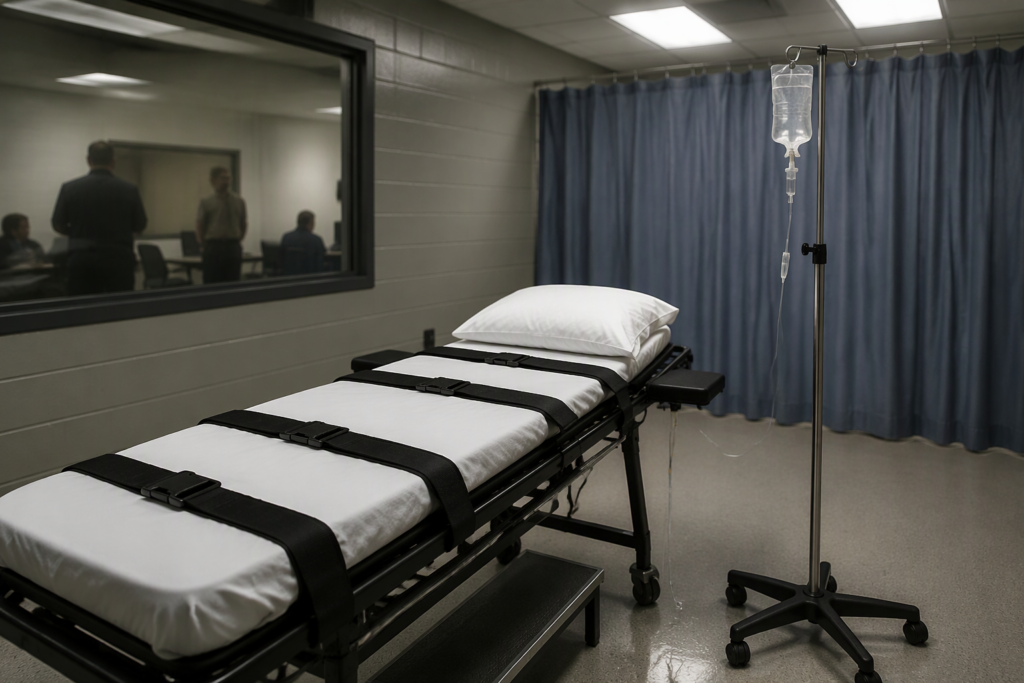
Strapped to a gurney inside the Huntsville death chamber, Reinaldo Dennes pleaded for relief as prison medical staff spent nearly an hour hunting for workable veins. The Reinaldo Dennes execution stretched on for 63 minutes on Thursday evening, marked by repeated cries of agony from the condemned inmate before he was pronounced dead.
Dennes was sentenced to death for the 1996 murder of Houston diamond dealer Janos Szucs. Decades later, his final hour at the Texas state penitentiary laid bare the practical difficulties execution teams face when administering lethal doses of pentobarbital. Staff repeatedly missed veins in his arms, ultimately driving needles into his left foot and the left side of his neck to deliver the chemical.
Also read: Fiona the Hippo Autopsy Findings Reveal Fatal Hat Blockage
The prolonged procedure adds fresh urgency to national questions surrounding lethal injection protocols. When states fail to secure clean vein access quickly, the execution chamber turns into a scene of distress that challenges state claims of humane administration.
The 63-minute timeline in Huntsville
Prison staff strapped Dennes to the gurney shortly after 6:00 p.m. Trouble started almost immediately as technicians searched for suitable veins. Multiple needle sticks failed to establish a line, dragging out the preparation phase for over three-quarters of an hour.
Technicians finally placed an intravenous line into Dennes’ left foot. They inserted a second line into the left side of his neck. Only after securing those alternative access points did prison staff initiate the chemical flow at 6:52 p.m.
The lethal pentobarbital took 16 minutes to stop his heart. Officials pronounced Dennes dead at 7:08 p.m., just one minute after the drug delivery ended. That brought the total duration on the gurney to 63 minutes.
Cries from the gurney: ‘Don’t let me suffer like this’
Witnesses inside the chamber watched Dennes struggle and call out repeatedly during the procedure. He groaned, twisted, and directed his voice toward the ceiling, asking God to intervene.
“The pain! Go! Go!” Dennes shouted from the gurney. He complained that his lower body was throbbing, yelling moments later: “My right leg is killing me!”
He likened the sensation to a severe cramp before questioning what staff were doing to him. He begged for the ordeal to finish quickly.
“I don’t think this is normal. Take me, father. Don’t let me suffer like this. C’mon,” he added.
The outbursts continued until the pentobarbital sedated him. Witnesses noted that the distress began well before the lethal dose was introduced into his bloodstream.
State officials defend the Reinaldo Dennes execution
The Texas Department of Criminal Justice rejected characterizations that the event had gone wrong. Agency spokesperson Amanda Hernandez insisted the staff adhered strictly to execution regulations, despite the hour-long delay in establishing IV lines.
Hernandez acknowledged that staff made multiple failed attempts on standard injection sites before resorting to the foot and neck. But she declined to confirm the exact number of needle sticks Dennes endured. She argued that the 16 minutes elapsed while the drugs were flowing fit within the typical window for Texas executions.
Hernandez also pushed back against the inmate’s claims of physical agony. She suggested Dennes exaggerated his pain, pointing out that he shouted about his right leg even though lines had been placed in his left foot and neck, and complained before the drugs started flowing.
“This isn’t the first time we had to insert IVs into other locations,” Hernandez said. “It’s also not the first time we’ve had an inmate make allegations of pain immediately.”
When asked directly whether she believed Dennes was faking his distress, Hernandez replied: “I think, yeah, there were allegations … There was nothing abnormal on our part.”
Scrutiny mounts over lethal injection procedures
The difficulties during the Reinaldo Dennes execution follow another high-profile breakdown in capital punishment administration. In September, Tennessee officials halted an attempt to execute death row inmate Christa Pike.
Pike survived two doses of pentobarbital after technicians misplaced the intravenous needles. Her legal team stated the drugs leaked directly into her arm tissue rather than entering her veins, inflicting severe internal trauma and leaving her in critical condition. That incident sparked intense pushback against how correctional departments train and supervise execution teams.
Thursday was an unusually active day for American executioners. Hours before Dennes died in Huntsville, Florida prison officials executed 71-year-old Thomas Mitchell Overton for the murder of a pregnant woman and her husband. Overton’s death marked Florida’s 20th execution of the year, a modern record for that state.
Texas officials face continued inquiries into the vein placement choices made on Thursday as defense attorneys evaluate future execution dates on the state docket.
Source: Fox News