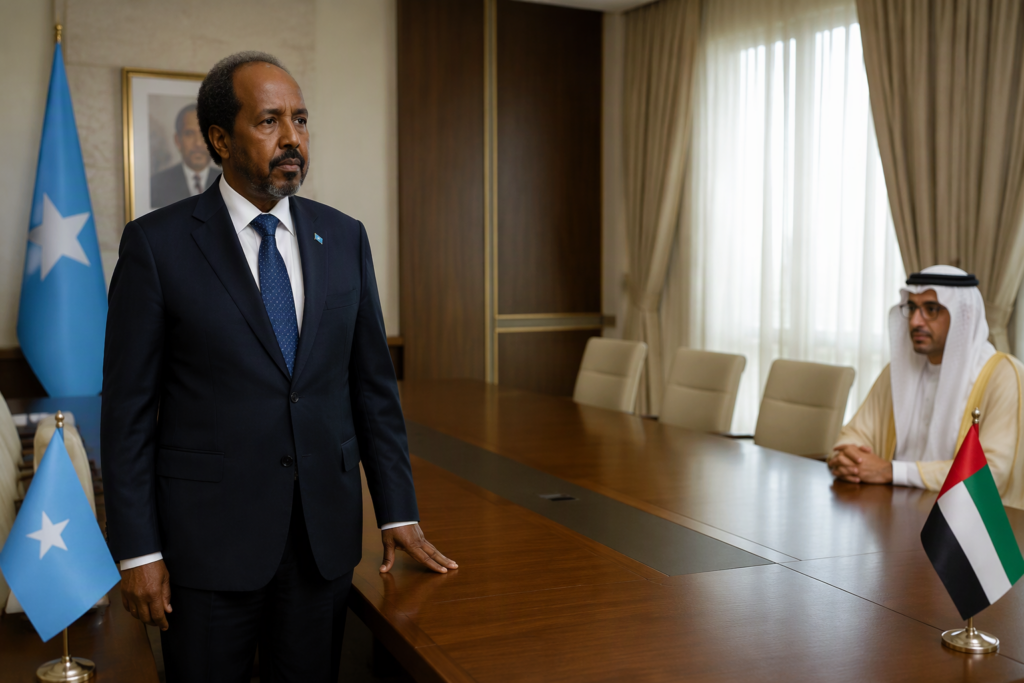
Somali President Hassan Sheikh Mohamud once stood before a Mogadishu town hall and called the United Arab Emirates a pillar of his nation’s fight against al-Shabab. On November 19, his government ordered the Emirati ambassador out of the country and recalled its own diplomat from Abu Dhabi. That abrupt expulsion shattered years of close security work, bringing ties between Somalia and the UAE to an open, bitter crisis.
The falling-out changes the balance of power across the Horn of Africa. For years, Abu Dhabi poured money into regional ports and private security units while Mogadishu struggled to run its own territory. Now, Somalia’s central government treats those Gulf investments not as foreign aid, but as direct threats to national unity.
Also read: El Chapo Isidro Captured in Violent Sinaloa Raid
Mohamud made his anger personal just two days before issuing the expulsion notice. He accused the Gulf state of funding rival administrations and armed factions that ignore central orders.
“A brother does not burn your house. A brother does not buy your property without your knowledge. A brother does not divide your family.”
The port deals that bypassed Mogadishu
The rift began with coastal infrastructure. Abu Dhabi spent years building deep financial ties with Somalia’s semi-autonomous regions, cutting deals that left federal leaders on the sidelines. Dubai-based DP World developed Berbera port in Somaliland, building an extensive corridor toward Ethiopia. Further east in Puntland, its subsidiary P&O Ports took over operations at Bosaso.
Both deals delivered millions in local revenue and gave regional bosses independent cash streams. Somaliland declared independence in 1991, and its leaders welcomed the Gulf money because it came with de facto diplomatic recognition. Somaliland Foreign Minister Abdirahman Dahir Adam said the Emirates treated the region as an independent state, turning Berbera into a major trade hub.
Federal officials in Mogadishu saw the same investments as a quiet land grab. In January, Somalia annulled those maritime and defence pacts, arguing that regional authorities had no constitutional right to hand over national assets. Somali National Security Adviser Awes Hagi Yusuf Ahmed posted that running maritime hubs outside federal oversight took strategic infrastructure away from the state.
Backing regional rivals on the battlefield
Cash was only part of the problem. Security operations deepened the split between Somalia and the UAE. In Puntland, Abu Dhabi funded and trained the Puntland Maritime Police Force, an armed unit that operates without Mogadishu’s command.
The Gulf state also launched drone strikes against ISIL and al-Shabab militants in Puntland, coordinating directly with local commanders. That help protected local cities, but it gave regional leaders the firepower to resist federal control. When Mohamud tried to reform election rules, Puntland and Jubbaland pushed back hard, relying on their own Emirati-backed units for leverage.
Federal troops later clashed with local forces in Southwest State. Mogadishu used Turkish-trained soldiers to unseat regional leader Abdiaziz Hassan Laftagareen, who promptly accused the central state of staging an illegal power grab. Somali officials responded by accusing the UAE of funding Laftagareen as his fighters tried to reclaim towns around Baidoa.
How regional proxy fights reached Somalia and the UAE
Somalia is also getting dragged into foreign conflicts raging across the Red Sea. In early 2025, Sudan’s intelligence chief flew to Mogadishu to protest Emirati operations. Sudanese commanders accused Abu Dhabi of shipping cargo through Bosaso and Berbera to arm the Rapid Support Forces, the paramilitary group fighting Sudan’s army.
Yassir al-Atta, Sudan’s army chief of staff, went further by claiming northern Somali fighters had joined the RSF on the ground. At the same time, Mogadishu watched nervously as Abu Dhabi-backed Yemeni separatist leader Aidarous al-Zubaidi moved through northern Somali territory without federal clearance, dragging the fragile state into Yemen’s civil war.
To balance Abu Dhabi’s weight, Mohamud turned to rival allies. Mogadishu signed security pacts with Turkey, Egypt and Qatar. While federal units drill with Turkish officers, regional leaders in Puntland and Jubbaland lean on Gulf funding and Ethiopian intelligence, splitting the country along foreign battle lines.
What comes next for federal elections
Senior Emirati diplomat Anwar Gargash claimed Abu Dhabi’s ties to the Somali people will endure despite political disputes. Even so, the embassy in Mogadishu has sat empty since January, and reconciliation looks distant.
All eyes now turn to Baidoa and Kismayo, where disputed regional elections will test whether federal troops or Emirati-backed local leaders control the ballot boxes ahead of planned national voting.
Source: Al Jazeera


