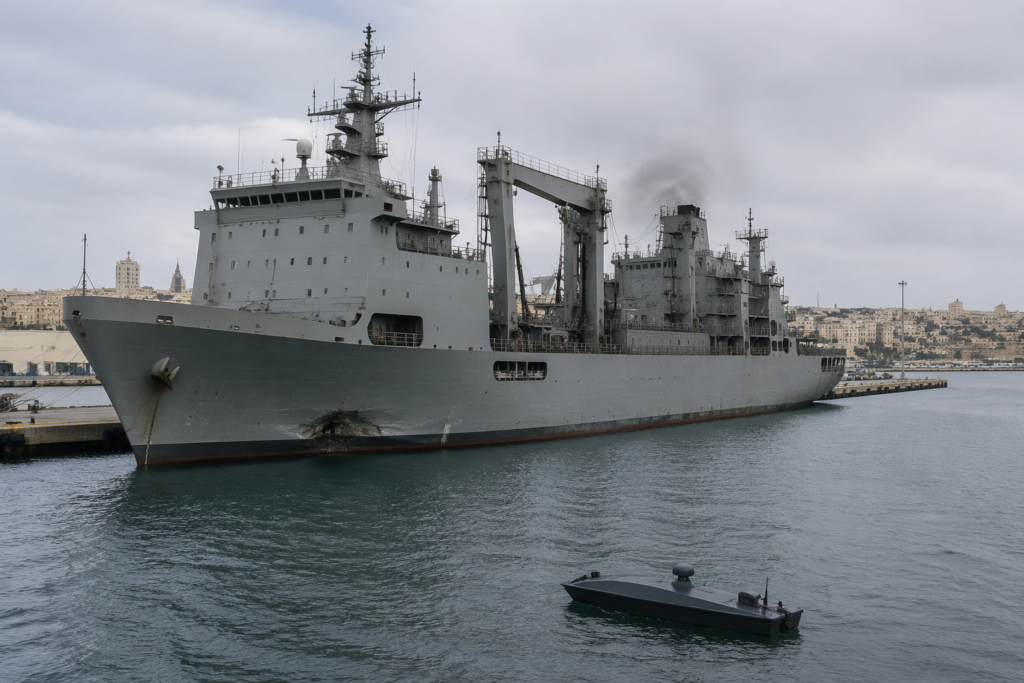
A suspected remote-controlled watercraft detonated against a Russian vessel in Libya on Sunday, injuring several people and bringing naval warfare directly into a North African port. The blast set off a fire across the decks at the Benghazi naval base along the Mediterranean coast before emergency crews contained the flames.
The incident signals an alarming reach for maritime strikes far outside traditional combat zones. Commercial crews and naval operators across the Mediterranean now face the reality that remote weapons can strike docked ships thousands of miles from active front lines.
Also read: Russian Ship in Libya Sinks Partially After Drone Blast
Local authorities quickly cordoned off the pier to treat the wounded. The exact number of casualties and their nationalities have not yet been released.
What happened at the Benghazi docks
The strike hit without warning while the ship was moored at the military harbor in Benghazi. An explosion ripped through the hull, followed by thick smoke and a blaze that threatened nearby installations.
Firefighters extinguished the fire shortly after the blast and secured the perimeter. Officials confirmed that an unspecified number of crew members or port workers sustained injuries during the detonation.
Authorities have withheld the name of the ship, its registry, and the exact nature of the cargo it carried into the harbor.
How the Russian vessel in Libya got there
Eastern Libyan officials explained that the targeted Russian vessel in Libya had arrived at the terminal under an official bilateral arrangement. The ship pulled in specifically to refuel and take on fresh provisions.
The port call was part of an ongoing cooperation agreement between Moscow and the eastern-based administration governing that half of the country. Libya remains split between two rival governments: a United Nations-recognised administration in Tripoli and an opposing authority ruling from Benghazi in the east.
That political fracture dates back to 2011, when a NATO-backed uprising ousted longtime ruler Muammar Gaddafi. In the years since, the oil-rich nation has turned into a contested hub of influence between Russia and Western nations.
Expanding beyond the Black Sea
While no military has formally claimed responsibility, the sea drone attack mirrors an expanding campaign of long-range waterborne strikes. Ukrainian forces have relied heavily on explosive unmanned boats and guided missiles to batter Russian warships throughout the Black Sea since 2022.
Recent days suggest those tactics are stretching across European and Mediterranean waters. Just one day before the Benghazi blast, a drone hit a Russian cargo vessel in the eastern Baltic Sea near Finnish waters, an action Finland’s border guard attributed to Ukraine.
The Mediterranean has seen similar incidents over the past year. Last December, Ukrainian forces confirmed using aerial drones against a Russian-linked oil tanker in Mediterranean waters. In March, a Russian liquefied natural gas carrier sank off the Libyan coast following a strike that Russian President Vladimir Putin directly blamed on Ukraine.
These incidents show how quickly the Russia Ukraine naval war has spilled into international shipping lanes, creating severe headaches for maritime security Mediterranean planners.
What eastern Libyan authorities say next
The eastern Libya government condemned the Benghazi naval base blast as an assault on national sovereignty and a direct danger to commercial maritime traffic. Officials warned that foreign belligerents must not drag North African harbors into overseas conflicts.
“The Libyan government will not allow Libyan ports, territory or territorial waters to be turned into an arena for settling scores or exporting international conflicts,”
The administration stressed that the nation takes no part in foreign hostilities and will defend its coastline against outside sabotage. Even so, the strike on the Russian vessel in Libya has forced military commanders in Benghazi into emergency posture.
Security teams from eastern Libya and Russian investigators have now begun inspecting the damaged hull and waterfront debris to identify the drone’s origin, launch point, and assembly components.
Source: Al Jazeera


