
Why the Real Christopher Robin Resented Winnie-the-Pooh
To millions of readers worldwide, the Hundred Acre Wood represents the pinnacle of childhood innocence, gentle adventures, and lifelong friendship. Yet for Christopher Robin Milne, the boy whose nursery toys inspired A.A. Milne’s beloved stories, the global literary phenomenon became a lifelong burden. Far from cherishing his association with the world’s most famous bear, the real Christopher Robin spent decades grappling with deep-seated resentment toward the fictional persona that overshadowed his identity.
A.A. Milne published Winnie-the-Pooh in 1926 and The House at Pooh Corner in 1928, drawing inspiration from his son’s stuffed animals—a teddy bear named Edward, a piglet, a donkey, and a tiger. While the books brought immense joy to the public and substantial wealth to the Milne family, they also thrust a young, introverted child into an unrelenting spotlight he never chose.
Also read: Letter About Meghan’s Father Written by His First Wife, BBC Understands
A Childhood Commercialized for Public Delight
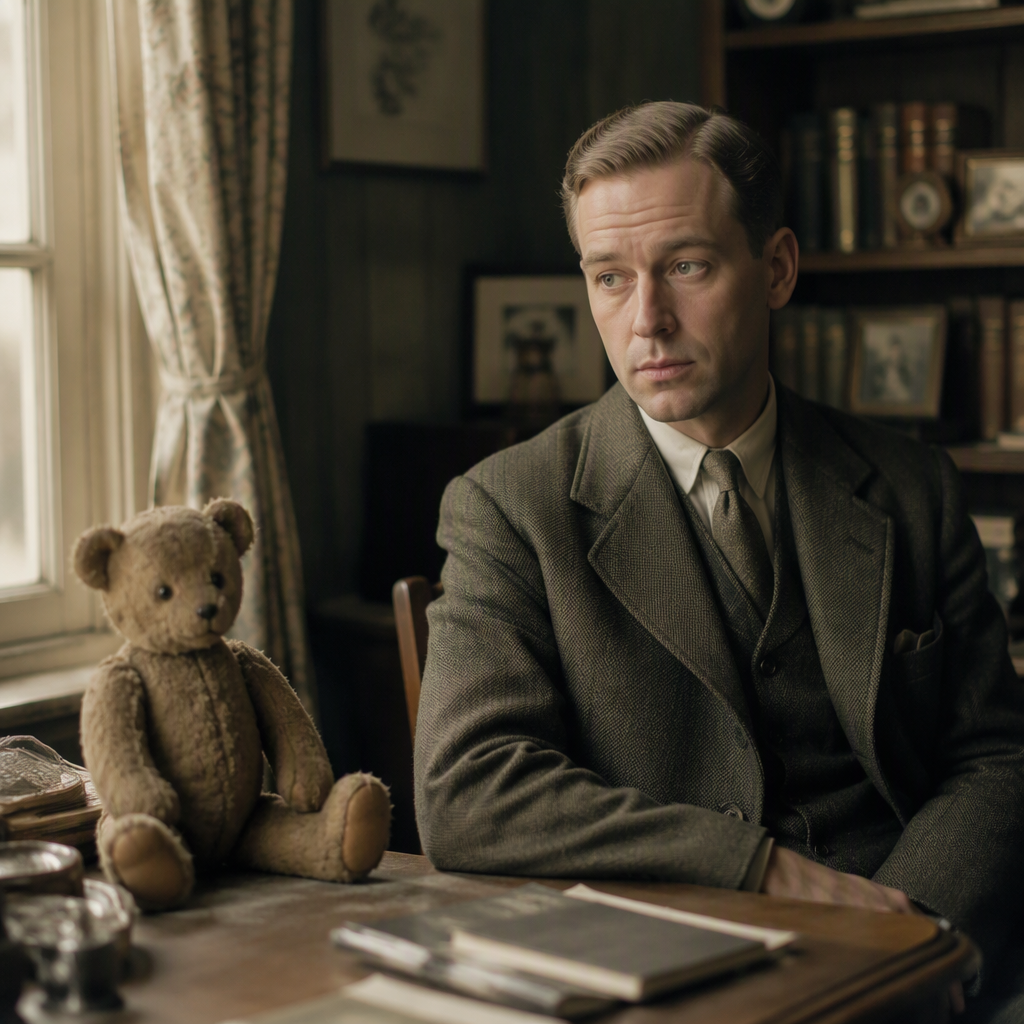
In the late 1920s, public appetite for Winnie-the-Pooh exploded into an unprecedented media circus. The young Christopher Robin was routinely photographed with his stuffed bear, paraded before journalists, and even featured in promotional radio broadcasts.
At first, the young boy embraced the excitement. He appeared at book signings and posed for illustrations drawn by E.H. Shepard. However, as the fame intensified, the boundary between the private child and the public commodity collapsed. Milne later recalled that while his father observed him at play, the author was rarely personally engaged with him, leaving the boy primarily in the care of his nanny, Olive Rand.
Boarding School Bullying and the Echoes of ‘Vespers’
The resentment began to calcify when Christopher was sent to Boxgrove School, a preparatory boarding school, at the age of nine. Far from granting him celebrity status, his literary fame turned him into an easy target for cruel classmates.
A particularly excruciating ordeal stemmed from his father’s poem “Vespers,” which depicted a young Christopher Robin kneeling by his bed in prayer. Schoolmates discovered a gramophone record of the young Christopher reciting the poem and played it repeatedly to mock him. To survive the brutal schoolyard environment, the boy took boxing lessons to defend himself against physical and verbal attacks, but the psychological damage was already done.
Why the Real Christopher Robin Resented Winnie-the-Pooh and His Father
As Christopher reached adulthood, the literary creation continued to haunt his ambitions. After serving as an officer with the Royal Engineers during World War II, he returned home with an English degree from the University of Cambridge, eager to establish his own career as a writer or professional.
Instead, employers and publishers viewed him only as the boy from the children’s books. No matter his qualifications, society refused to separate the grown man from the nursery character in short trousers. In his 1974 memoir, The Enchanted Places, Milne laid bare his frustration regarding his father’s literary success:
“It seemed to me almost that my father had got where he was by climbing on my infant shoulders, that he had filched from me my good name and had left me nothing but the empty fame of being his son.”
This deep professional frustration created an irreparable rift within the family. Christopher felt his father had extracted the sweetest moments of his childhood and commercialized them, leaving him an empty shell in adulthood. When his father died in 1956, the two men had remained largely estranged for years.
Forging an Independent Identity in Dartmouth
Determined to escape the shadow of the Hundred Acre Wood, Christopher Milne married his first cousin, Lesley de Sélincourt, in 1948—a union his parents strongly opposed. The couple relocated to Dartmouth, Devon, where they opened the Harbour Bookshop in 1951.
In Devon, Milne lived a quiet, industrious life as a dedicated bookseller and skilled woodturner. For decades, he refused to accept royalties from commercial Winnie-the-Pooh merchandise and adaptations, maintaining strict distance from the empire his name had built. He eventually accepted a portion of the royalties later in life, primarily to ensure long-term care for his daughter, Clare, who was born with cerebral palsy.
A Complex Legacy Beyond the Hundred Acre Wood
Christopher Robin Milne passed away in his sleep on April 20, 1996, at the age of 75. In his later years, through writing multiple memoirs, he found a measure of peace with his past, acknowledging that while he had resented his childhood fame, he could not blame his father for writing stories that touched millions.
Today, the story of the real Christopher Robin stands as one of literature’s most poignant cautionary tales: an enduring reminder that the idyllic worlds created on the page can sometimes come at a profound personal cost to the real individuals left behind.