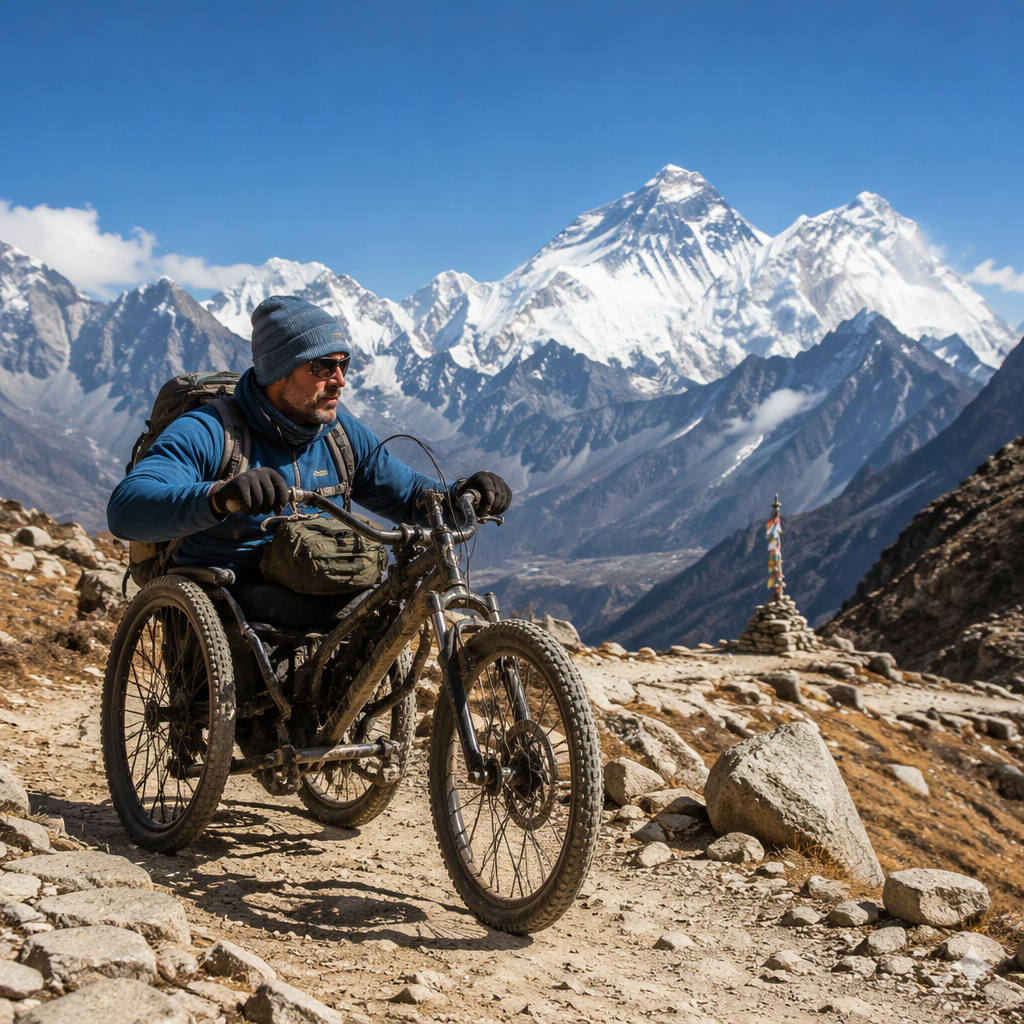

The Extraordinary Journey to Everest Base Camp by Handcycle
In one of the most grueling demonstrations of endurance and adaptive athleticism in recent mountaineering history, an expedition team successfully navigated the rugged trails of Nepal to reach Everest Base Camp by handcycle. Operating at elevations exceeding 17,500 feet (5,364 meters), the feat redefines the boundaries of accessible adventure and highlights the evolving capabilities of specialized off-road hand-cranked cycles.
The journey from the mountain airstrip at Lukla to the foot of the world’s tallest peak is notorious for its relentless stone staircases, narrow suspension bridges, and thinning air. While thousands of trekkers make the pilgrimage on foot each year, attempting the rocky Khumbu route seated low to the ground on three wheels requires unmatched upper-body stamina, precision engineering, and seamless teamwork.
Also read: How a Fan’s Dying Wish Led a Dutch Football Team to a Tartan Kit
Navigating the Brutal Terrain to Everest Base Camp by Handcycle
The standard trek to Everest Base Camp covers roughly 40 miles (65 kilometers) each way, climbing more than 9,000 vertical feet from Lukla. For an athlete operating a handcycle, nearly every mile presents severe technical obstacles. The trails are not smooth paths; they are ancient trade corridors paved with loose scree, boulders, and steep vertical steps carved into granite mountainsides.
To withstand the Himalayan elements, the expedition relied on custom-engineered mountain handcycles equipped with heavy-duty disc brakes, fat off-road tires, and specialized low-gear drivetrains. In areas where massive boulders and sheer drops made rolling impossible, the cyclist worked in close synchronization with local Sherpa guides and support crew members who provided stability ropes and lifted the chassis over impassable stone ledges.
Crossing the famous suspension bridges suspended hundreds of feet above the roaring Dudh Koshi River posed another major operational challenge. The narrow walkways, frequently crowded with yak caravans and high crosswinds, required millimeter-precise navigation to ensure the cycle’s wide rear axle cleared the cables safely.
Combating Altitude Sickness with Arm Power
Beyond the mechanical obstacles, the biological demand of high-altitude handcycling is severe. As atmospheric pressure drops, oxygen molecules per breath decrease by more than 50 percent at base camp compared to sea level.
Unlike trekking, which utilizes the human body’s largest muscle groups in the legs, handcycling relies almost entirely on the arms, shoulders, and chest. These smaller muscle groups fatigue rapidly and consume precious oxygen at an accelerated rate. Maintaining an aerobic rhythm on sustained 20-percent inclines required methodical pacing, strict hydration protocols, and deliberate acclimatization days in Sherpa villages like Namche Bazaar and Dingboche.
Medical advisors monitoring the expedition tracked blood oxygen saturation and heart rates daily, ensuring that the extreme physical exertion did not precipitate High Altitude Pulmonary Edema (HAPE) or Cerebral Edema (HACE).
A Milestone for Adaptive Mountaineering
The successful trek into the Khumbu Valley adds to a growing movement of adaptive athletes tackling iconic global objectives previously deemed inaccessible for wheelchair users. Rather than viewing disability as a barrier, modern expeditions use innovative design and cooperative teamwork to prove that extreme environments can be traversed through different means of mobility.
Expedition leaders emphasized that the mission aimed to inspire people recovering from spinal cord injuries and other life-altering conditions, demonstrating that physical setbacks do not close the door on world-class exploration.
What Happens Next
Following the successful arrival at the Khumbu Glacier, the team plans to publish a comprehensive technical debrief detailing equipment wear, battery performance in sub-zero temperatures (for assistive hub motors), and trail logistics. The data will assist future adaptive expeditions planning journeys in remote, non-paved wilderness corridors.
As adaptive technology advances and trail awareness expands, the journey to Everest Base Camp by handcycle stands as a historic benchmark, proving that determination and human ingenuity can conquer even the highest and harshest corners of the planet.