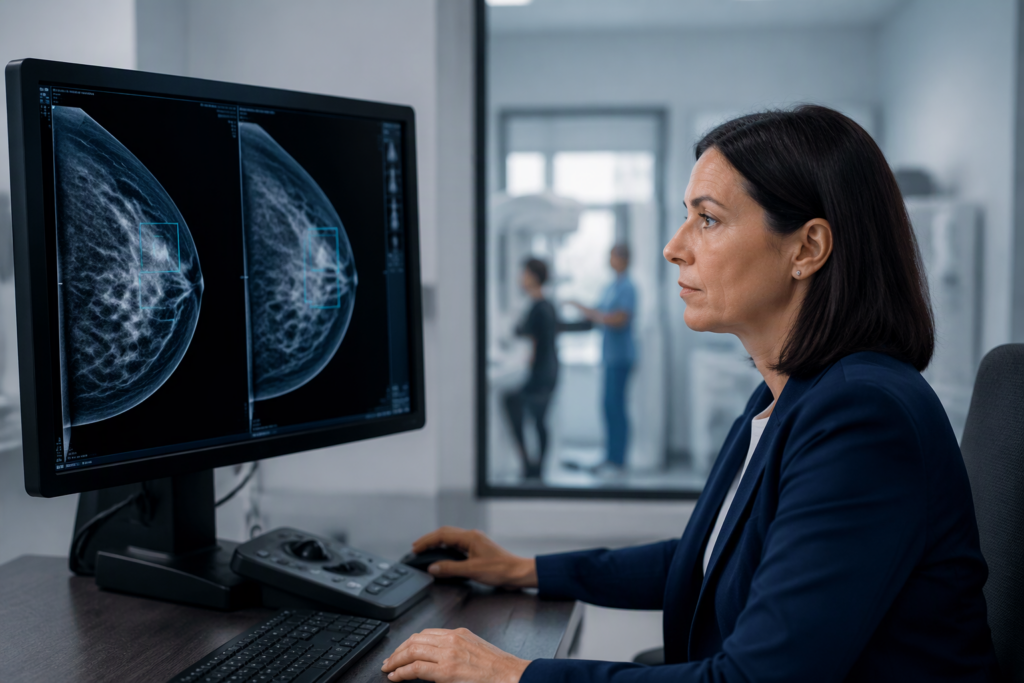
Nearly 700,000 women across the UK are being asked to let computer algorithms examine their routine mammograms, as the NHS opens the world’s biggest study into AI breast cancer screening.
The £11m project, known as the EDITH trial, replaces one of two human specialists reviewing each scan with automated software. Cambridge University Hospitals has enrolled the first patients, with 29 other hospital sites preparing to join the research across the country.
Also read: Pancreatic Cancer Drug Shrinks Tumors in Most Trial Patients
Routine screening already catches around a third of all UK breast tumors early, but staff shortages are stretching clinics thin. If the computers prove accurate, they could cut wait times, spot hidden tumors faster, and ease pressure on overloaded hospital teams.
Replacing one human reader at thirty hospital sites
Every year, more than two million women aged 50 to 71 attend routine mammogram appointments through the NHS. Under the current setup, two specialists independently inspect each X-ray image to decide if a patient needs further tests.
The EDITH trial alters that balance. Women invited for their standard three-year checkups will be asked if they wish to take part. Those who consent will undergo the exact same scan as usual, but software will take the place of one doctor.
The trial tests the software in two separate pathways across different clinical teams:
- In one arm, the AI model grades scans first before passing them to an NHS specialist.
- In another arm, a specialist examines the scan first and the computer provides a second check afterwards.
Four independent software companies are supplying tools for the project. In all cases, an NHS specialist will continue to review every patient file before doctors make any clinical recall decisions.
Radiologist shortages push clinics to breaking point
Breast cancer remains the most frequently diagnosed cancer among women in the UK, accounting for roughly 59,000 new cases every year. Routine screening prevents an estimated 1,300 deaths annually by finding early breast cancer detection opportunities before physical lumps appear.
Yet finding enough specialists to review those scans has become increasingly difficult. Demand for imaging examinations rises by 8% every year, creating severe staffing deficits across the health service.
Professor Fiona Gilbert, a consultant at Addenbrooke’s Hospital and co-chief investigator from the University of Cambridge, explained why the shift matters for clinical staff.
“Technology can make reviewing these images more efficient, freeing up specialist breast radiologists to spend more time caring for patients with cancer, supporting faster diagnosis and earlier treatment.”
Gilbert pointed out that less than 1% of women who attend routine appointments turn out to have cancer. Freeing doctors from manually checking hundreds of thousands of normal scans could help them focus directly on confirmed cases.
The fear of false alarms and overdiagnosis
While computer vision models learn patterns from millions of past scans, scientists caution that raw sensitivity can create new risks for healthy patients. An algorithm that flags every tiny shadow could drag thousands of healthy women through stressful biopsies and false alarms.
Researchers running the trial want to guarantee that automated tools do not trigger excessive recalls. Early trials showed algorithms can find tiny abnormalities, but not every abnormality poses a fatal threat.
Professor Sian Taylor-Phillips, co-chief investigator from the University of Warwick, warned that detecting minor lesions can sometimes do more harm than good.
“AI-assisted technology could help improve early cancer detection but we want to avoid the overdiagnosis of milder disease that would never have caused symptoms,” Taylor-Phillips said.
That balance is what the three-year trial intends to measure. If the system drives up false alarms, the burden on hospital staff could actually increase rather than shrink.
How early screening alters patient outcomes
For patients who have gone through routine checks, the value of fast detection is deeply personal. Shirley Essex, a 70-year-old resident from Cambridgeshire, received an early-stage diagnosis just one year ago after a routine appointment.
She had no physical symptoms when she walked into the clinic. Because the scan spotted the tumor right away, Essex required surgery and radiotherapy but avoided chemotherapy altogether.
“I was astonished to be told I had cancer because I did not have any symptoms,” Essex said. She is not participating in the EDITH trial, but she credits routine screening with saving her life.
Health Secretary Yvette Cooper visited the screening unit at Addenbrooke’s Hospital as recruitment started. She stated that public trials with firm safeguards are essential before rolling out algorithms across national health services.
Where the three-year study heads next
Funded by the National Institute for Health and Care Research, the EDITH trial brings together NHS England alongside teams from the University of Warwick, the University of Cambridge, and Cambridge University Hospitals NHS Foundation Trust.
Professor Peter Johnson, national clinical director for cancer at NHS England, urged women who receive invitations to participate. He stressed that no scan will go unread by a qualified doctor while data collection is underway.
Researchers will monitor outcomes and recall rates across all 30 participating hospital sites over the next three years, with initial findings expected once the testing phase concludes in 2028.
Source: BBC