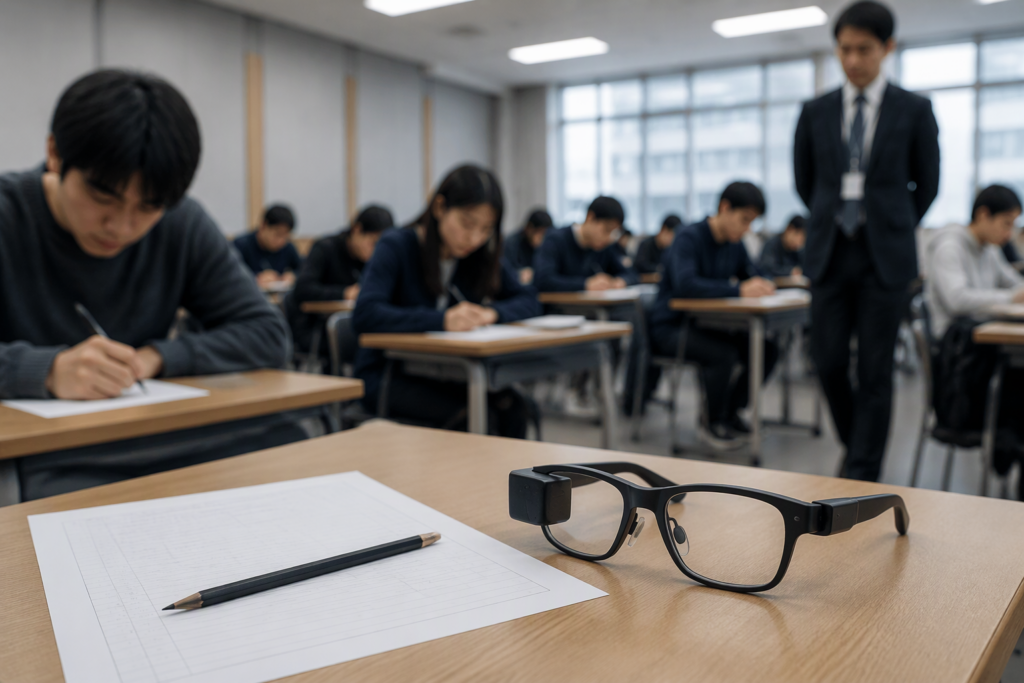
A masked test-taker sat in front of a camera on YouTube and admitted he had engineered one of the most brazen test frauds in South Korea’s history. He had walked away with nearly perfect scores on a national certification exam, not through endless cramming, but by transmitting test questions to an artificial intelligence engine through a concealed camera.
The confession set off a high-level government scramble. In a country where exam rankings dictate careers, social standing and university admissions, South Korean authorities now fear that AI smart glasses and hidden wireless gear have outpaced traditional classroom monitoring.
Also read: Inside the Shenzhen AI Hub: What World Leaders Won’t See
With hundreds of thousands of teenagers preparing to sit for the high-stakes Suneung college entrance exam this week, Prime Minister Han Seok-sook convened an emergency meeting on Monday. She ordered cabinet officials to tighten test security immediately, warning that anyone caught deploying digital tools faces criminal prosecution rather than just academic penalties.
How Han Won-seok beat the tax test
The scandal broke into public view after test administrators noticed suspicious scores on two separate national exams for aspiring tax accountants held in April and July. One applicant, identified by local media as Han Won-seok, answered nearly every single question correctly across tests containing hundreds of complex prompts.
Rumors circulated online until Han posted his video confession on Sunday. He explained that he used a miniature camera to snap photos of test pages before feeding the images to an AI tool through a smartphone.
“I cheated using electronic devices and generative AI. My passing the exam with the top score was not the result of fair effort,” he said in the YouTube video.
Han said he filed a formal confession with the Seoul police detailing how he pulled off the scheme. He told viewers that investigators would soon have every detail of his methods, warning other students that their gadgets would not protect them from exposure. The prime minister responded by ordering his test results scrapped and calling for a permanent ban on his participation in state examinations.
Why AI smart glasses terrify test proctors
Education officials acknowledge that detecting miniaturized hardware has become an operational nightmare. While early connected eyewear carried bulky frames and obvious lenses, newer models look almost identical to prescription spectacles.
Students can program AI prompts ahead of time and trigger automated searches with subtle taps or eye movements. Once the text is processed, the answers appear directly on tiny heads-up displays embedded inside the lenses.
The threat is no longer theoretical. In October, proctors caught three university students in Seoul using smart frames during mid-term exams. In June, National Taiwan University disqualified an applicant from its medical school admissions test after discovering the student wore camera-enabled eyewear during the sitting.
For exam monitors, the devices blur the line between basic vision aids and illicit transmitters. If proctors cannot distinguish a medical necessity from a connected computer, testing integrity collapses.
Eyewear checks and jail time at 1,312 sites
In response to the scandal, Minister of Education Choi Kyo-jin announced that proctors will physically inspect the frames of all spectacles worn by students during test sessions. The government plans to deploy at least one dedicated inspector to each of the country’s 1,312 College Scholastic Ability Test sites.
Authorities are also moving to raise the stakes for those considering illicit help. The education ministry wants to triple the standard testing ban for cheaters from one year to three years, alongside active criminal charges for candidates caught with transmission gear.
Officials in Seoul are reviewing additional technological countermeasures:
- Physical frame inspections for every student entering an exam room.
- Radio-frequency signal detectors swept through corridors during testing blocks.
- Disabling local public Wi-Fi networks around testing facilities.
- Police escorts and criminal investigations for individuals carrying covert electronics.
A testing race across East Asia
The problem reaches far beyond Seoul. Competitive entrance exams across East Asia place immense pressure on young people, creating a lucrative underground market for undetectable electronics. In mainland China, authorities managing the annual Gaokao university exam recently installed intelligent security gates at testing centers specifically calibrated to flag hidden camera components and wireless earpieces.
In South Korea, the cultural reverence for test fairness makes any compromise toxic to public trust. During the 10-hour Suneung, the entire nation adjusts its routine. Flights pause so aircraft noise does not interfere with the English listening section, and morning commuters stay off roads to keep traffic clear for students.
Now, test supervisors must master counter-surveillance techniques within days. When the Suneung begins on Thursday morning, over half a million students will have their glasses examined by hand before they are allowed to turn over their first test booklet.
Source: Al Jazeera


