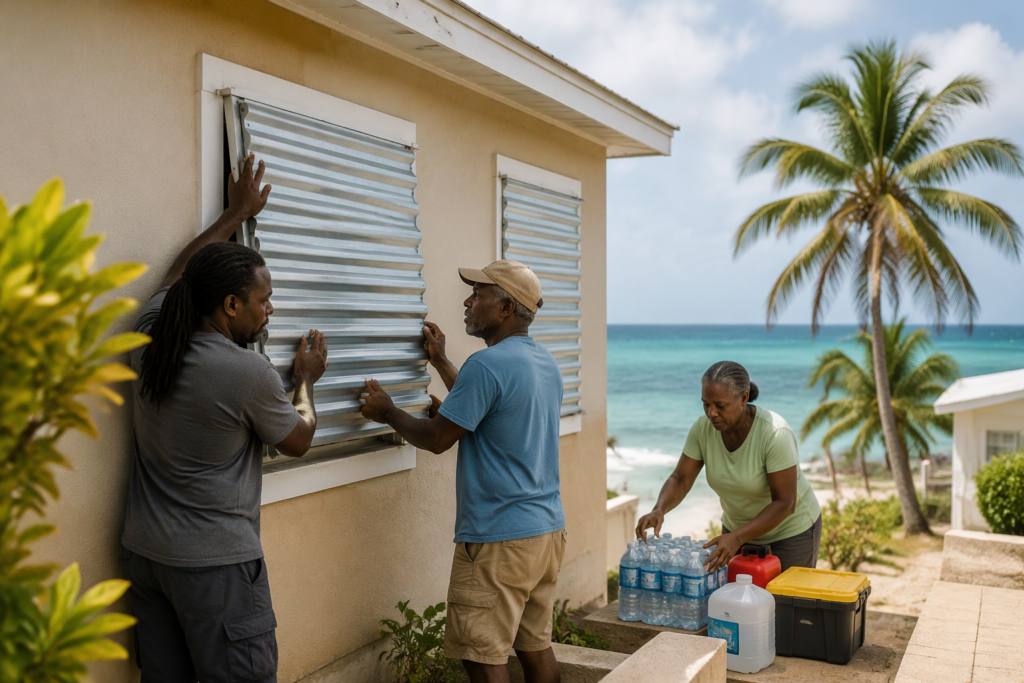
When Hurricane Dorian hit, it wiped out electricity for entire towns and left residents waiting two years just to plug back into a functioning wall outlet. Now, a record-quiet Atlantic storm season driven by a powerful El Niño has bought the country valuable breathing room to rebuild the Bahamas energy grid so it never collapses like that again.
Instead of stringing up the same fragile wires and ordering more diesel, island authorities are building decentralised networks powered by the sun. For families paying some of the highest power bills on earth after fuel costs jumped 33% in a single year, the shift offers both financial relief and a shield against the next disaster.
Also read: Ukrainian Naval Drones Sink Russian Warship in Libya
The work underway shows what happens when an island nation treats recovery as a complete clean slate rather than a patch-up job.
The wreckage that forced a complete restart
The push began in the ruins of the 2019 season. Dorian struck as the most intense cyclone in Bahamian history, killing at least 74 people, leaving 282 missing, and displacing 70,000 residents.
The storm wiped out a quarter of the nation’s gross domestic product. On the northern Abaco islands and Grand Bahama, the damage was near total. Power utility Bahamas Power and Light faced an infrastructure network that was completely ransacked.
David Gumbs, director of the Islands Energy Program at the Rocky Mountain Institute, lived through Category 5 winds himself in Anguilla during Irma two years earlier. He watched his home wreck and his island’s electrical lines shatter.
“One lesson many of us have learned is the islands that use the quieter years to prepare are often the ones that recover most effectively,” Gumbs said.
How renewable microgrids keep classroom lights on
Prime Minister Philip Davis challenged the nation after the disaster to abandon unreliable fuels and pivot toward self-sufficient systems. The answer has taken shape as renewable microgrids, which generate, store, and distribute electricity locally without needing distant high-voltage towers.
Three public schools across Abaco now draw 90% of their power from rooftop solar panels backed by industrial batteries. These buildings serve roughly 10,000 residents and double as emergency shelters when gale-force winds hit.
Before the switch, one of the schools suffered up to five blackouts every day. When blackouts hit the surrounding district now, the school buildings stay bright.
“The principal of Man-O-War Cay Primary described looking across Abaco during an island-wide outage and seeing the school still illuminated because its solar panels and batteries were supplying power,” Gumbs said.
Two more independent systems are currently in development to run a government complex and pair of medical clinics.
Inside the new hybrid Bahamas energy grid on Abaco
Commercial builders are expanding that model to cover entire islands. EA Energy, a joint venture between Bahamian and Turkish investors, launched construction on Abaco in 2024 to install a hybrid system.
The project merges solar panels, natural gas engines, and a 20-megawatt-hour battery storage unit into one unified plant. The physical structures are engineered to stay intact against sustained 200 mph winds.
Because sun and wind fluctuate, the battery storage setup smooths out second-by-second changes in consumer demand. Gas engines kick in only when stormy skies limit solar production.
Project director Emre Ozer explained that generating power domestically insulates families from volatile overseas oil tankers. When the project launches, it will produce 1,305 megawatts of electricity, supplying all of Abaco’s power demand across up to 3,000 homes.
The islanding trick that shields local networks
Centralised utilities fail during hurricanes because a single fallen tree branch can knock out power for fifty miles of coastline. During Hurricane Dorian, Abaco’s central generation plant actually survived, but broken distribution lines made it useless.
Small island networks solve this through an operational technique known as islanding. If an incoming storm snaps an external transmission link, the local network instantly separates itself and keeps running on its own local resources.
Mundu Mustafa, an energy systems researcher at Kampala International University, pointed out that smaller territories hold a clean-slate advantage. They can skip twentieth-century grid designs entirely and place generating units directly beside the people using them.
Similar shifts are taking root across the Caribbean, from geothermal drilling in Dominica to rooftop solar aggregation across Puerto Rico and the Virgin Islands.
Training local crews before the next storm hits
Hardware alone cannot keep the lights burning if no one on the island knows how to rewire an inverter after a gale. Shipping in replacement crews by boat is impossible when harbours are choked with storm debris.
To eliminate that delay, organisations are training Bahamians on the ground. EA Energy has staffed one-sixth of its installation workforce with local hires, while the Rocky Mountain Institute runs six-month technical apprenticeships.
Residents learn how to mount solar arrays, wire high-capacity batteries, and troubleshoot control systems. When the next major weather front moves in, repair teams will already be on site.
The full hybrid network on Abaco is scheduled to go live and feed into the Bahamas energy grid in May 2027.
Source: BBC


