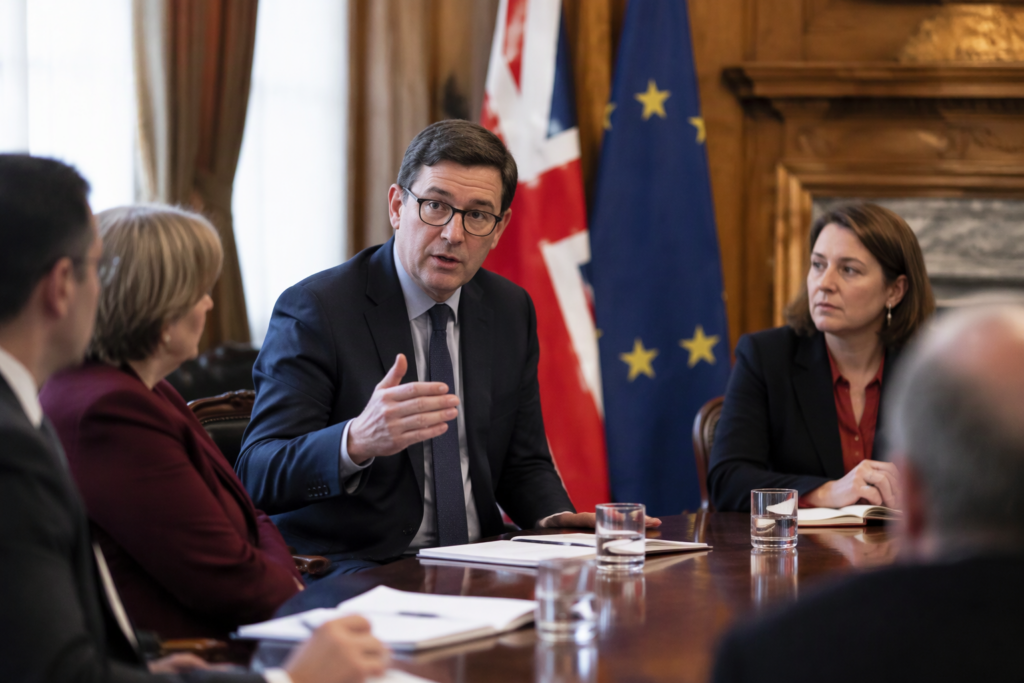
Andy Burnham will walk into Parliament on Monday morning to tell lawmakers that his newly agreed pact with Brussels can finally reverse ten years of British stagnation. Defending the Burnham EU deal reached on Friday, the prime minister will insist the country faces a straight choice between clinging to a broken status quo or embracing economic change.
The agreement marks the most aggressive reset of relations between London and the European Union since Britain departed the bloc. Burnham intends to frame the pact as the single biggest growth measure of this entire parliament, projecting a 0.5% boost to gross domestic product that his government claims will deliver a £17bn lift to the British economy.
Also read: Trump Dares Tehran as Iran Tanker Blockade Standoff Escalates
For millions of households battling stubborn supermarket inflation, the prime minister insists the stakes could not be more direct. He argues that rejecting closer European alignment will leave food prices to climb higher, while backing the arrangement will ease immediate pressure on household budgets across the country.
Why Burnham says the decade ahead looks brighter
Addressing MPs, Burnham will argue that the Brussels agreement offers a real opportunity to ensure the coming decade treats Britain far better than the previous one did. He will tell the House of Commons that political leaders now hold the power to draw a line under ten years of drift and division.
“The ability to draw a line on a decade of drift and division is in our hands and I believe we should take it,” he will say in his speech.
Burnham points to recent opinion polls showing that the public wants closer ties with European neighbours. In his view, the compromise worked out across the English Channel simply delivers on that public appetite while safeguarding domestic interests.
However, Burnham has said this pact is likely to be all that his government will be able to deliver before the next general election. Passing the agreed upon legislation is bound to consume a lot of time and energy of the legislature. Informal talks between the British and the EU officials will start soon to scope out longer-term arrangements for the next Parliament to consider.
What the Burnham EU deal changes for trade and travel
The deal addresses three main contentious areas of the UK’s trade with the EU. These are: trade in agricultural products, the EU’s carbon market, and cross-border travel of individuals below the age of 25. The deal was seen as a positive development to ease trade while avoiding constitutional issues.
Agricultural products trade is at the center of the changes. The agreement eased the free movement of agricultural products across the borders, even if some experts think this provision binds British farmers to EU rules.
The pact also links carbon emissions trading systems and introduces a youth experience scheme to revive travel and work opportunities across Europe. Burnham will argue to MPs that blocking such arrangements only punishes younger generations who had their horizons abruptly narrowed.
Conservative and Reform leaders push back at CBI
The political backlash against the Burnham EU deal emerged almost immediately from rival parties. Conservative Party leader Kemi Badenoch will take the stage at the Confederation of British Industry annual conference on Monday to launch a fierce counter-attack against the agreement.
Badenoch argues that the terms treat British farmers unfairly by forcing them to comply with production regulations crafted in Brussels. She has also attacked the government’s economic projections, claiming the prime minister plucked the £17bn figure out of thin air and arguing that independent modelling shows a 0.0% gain rather than 0.5%.
Reform UK leader Nigel Farage will also address business leaders at the same CBI conference, warning that closer European ties will prove disastrous for domestic commerce. Farage argues that small enterprises that never export to continental buyers will still end up choked by extra compliance burdens and foreign rules.
Over the weekend, Farage said the pact was a humiliating spectacle for a country that voted to govern itself. He also said that Andrew (A.J.) Burnham was a fraud, and that only his party was fighting to keep the will of the British people.
Former prime ministers voice their own doubts
The resistance extends well beyond current opposition leaders, with three former prime ministers publicly questioning Burnham’s European strategy. The intervention highlights how quickly the debate has reopened familiar political fault lines across Westminster.
Theresa May, who spent three years negotiating Britain’s departure, said she was aghast at the new agreement. May warned that Andy Burnham should move on rather than rehash past European battles.
Sir Tony Blair took a different angle of critique in comments to The Sunday Times. The former Labour leader argued that Britain should only contemplate closer ties or re-entry if the European Union reforms its own structures to encourage technological innovation.
All this comes at a time when Rishi Sunak also joined former Prime Ministers Boris Johnson, Theresa May and David Cameron in criticising the Brussels pact. It is clear Burnham faces an uphill battle at home with his compromise.
The next test in Parliament and beyond
Burnham faces the House of Commons on Monday afternoon to defend the deal directly to skeptical lawmakers, while Badenoch and Farage lay out their counter-arguments across town at the CBI gathering. Both sides will soon begin informal brainstorming sessions to outline the UK’s long-term relationship with Europe ahead of the next general election.
Source: BBC


