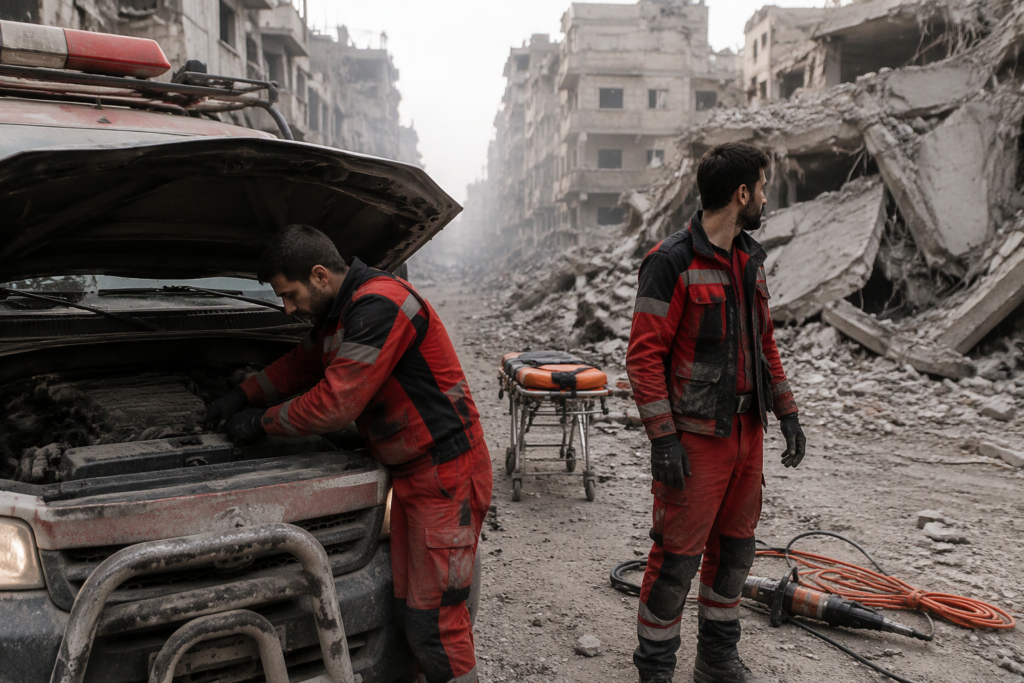
When an explosion rattled near the al-Qattan Centre on November 3, the local Gaza Civil Defence crew scrambled to move. They turned to their only fire engine, but the engine would not start. Instead of driving, the rescuers grabbed their heavy tools, threw stretchers over their shoulders and sprinted down the street on foot.
It took them ten minutes of hard running to reach the blast site. By the time they arrived, one person was dead and several were bleeding on the ground. The crew treated the wounded, carried them back by hand, and recovered the body. For the emergency workers trying to keep people alive, every broken engine turns a five-minute sprint against death into a desperate struggle.
Also read: Trump Board of Peace Has $18bn for Gaza, but Money Sits Idle
More than 85 percent of all emergency response vehicles across the territory are now completely out of service. Across all five governorates, only 15 percent of the fleet can still turn an engine over. If two buildings collapse at the same moment, rescuers must make a terrible choice about who gets help and who waits in the dust.
Running to bomb sites with stretchers in hand
Running on foot is no longer an isolated incident for rescue crews. In southern Gaza City’s Sabra neighbourhood, an emergency truck sputtered and died in the middle of a run toward an air strike. Rescuers were delayed as they tried to reach the trapped families. By the time they arrived at the rubble, several people had already died from their injuries.
Abdullah al-Majdalawi, a field officer who responded to both scenes, noted that reaching those victims earlier could have saved their lives. When vehicles fail completely, teams take whatever transport presents itself on the road. During one call in 2024, an entire rescue squad loaded their gear onto a wooden cart pulled by a donkey just to reach the scene.
Bystanders stopped and stared as the uniformed crew rattled past on the cart. But as al-Majdalawi pointed out, responders had no other choice. When people are buried under concrete, waiting for a mechanic is not an option.
Patching 20-year-old rescue vehicles with dough
In the entire Gaza governorate, there is only one dedicated rescue truck: an old Toyota Hilux pick-up. It is more than 20 years old and has run continuously through months of heavy bombardment. Today, it sits idle, completely broken down after weeks of mechanical failure.
Crews tried everything to keep the Hilux rolling. When proper tyre patches vanished from local shelves, mechanics filled punctured tyres with raw flour dough to seal the air. That fix could only hold for so long. The truck now suffers from a ruined power steering pump, shredded tyres, a failed turbo system, and broken emergency lights that make night operations hazardous.
Without that small truck, crews must deploy heavy fire engines into narrow alleyways packed with market stalls and displaced families living in plastic tents. Navigating those tight spaces wastes precious minutes. It also burns fuel that the department can barely afford to spare.
Why Gaza Civil Defence faces a total mechanical halt
The roots of the vehicle breakdown stretch back decades. Raed al-Dahshan, director of Gaza City’s Civil Defence, explained that many trucks have been operating since 1994, when the Palestinian Authority was first created. Standard international fire service guidelines urge departments to retire and replace front-line emergency engines every 15 to 20 years. Gaza’s engines have logged 30 years of hard driving over shattered, cratered roads.
Finding replacement parts has become nearly impossible. Maintenance officer Abd al-Fattah al-Nimra and his workshop crew spend their days fabricating makeshift components. Proper spare parts are barred from entering the strip, and the few worn pieces available on the local market carry impossible price tags that far outstrip the department’s budget.
The shortage of basic engine oil and filters has turned minor maintenance issues into permanent breakdowns. A United Nations Office for the Coordination of Humanitarian Affairs report confirmed that border restrictions on oil and mechanical parts are crippling humanitarian vehicles across the board. Generators, rubble-clearing machinery, and ambulances are failing one after another without replacement parts to revive them.
“We are not asking for much. We need tyres, engine oil and fuel. We are ready to dig through the rubble for hours and days to rescue people, but we need the equipment to do that.”
Winter storms, deadly delays and unanswered calls
The mechanical crisis hits just as winter weather arrives. Heavy rains in early November collapsed cracked walls and flooded dozens of informal camps. The department received hundreds of emergency calls during the downpours, but crews could only respond to a tiny fraction in person. Dispatchers spent the stormy nights giving first-aid advice over the phone to families trapped by rising water and crumbling concrete.
The physical toll on the staff is just as severe. Over 140 Civil Defence personnel have been killed on duty since October 2023. Fewer than 1,000 active employees remain to cover all five governorates, and most of them work without regular pay.
International law protects emergency personnel under Article 62 of Additional Protocol I to the Geneva Conventions. Yet civilian rescue crews find themselves without safety, without spare parts, and without functional transport. As winter storms threaten to bring down more rain-soaked concrete buildings in the coming weeks, dispatchers in Gaza City are monitoring deteriorating weather forecasts with only a handful of running engines left to answer the sirens.
Source: Al Jazeera


