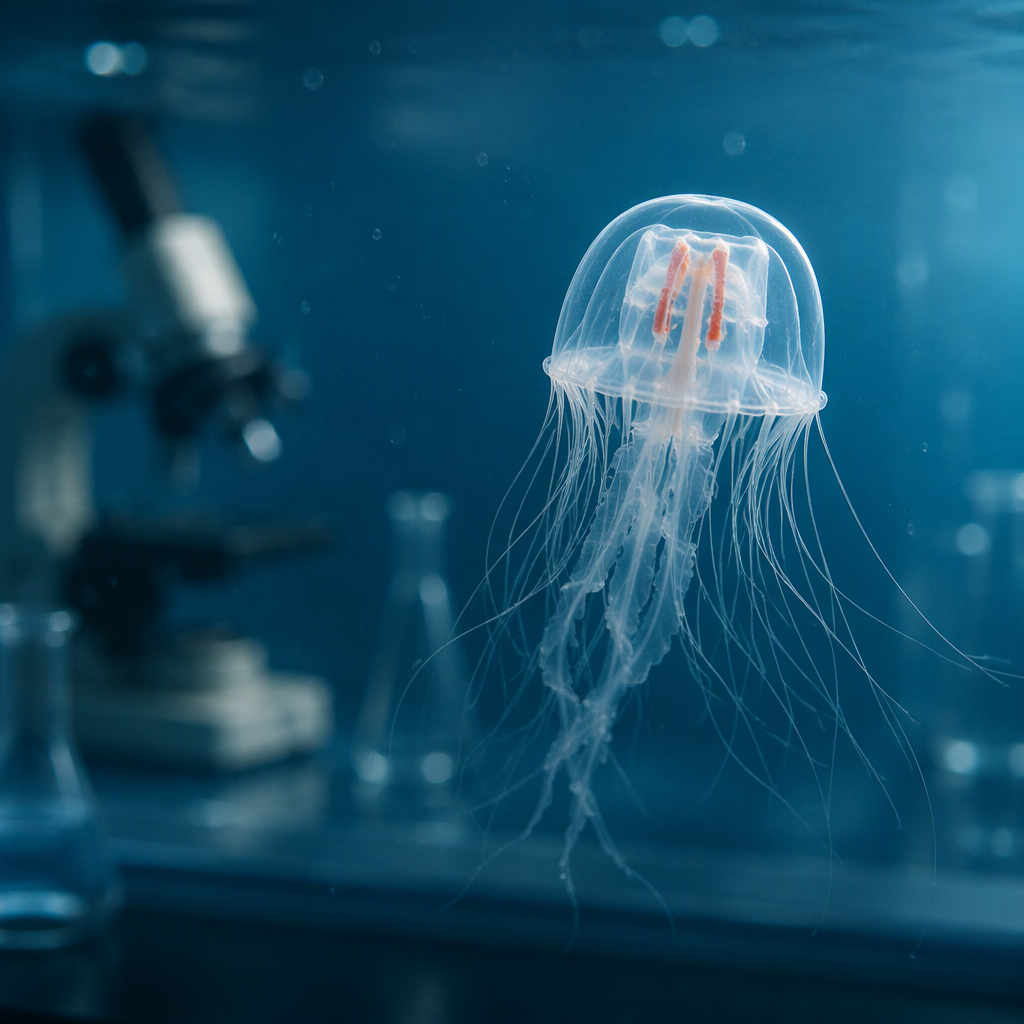

How the Immortal Jellyfish Could Unlock New Treatments for Diseases of Old Age
A tiny marine creature known as the immortal jellyfish holds biological secrets that could transform modern regenerative medicine. While humans and nearly all other animals face an irreversible biological clock, this species possesses the rare ability to hit rewind on its lifecycle, offering biomedical researchers vital clues for combating chronic diseases associated with human aging.
Known scientifically as Turritopsis dohrnii, the bell-shaped organism measures barely four millimeters across. When confronted with physical injury, starvation, or environmental stress, it avoids death not by healing old tissues, but by reverting its adult body back into a juvenile polyp stage. Scientists are now analyzing this process to discover how human cells might be protected from age-related deterioration.
Also read: How the Immortal Jellyfish Beats Ageing to Inspire Treatments for Human Disease
The Biology Behind Cellular Rejuvenation
In standard animal development, cells begin in an undifferentiated embryonic state and specialize into muscle, nerve, or skin cells. Once specialized, these cells typically stay on their assigned biological path until they degrade and die.
The immortal jellyfish breaks this fundamental rule through a process called transdifferentiation. During periods of severe stress, specialized adult cells shed their identities and reprogram themselves into primitive, versatile stem cells. These cells then form a cyst-like cluster on the ocean floor, which develops into a new polyp colony capable of producing genetically identical adult jellyfish.
This biological reset can occur repeatedly, earning the species its immortal reputation. While predators and disease still kill individuals in the wild, the creature appears physiologically exempt from dying of old age.
What Genomic Mapping of the Immortal Jellyfish Reveals
Recent comparative genomic studies have provided unprecedented insight into how the immortal jellyfish sustains its perpetual renewal. Researchers at the University of Oviedo in Spain mapped the genome of Turritopsis dohrnii alongside its close relative, Turritopsis rubra, which lacks the ability to revert after sexual reproduction.
The findings showed that the immortal species has twice as many copies of genes linked to DNA repair and protective telomere maintenance. Telomeres, the protective caps at the ends of chromosomes, shorten as cells divide, a primary driver of cellular senescence and aging in humans.
Beyond DNA stabilization, the jellyfish demonstrated enhanced genetic mechanisms for stem cell maintenance, intercellular communication, and the reduction of oxidative stress. Crucially, the creature can silence certain developmental genes and reactivate embryonic pathways on demand, demonstrating an innate mastery of epigenetic control.
Translating Marine Biology into Human Therapeutics
Medical researchers caution that humans will never achieve biological immortality like Turritopsis dohrnii. However, understanding the exact genetic pathways that allow a complex organism to reset cellular health offers tangible medical opportunities.
Current research efforts are exploring how these mechanisms could address several debilitating age-related conditions:
- Neurodegenerative Disorders: Conditions such as Alzheimer’s and Parkinson’s disease stem from the progressive death of non-replicating neurons. Understanding natural cellular reprogramming could assist scientists in coaxing damaged brain cells to repair themselves.
- Cardiovascular Damage: Adult heart muscle cells rarely regenerate after a heart attack. Harnessing molecular triggers similar to transdifferentiation could help regenerate damaged cardiac tissue.
- Cancer Treatment: Cancer cells exploit uncontrolled replication and avoid apoptosis, or programmed cell death. Studying how the jellyfish repairs extensive genetic damage without developing tumors could lead to safer therapies that selectively halt malignant growths.
- Tissue Engineering and Organ Repair: Insights into natural stem cell preservation may improve methods for growing replacement tissues in laboratory settings.
Challenges in Longevity Research
Translating discoveries from a simple cnidarian to human clinical practice remains a formidable task. Jellyfish lack complex circulatory, nervous, and immune systems, meaning molecular interventions that work in marine invertebrates often behave unpredictably in human trials.
Additionally, cellular plasticity in mammals carries inherent risks. When human cells lose their differentiated identity without tight regulation, they can form teratomas or other aggressive tumors. Safely applying cellular rejuvenation techniques will require precise control over when reprogramming begins and ends.
What Happens Next
Biomedical institutions and longevity researchers are prioritizing gene-expression profiling to identify the specific molecular switches that trigger jellyfish rejuvenation. High-throughput screening tools are currently being used to test whether small-molecule compounds can activate similar DNA-repair pathways in human cell cultures.
Clinical trials using jellyfish-derived therapies remain years away, but laboratories are already integrating these genomic datasets into pre-clinical studies focused on wound healing and organ regeneration.
Conclusion
The immortal jellyfish demonstrates that biological aging is not an immutable law of nature, but a cellular program that can be altered under the right conditions. By mapping how Turritopsis dohrnii repairs its genome and rejuvenates its tissues, scientists are moving closer to therapies that could extend human healthspan and alleviate the heavy burden of age-related disease.