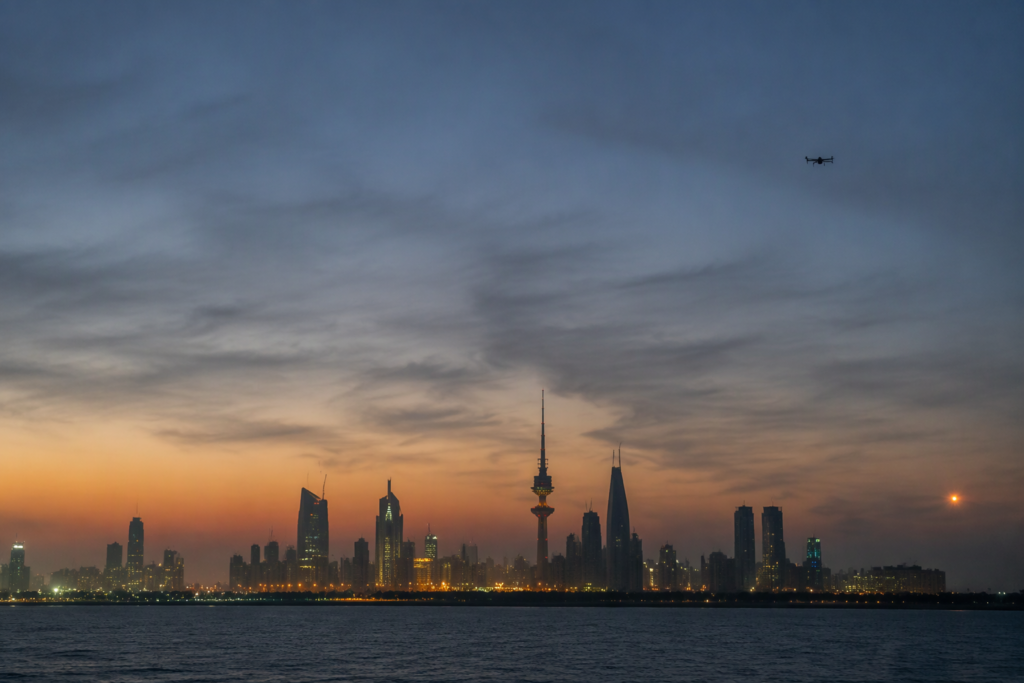
Kuwait’s military activated air defence batteries across the country on Tuesday night to counter hostile drones, as a widening confrontation between Iran and the United States spilled across Gulf borders. Explosions echoed above residential areas while the armed forces urged residents indoors, making the Kuwait drone attacks the latest flashpoint in an expanding regional conflict.
The military confirmed in an official statement on X that any blasts heard across the emirate came from interceptor batteries engaging incoming targets. Kuwaiti officials did not state where the drones were launched from, and authorities did not immediately disclose casualty numbers or physical damage on the ground.
Also read: Iran Assassination Plot Foiled in Europe as Trump Issues Warning
What happens across the Gulf now touches the world’s most congested oil choke point and directly endangers US installations across multiple host nations. With commercial tankers burning at sea and three global powers preparing to meet in Asia, the cross-border strikes threaten to turn localised skirmishes into an unmanageable confrontation.
US strikes hit Qeshm island missile facility
Hours before the explosions over Kuwait, American forces launched air raids against targets on Iran’s southern island of Qeshm, located in the Strait of Hormuz. A US official stated the bombardment zeroed in on an active Iranian missile launch facility on the island.
Iranian authorities acknowledged the strikes while downplaying their effect on civilian centres. Ahmad Nafisi, deputy governor of Iran’s Hormozgan province, confirmed that the American bombardment produced multiple loud detonations across the area.
“The American attack on locations on Qeshm island caused no damage to residential, commercial, or infrastructural areas,” Ahmad Nafisi, deputy governor of Iran’s southern Hormozgan province, told the official IRNA news agency on Tuesday.
State media reported five to six explosions shook Qeshm on Tuesday evening, leaving emergency and relief workers placed on high alert. US planners ordered the island strike in direct retaliation for an Iranian attack on American positions across the water earlier that day.
Drones target US radar at Bahrain air base
The exchange started when Iran launched unmanned aircraft across the Gulf toward Bahrain, home to the US Navy’s Fifth Fleet. Iran’s Islamic Revolutionary Guard Corps said its forces executed a precision strike against a US-operated radar installation at the Sheikh Isa air base.
Tehran defended the barrage as a countermeasure against what it described as persistent violations of Iranian airspace by American military reconnaissance drones. Blasts reverberated across Bahrain’s capital, Manama, as local interceptors engaged the incoming targets in mid-air.
US Central Command confirmed the Bahrain air base incident, reporting that defensive units shot down all incoming Iranian drones before they could inflict damage on American equipment or injure military personnel. Even so, the strike marked the third time in five days that Iranian systems targeted Bahrain, ending weeks of relative calm.
Regional tensions had escalated sharply after a Bahraini court handed down life sentences to 64 defendants, mostly Shia clerics, accused of working with Tehran. The resulting strike on Friday became Iran’s first direct hit against a Gulf neighbour since September.
Mine strikes and tanker fires in the Strait of Hormuz
While the Kuwait drone attacks rattled Gulf capitals, the commercial waterway connecting them descended further into turmoil. Iran’s military announced that three commercial oil tankers struck naval mines on Tuesday while attempting to navigate the narrow Strait of Hormuz.
The US military disputed the severity of the hazard, stating that naval vessels had cleared main shipping corridors of naval mines. Since the conflict began on February 28, Iranian authorities have insisted all maritime transit stick strictly to Tehran-approved channels, while Washington has enforced a naval blockade of Iranian ports and provided armed escorts for merchant ships.
Commercial shipping off Oman suffered heavy damage earlier in the week:
- The Panamanian-flagged tanker Tara Gas suffered an engine-room fire Monday when struck seven nautical miles north of Khasab, Oman.
- A second hit on the Tara Gas forced the 25-man crew to abandon ship, leaving one Indian mariner missing.
- Another Panamanian-flagged vessel, the On Phoenix, took a direct strike from an unidentified projectile off Oman’s coast.
Diplomacy in Muscat ahead of Beijing summit
With tankers burning and Kuwait drone attacks signalling an expanding geographic footprint, regional diplomats are scrambling to prevent total closure of the trade artery. Iranian Foreign Minister Abbas Araghchi travelled to Muscat on Tuesday to meet Omani Foreign Minister Badr Albusaidi, holding talks focused on maritime security and possible diplomatic off-ramps.
Military hardware continues to flood the theatre regardless of talks. A third American aircraft carrier, the USS Theodore Roosevelt, entered Middle Eastern waters on Monday, significantly expanding Washington’s offensive strike capacity across the Gulf.
All attention turns to Beijing on Thursday, when US President Donald Trump meets Chinese President Xi Jinping and Russian President Vladimir Putin for high-stakes three-way talks focused directly on the Iran war.
Source: Al Jazeera


