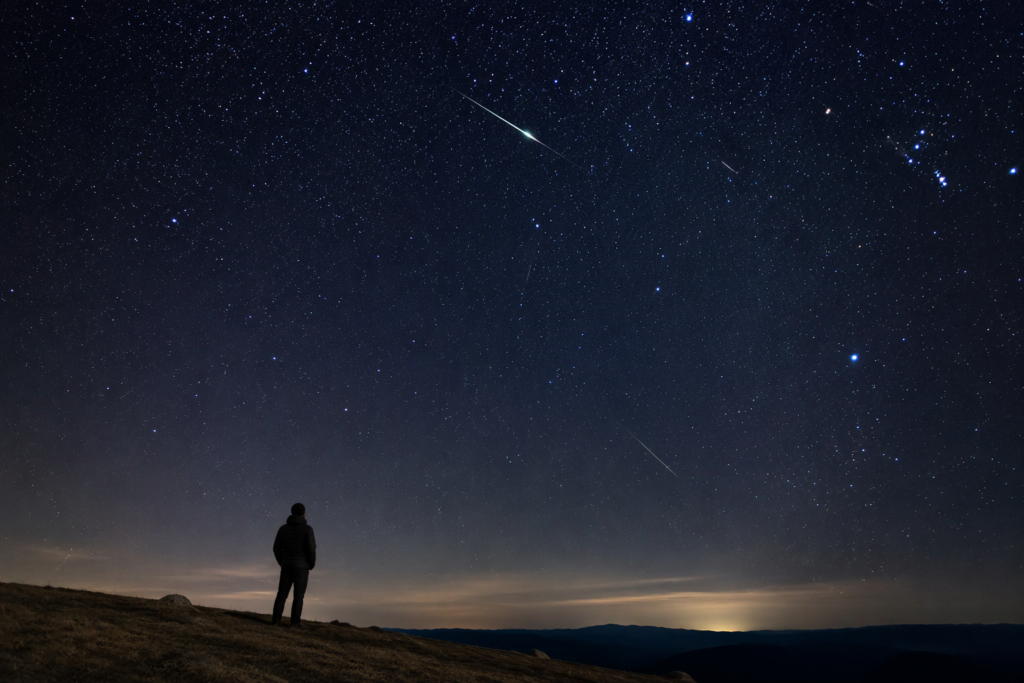
Tiny fragments of ancient cosmic dust are colliding with Earth at 44 miles per second this week, producing the Leonid meteor shower 2026. Moving at roughly 71 kilometers per second, these particles rank among the fastest meteors in the night sky, often leaving glowing ionisation trails that linger overhead for several seconds after the initial flash disappears.
For skywatchers across both hemispheres, the display offers a clean window for observation. The shower peaks on the night between November 17 and November 18, and a half-full moon will drop beneath the horizon right as the prime viewing hours begin.
Also read: Jesse Watters Questions Slew of Technology Outages
While this year will not match the furious rates of August’s Perseids, catching even a handful of these fast-moving fireballs provides a direct view of debris left behind by deep-space orbits.
When the Leonid meteor shower 2026 reaches its peak
The International Meteor Organization tracks the Leonids across their full window of activity from November 6 through November 30. The peak timing arrives around 23:45 GMT on Tuesday night, spanning the dark hours between November 17 and 18.
Under clear, rural skies, observers can anticipate seeing up to 15 meteors an hour. That hourly rate sits well below the 100 meteors delivered by the Perseids or the 150 seen during December’s Geminids, but the Leonids make up for modest counts with sheer velocity and brightness.
The first-quarter moon sets near midnight in most regions. Once it dips out of sight, moonlight will no longer wash out fainter streaks, leaving dark conditions until the first light of dawn.
Where those high-speed fireballs come from
Every November, Earth sweeps through a river of cosmic grit shed by Comet Tempel-Tuttle. As this icy body swings near the sun, solar heat vaporises its frozen crust, releasing trails of dust and pebble-sized meteoroids into space.
When Earth barrels into this trail, friction against the upper atmosphere superheats the debris until it glows white-hot. The Leonids frequently generate fireballs, which occur when slightly larger chunks of rock incinerate with exceptional brightness.
They also produce Earth-grazers. These meteors enter the atmosphere at an extremely shallow angle, cutting long, slow-burning paths near the horizon instead of dropping straight down.
How to spot meteors from where you live
Perspective makes all shooting stars in this shower appear to radiate outward from the constellation Leo, which climbs above the eastern horizon around midnight. You do not need to stare directly at Leo to spot them, because streaks can flash across any section of the sky.
Viewing conditions remain strongest in the Northern Hemisphere, where the constellation climbs higher before daybreak. Observers living south of the equator can still watch the show, though their best chances arrive in the final hour or two before morning twilight.
You will get the most out of viewing meteor showers by keeping your setup simple:
- Get as far from city streetlights and commercial signs as possible.
- Give your eyes at least 20 minutes to adjust to complete darkness.
- Lie flat on an open blanket or reclining chair with a clear view of the open sky.
- Avoid looking at your phone, as white screen light instantly resets your night vision.
Why astronomers remember the historic storms
What gives the Leonids their reputation is not their quiet years, but their explosive storms. Comet Tempel-Tuttle returns to perihelion near the sun once every 33 years, dumping fresh, dense bands of debris along its orbital path.
A legendary storm in 1833 illuminated skies over North America with hundreds of thousands of meteors, convincing scientists that these streaks originated in outer space rather than local weather. A similar surge in 1966 treated observers to thousands of falling particles every minute for a wild 15-minute stretch.
The most recent intense storms hit in 1999, 2001, and 2002. Skywatchers tracking the 33-year cycle will look forward to 2031, when Comet Tempel-Tuttle makes its next close approach to the sun.
Source: Al Jazeera