
The midterm elections once again tested the accuracy of conventional polling and media narratives, but political commentator Stu Burguiere argued that prediction markets emerged as one of the most reliable tools for cutting through partisan spin. As campaigns flooded the airwaves with competing claims of momentum, market-based forecasting platforms offered an alternative assessment grounded in financial incentives rather than political rhetoric.
The Rise of Prediction Markets in Election Forecasting
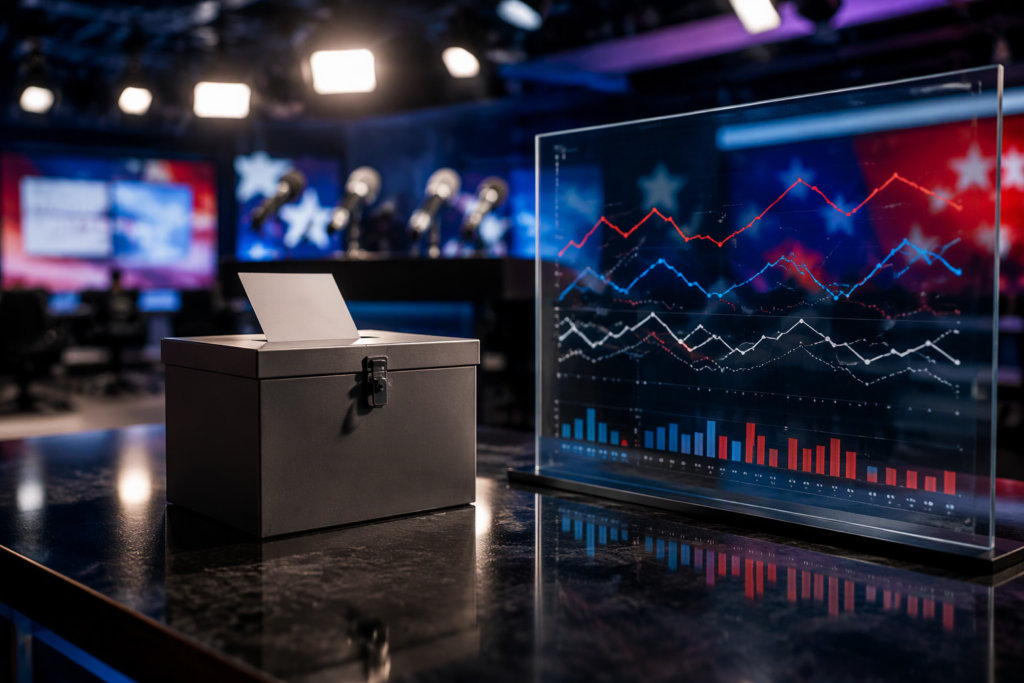
In modern election cycles, voters and analysts often face an overwhelming volume of conflicting data. Public opinion surveys, internal campaign polls, and pundit forecasts frequently provide mixed signals about competitive races. Amid this noise, prediction markets have gained significant attention by allowing participants to trade shares based on the probability of specific political outcomes.
Also read: How America Turned Away from Trump in Historic Democrats Midterms Victory
Unlike traditional opinion polling, which measures voter sentiment at a specific point in time, prediction markets adjust dynamically as new information emerges. When market participants put their money behind an outcome, their collective behavior reflects a synthesis of polling data, historical voting patterns, economic indicators, and real-time news developments.
Cutting Through Campaign Spin and Polling Noise
A central argument for the effectiveness of prediction markets is their ability to bypass ideological bias and campaign spin. During high-stakes elections, campaign operatives routinely project confidence, releasing selectively chosen internal polling to boost donor enthusiasm and volunteer morale. Meanwhile, media commentary often emphasizes dramatic narrative shifts to keep audiences engaged.
Prediction markets impose a direct cost on wishful thinking. Traders who allow political preference to dictate their bets face real financial losses, creating a powerful incentive to evaluate candidates and races objectively. As a result, the aggregated odds on these exchanges frequently offer a more sober view of tight races than partisan talking points suggest.
Why Financial Stakes Influence Forecasting Accuracy
Economists and data analysts have long studied the efficiency of decentralized information markets. When individuals risk their own capital, they tend to seek out high-quality information, discount unverified rumors, and react quickly to substantive developments on the ground.
During the midterms, this dynamic was evident across several key races. While pundits debated potential wave scenarios, market prices often reflected more nuanced probabilities, identifying genuinely competitive contests while resisting overreactions to outlier survey results.
The Future of Forecasting in American Politics
While prediction markets are not infallible and can experience volatility or low liquidity in smaller races, their performance in recent cycles has solidified their place in political analysis. Observers increasingly look at market odds alongside traditional polling averages to gauge the true state of a race.
As election forecasting continues to evolve, the demand for objective, data-driven analysis is growing. By requiring participants to back their predictions with real stakes, prediction markets have established themselves as an indispensable filter against the spin of modern campaign politics.
Source: Fox News