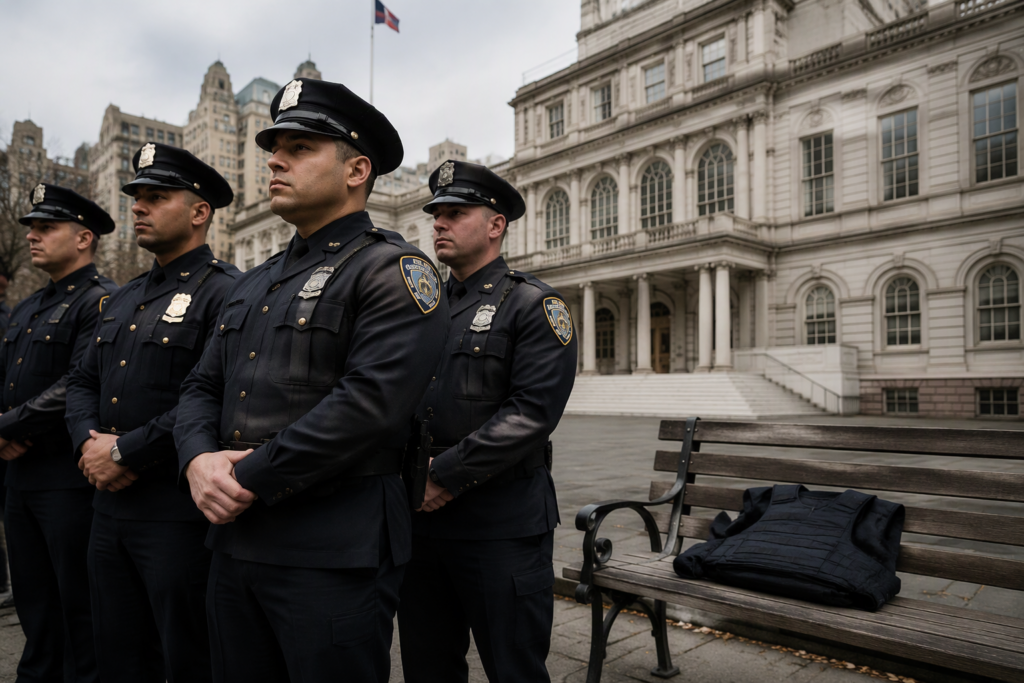
New York City police officers who handle massive street protests will no longer carry riot batons or deploy tactical squads under an order eliminating the department’s dedicated protest unit. Mayor Zohran Mamdani disbanded the NYPD’s Strategic Response Group on Monday, turning crowd negotiations over to civilian-led teams without arrest powers.
The move fundamentally alters how the country’s largest police department manages street unrest, campus occupations, and large marches. Instead of heavily equipped officers moving in to clear roadways or disperse disorderly crowds, the city will now dispatch unarmed teams tasked with talking demonstrators down.
Also read: Scott Colom Senate Win Flips Mississippi in Historic Upset
Police union leaders erupted over the policy shift, warning that cutting the Strategic Response Group leaves officers and residents exposed to mob violence. The dispute opens an intense struggle between City Hall and frontline officers over public safety and order on city streets.
Inside the plan to replace the Strategic Response Group
Under the restructuring plan presented Monday by Mayor Mamdani and Police Commissioner Jessica Tisch, the Strategic Response Group will cease operating in its current form. Its counterterrorism responsibilities will move into an existing NYPD command.
Protest oversight will shift to a newly formed entity called the Community Dialogue and De-escalation Division. This unit will operate directly out of the Mayor’s Office of Community Safety rather than standard police bureau channels.
Staff members in the new division will not carry weapons and will hold no arrest authority. Their mandate focuses solely on communicating with protest leaders to prevent volatile situations before clashes begin.
The division includes the First Amendment Support Team, an initiative known as FAST. The squad consists of 30 uniformed officers trained in conflict de-escalation and communication strategies.
City Hall also introduced the Patrol Support Division to handle protests that spin out of control. Stationed within the NYPD Patrol Services Bureau, these officers will handle regular precinct patrols but receive specialized crowd management instruction when demonstrations escalate.
Union leaders accuse City Hall of endangering public safety
Union officials representing rank-and-file officers condemned the disbandment within hours of the announcement. Patrick Hendry, president of the NYC Police Benevolent Association, said the mayor’s directive sacrifices officer safety to satisfy political activists.
“Mayor Mamdani is showing his true colors: He’s willing to put our safety and police officers’ safety at risk to appease his radical base.”
Hendry warned that ordinary residents will suffer whenever demonstrators shut down transit corridors or disrupt traffic. Drivers trapped behind blocked bridges and highways will have little support once specialized crowd units disappear, he said.
Hendry argued that the mayor made a deliberate choice between everyday commuters and disruptive demonstrators. In his statement, Hendry told New Yorkers that City Hall is siding with lawbreakers rather than working families trying to move across the city.
Warnings over detective shortages and campus unrest
Leadership from the city’s detective union expressed similar outrage over the organizational shakeup. Scott Munro, president of the Detective’s Endowment Association, warned that eliminating the Strategic Response Group will drain investigative resources away from serious felony cases.
Munro said regular detectives will have to fill crowd control duties whenever protests erupt across the city. Pulling investigators from active cases will delay justice for victims of violent crime, he added.
Munro highlighted the massive 2024 demonstrations at Columbia University, where protesters took over Hamilton Hall. Tactical officers from the specialized unit conducted the raid that cleared the facility and resulted in more than 100 arrests.
Without the Strategic Response Group, Munro argued that officers will lack the tactical capability to resolve building seizures safely. He also dismissed the city’s track record with civilian-led public safety initiatives, pointing to poor outcomes from earlier efforts to replace officers with civilian crisis teams.
Munro stressed that elected leaders must focus on running the city rather than catering to activist movements. He urged administration officials to recognize the daily realities officers face when maintaining order.
The political test facing Mamdani and Tisch
The swift dissolution of the squad creates an immediate test for Police Commissioner Jessica Tisch as she manages City Hall’s policy mandates. Mamdani campaigned openly against the tactical unit, framing it as an overly aggressive force during his mayoral run.
The mayor faces sustained pressure from democratic socialist allies who demand deep structural reductions in police power. While Mamdani has avoided calls to dismantle prisons or replace Tisch, dismantling the tactical unit fulfills a major progressive objective.
Officers and business owners now wait to see how the First Amendment Support Team and newly trained crowd management units handle their first major street disturbance.
The new civilian and patrol units face their first trial during upcoming city demonstrations, where officials will see whether unarmed negotiators can manage crowded streets without tactical backup.
Source: Fox News