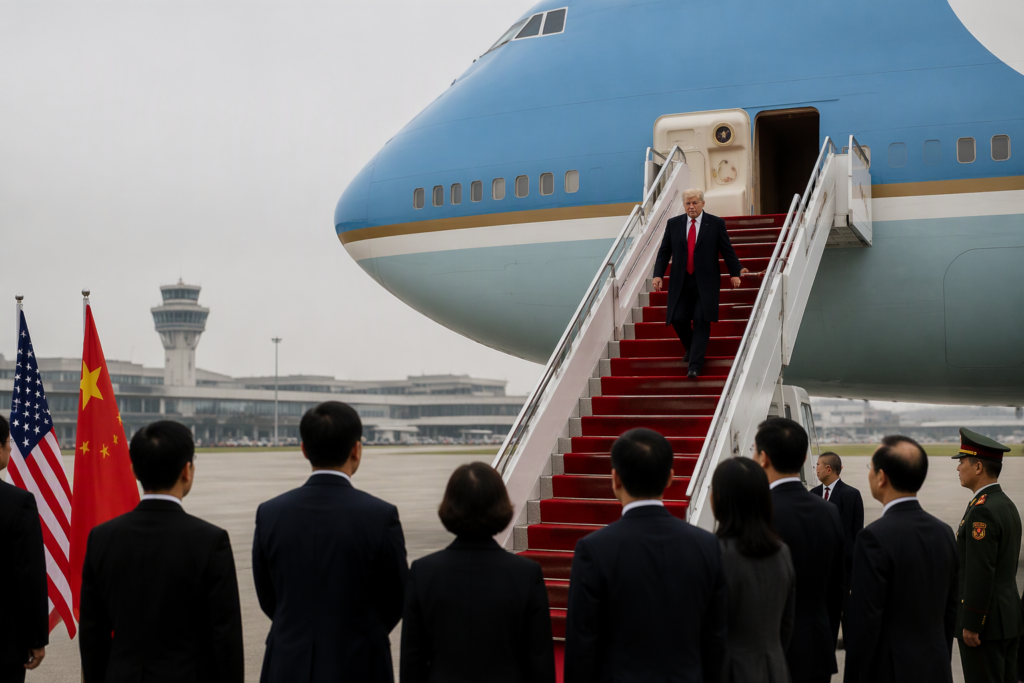
Chinese President Xi Jinping was waiting on the tarmac in Shenzhen before traveling reporters could even step off Air Force One, offering an unusual personal welcome to US President Donald Trump. Yet behind the red carpet greeting, the high-stakes Trump Xi meeting on the sidelines of the Asia-Pacific Economic Cooperation summit carries almost no expectations of a breakthrough.
The two leaders face a fraught agenda in southern China. They must keep a shaky ceasefire alive while their administrations clash over high-tech espionage allegations and supply chains. If the talks unravel, businesses on both sides could see punitive duties return within weeks.
Also read: Trump Putin Xi Summit in Shenzhen Puts Global Order on Edge
For global markets and manufacturers, the immediate question is whether this brief encounter can hold back another spiral in the economic fight. The two superpowers have maintained a tense detente since late last year, but deep disputes over semiconductors and raw materials continue to pull them apart.
What the runway greeting revealed
Xi rarely travels to an airport runway to welcome visiting foreign dignitaries in person. Doing so in Shenzhen signaled that Beijing wants to project control and stability despite intense pressure from Washington. Trump had landed in the tech hub for his third face-to-face sit-down with Xi since temporarily halting their renewed trade war.
Ryan Hass, director of the John L Thornton China Center at Brookings, explained why both sides wanted the optics of cooperation. Trump and Xi each benefit from projecting a sense of having things under control in the bilateral relationship, Hass said. He noted that their ability to steer ties will face tests in the coming year as opportunities for direct meetings dry up.
Opening the two-day APEC summit, Xi delivered a speech defending free and open trade and investment while rejecting unilateral moves. Beijing wants to prevent its ties with Washington from hardening into cold-war factions, but finding common ground on policy remains difficult.
The Nvidia scandal shadowing the Trump Xi meeting
The quiet diplomacy arrives during a political uproar over advanced artificial intelligence chips. Allegations surfaced recently that Chinese intelligence targeted Nvidia’s former chief executive Jensen Huang through an executive at Megaspeed, a Singapore-based data center operator.
US federal prosecutors opened a criminal investigation into Megaspeed, suspecting the company diverted advanced Nvidia graphics processing units into China to bypass US export restrictions. The controversy sparked heated debates across Washington over why the Commerce Department had failed to black-list the Singapore firm sooner.
Beijing dismissed the espionage allegations as groundless smears designed to damage China. Trump took a measured public stance before departing Washington, brushing aside calls to escalate the issue.
“We’re heading to China, and I don’t think you want to insult China just before you get there,” Trump told reporters on Monday.
Rana Mitter, S T Lee Chair in US-Asia relations at the Harvard Kennedy School, expects the two leaders to say little about Nvidia in public. Mitter noted that Trump does not plan to bring up the probe, and the US administration remains split on how to respond.
Tariffs, rare earths, and an uneasy truce
The core dispute between the world’s two largest economies remains unresolved. When Trump returned to the White House and launched aggressive economic salvos, tariffs jumped to 145 percent on Chinese imports and 125 percent on American goods.
Those punishing levies cooled off in October last year when the leaders struck a temporary pact in Busan, South Korea. A follow-up summit in Washington in September lowered tariffs on $60 billion worth of goods and created a communication link for AI security incidents, but fundamental grievances lingered.
Chief among Washington’s complaints is that China has choked off critical minerals. Chinese rare earth exports to the United States remain roughly 75 percent below typical volumes, according to estimates from the Center for Strategic and International Studies. Washington is also pressing Beijing on unmet commitments to purchase American agricultural shipments.
Deborah Elms, head of trade policy at the Hinrich Foundation, pointed out that incoming lawmakers will complicate negotiations. She noted that midterm election results and internal divisions over the Megaspeed chip scandal have left Washington’s negotiating stance unpredictable.
Two hours to keep the peace
Diplomats will have little time to untangle these disputes. Trump and Xi are scheduled to talk for roughly two hours on Thursday, squeezed between extensive summit protocols.
Trump is also slated to join a rare three-way session alongside Xi and Russian President Vladimir Putin during the APEC summit. With the schedule so crowded, seasoned observers believe the leaders will avoid deep negotiations.
Dennis Wilder, a former National Security Council official now at Georgetown University, said the limited window will restrict discussions to a handful of broad topics:
- Chinese pushback against US semiconductor export rules
- American frustration with suppressed rare earth exports
- Lagging Chinese purchases of US agricultural goods
- General security guardrails around artificial intelligence
Wang Wen, dean at Renmin University of China, emphasized that managing acute friction is the goal rather than signing ambitious pacts. As a reader following global commerce, you should not anticipate a sweeping accord from this trip.
Instead, the genuine test will come before January 10, 2027, when the current US-China trade war ceasefire officially expires.
Source: Al Jazeera


