
Why Germans Won’t Buy a Round of Beer: The Etiquette Behind Germany’s Pub Culture
For visitors from Britain, Ireland, Australia, or the United States, stepping into a German beer hall often comes with an unexpected social observation: nobody is offering to buy a round. Understanding why Germans won’t buy a round of beer requires looking beyond pub camaraderie into deep-seated cultural norms regarding personal autonomy, financial transparency, and social etiquette.
In many English-speaking countries, “shouting” or buying rounds is the cornerstone of an evening at the local tavern. Failing to take a turn at the bar can brand a patron as stingy or antisocial. However, Germany operates on an entirely different drinking ethos, one where individual pacing and meticulous accounting supersede communal purchasing.
Also read: The Unspoken Rules of Japanese Body Language: A Guide to Silent Etiquette
The Cultural Divide: Rounds vs. Individual Responsibility
In the Anglo-American pub model, one person typically approaches the bar, pays upfront for everyone in the group, and returns with a tray of identical or tailored pints. The expectation is reciprocal: each participant must buy a round before the night concludes.
In contrast, German social gatherings prioritize personal freedom. German drinkers view forced rounds as an unnecessary imposition that dictates both consumption speed and alcohol intake. If four people sit together and each buys a round, everyone must drink four beers. In Germany, forcing someone to match the group’s pace runs contrary to the concept of responsible, relaxed enjoyment.
How the ‘Bierdeckel’ and ‘Getrennt Zahlen’ Systems Work
The mechanics of German hospitality actively support individual consumption rather than group rounds. Most German beer gardens, Kneipen (corner pubs), and traditional Brauhäuser (brewery taverns) rely on table service rather than ordering at a bar counter.
In traditional venues—most notably in Cologne’s Kölsch taverns or traditional Bavarian halls—waiters track orders using a Bierdeckel, or cardboard coaster. Each time a server delivers a fresh glass, they mark a pencil tally on the coaster. The customer pays only at the end of the visit.
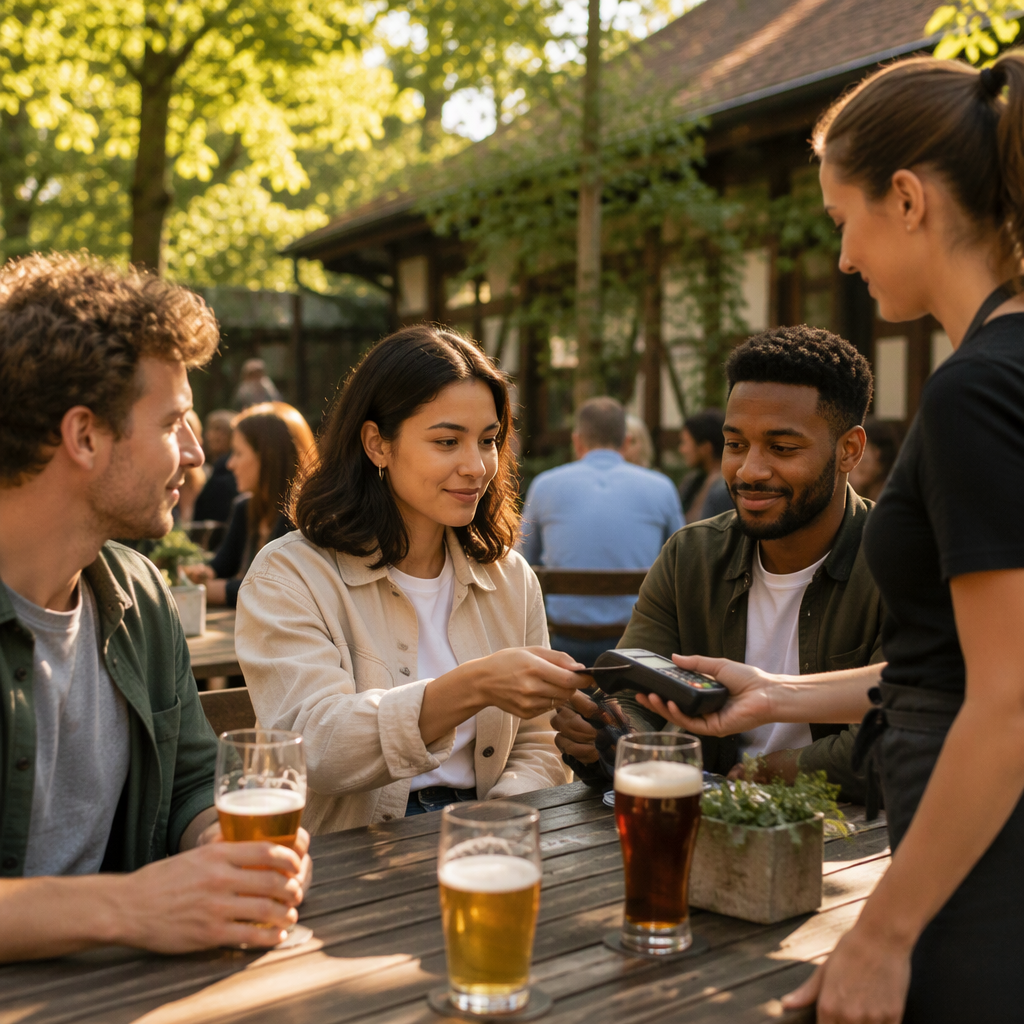
When the bill arrives, the standard phrase uttered across Germany is “getrennt zahlen” (to pay separately). Waitstaff routinely ask whether the table wants to pay together or apart. Without hesitation, servers calculate each person’s exact share, item by item, directly at the table. This practice is entirely frictionless and considered standard professional practice, not an inconvenience.
Why Germans Won’t Buy a Round of Beer: Avoiding Unspoken Social Debt
Another fundamental reason why Germans won’t buy a round of beer is the cultural aversion to creating unspoken social obligations. In German social psychology, an unrequested favor or financial gesture can generate an awkward imbalance known as a Verpflichtung (obligation).
Buying someone a drink without prior agreement implies that the recipient must reciprocate. If the recipient does not want another drink, prefers a non-alcoholic beverage, or plans to leave early, an unexpected round creates pressure. By paying strictly for one’s own drinks, everyone remains on equal footing, free to arrive and depart whenever they choose without lingering financial or social debt.
When Buying a Round Is Actually Appropriate in Germany
While spontaneous round-buying is rare, Germans do occasionally pay for group drinks, though under specific conventions. The phrase used in these situations is “Ich gebe eine Runde aus” (“I’m giving out a round”).
This gesture typically occurs under clear social circumstances:
- Celebratory Occasions: A patron celebrating a birthday, a job promotion, or a major life milestone will often announce they are buying a round for the table.
- The Stammtisch: In regular pub clubs or close-knit local groups (Stammtisch), established members may take turns buying celebratory shots (Schnaps) rather than full pints.
- Clear Intent: When someone offers to buy a round, it is understood as a gift without the expectation of an immediate tit-for-tat return that same evening.
What Visitors Should Do at a German Tavern
Travelers visiting Germany do not need to worry about being seen as cheap if they only pay for their own drinks. In fact, attempting to enforce an Anglo-style round system often causes confusion among local servers and companions alike.
The best approach is straightforward: order what you intend to drink, keep track of your own consumption, and state “zusammen” (together) or “getrennt” (separate) clearly when the bill arrives. Tipping typically involves rounding up the total to the nearest euro or adding roughly 5 to 10 percent directly to the server.
Conclusion
The reality of why Germans won’t buy a round of beer is not a sign of unfriendliness or thriftiness. Rather, it reflects a society that values individual choice, financial clarity, and comfortable socializing without peer pressure. By embracing separate checks and individual pacing, German tavern culture ensures that an evening out remains relaxed, transparent, and entirely on each patron’s own terms.