
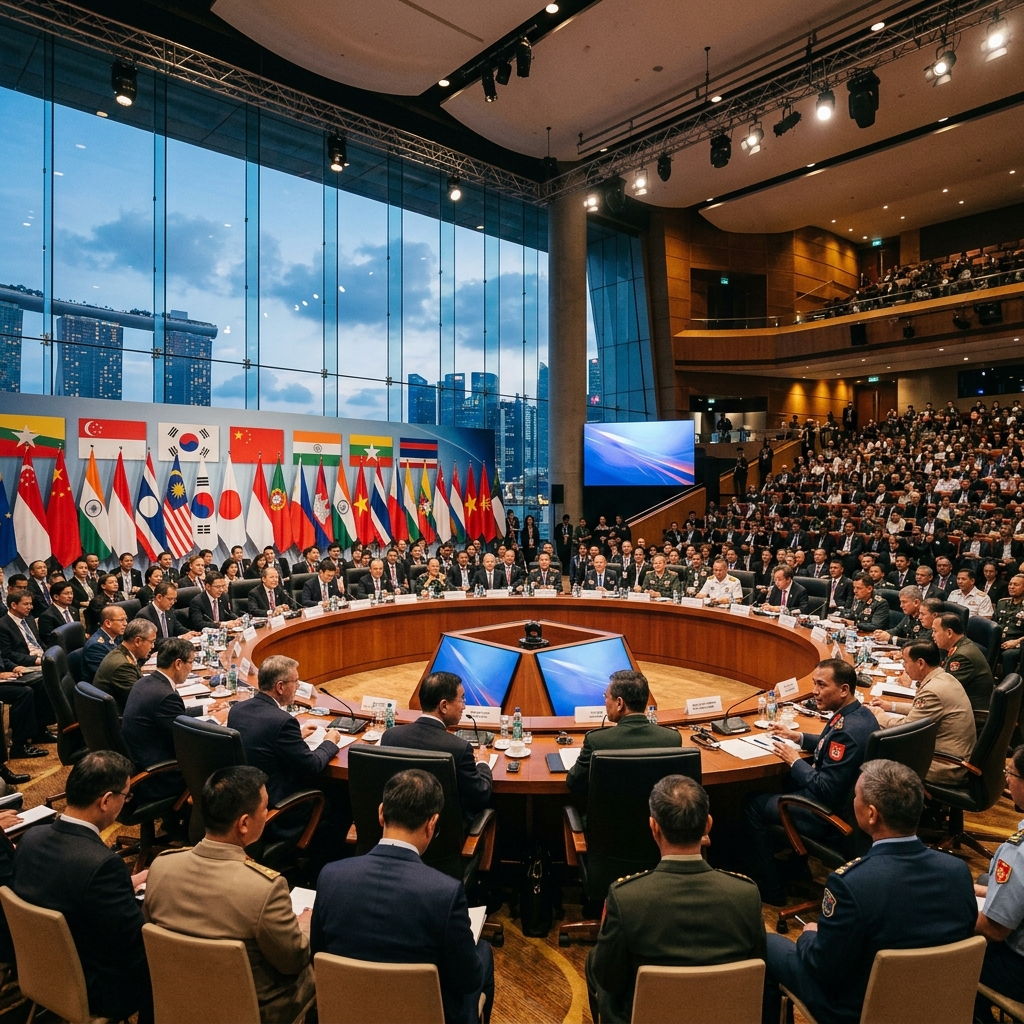
At one of Asia’s most prestigious defence forums, Japan’s top military official delivered his sharpest rebuke yet of Beijing’s growing criticism — and the world was listening.
Introduction
Tensions between Japan and China took centre stage at this year’s Shangri-La Dialogue — Asia’s premier international security summit held annually in Singapore — as Japan’s Defence Minister Shinjiro Koizumi delivered a bold and direct rebuttal to Beijing’s repeated accusations that Tokyo is embracing a dangerous new wave of militarism.
Rather than going on the defensive, Koizumi turned the spotlight squarely onto China, questioning how Japan — a country with no nuclear weapons or strategic bombers — could be labelled militaristic while China continues to rapidly expand its own vast military arsenal.
What Happened at the Shangri-La Dialogue?
Speaking on the final day of the high-profile security summit, Minister Koizumi addressed a room filled with senior defence officials from across Asia — many representing nations that experienced Japanese occupation during World War Two. His tone was firm, his message clear: Japan is not the aggressor Beijing portrays it to be.
Koizumi argued that every sovereign nation has the natural right to update and strengthen its defences in response to evolving threats. He pledged that Japan would pursue its defence ambitions with full transparency, open dialogue, and clear communication with the international community about the purpose and scope of its military developments.
He also directly pointed to China’s military expansion — which he described as occurring across a wide range of areas without adequate transparency — as a matter of far greater concern to Japan and the broader international community.
China’s Accusations and Japan’s Response
The diplomatic friction had been building for days before Koizumi’s speech. Just ahead of the Singapore summit, China’s national defence ministry had issued a stark warning, comparing Japan’s rearmament to a “grey rhino” gaining dangerous momentum and calling on the international community to collectively contain what it termed Japan’s “neo-militarism.”
Koizumi did not shy away from the confrontation. He challenged the very logic of Beijing’s position, pointing out the stark difference in military capabilities between the two nations. China, he noted, possesses a massive stockpile of nuclear weapons and strategic bombers — Japan has neither. For Tokyo to be labelled the militaristic party in this equation, he suggested, simply does not add up.
When a representative of the Chinese military raised the question of whether Japan would formally apologise to the victims of its wartime invasions in China, South Korea, and Southeast Asia, Koizumi redirected the conversation — while keeping the door open for dialogue between the two nations.
Japan’s Rapidly Growing Defence Budget
At the heart of the dispute is Japan’s dramatic and sustained increase in military spending. The country has now set new defence spending records for 12 consecutive years, with its most recently approved budget exceeding 9 trillion yen — equivalent to approximately $57 billion or £42 billion.
This trajectory is part of Japan’s broader goal of reaching defence expenditure equivalent to 2% of its GDP, a benchmark long associated with NATO member commitments and a significant shift for a country that has historically kept military spending deliberately low.
Under Prime Minister Sanae Takaichi, who assumed office in October 2025, Japan has accelerated its defence transformation considerably. Plans include investment in new surface-to-ship missiles, unmanned aerial drones, and underwater drone systems. Japan has also recently eased long-standing restrictions on the export of lethal weapons to allied nations — a move designed to strengthen its domestic defence industrial base.
Article 9 and the Battle Over Japan’s Pacifist Identity
Perhaps no issue is more symbolically charged in this debate than the future of Article 9 — the clause embedded in Japan’s post-war constitution that formally renounces war as a sovereign right of the state.
Prime Minister Takaichi has signalled her intention to revise this foundational pacifist provision, a move that has sparked intense national debate and significant public opposition. Anti-war protests have erupted in cities across Japan in recent months, with some demonstrations reaching a scale not seen in decades — reflecting deep public anxiety about the country’s shifting strategic identity.
Supporters of expanded defence argue it is a necessary response to a changing and increasingly threatening regional environment. Critics warn it risks dragging Japan into conflicts it has spent 75 years carefully avoiding, and abandoning a pacifist identity that many Japanese citizens hold as a point of national pride.
Rising Tensions Over Taiwan
The diplomatic relationship between Tokyo and Beijing has grown increasingly strained, particularly following comments made by Prime Minister Takaichi suggesting that Japan could deploy its self-defence forces in the event of a Chinese military action against Taiwan. Those remarks drew a sharp response from Beijing and pushed bilateral tensions to new heights late last year.
The Taiwan question remains one of the most volatile fault lines in East Asian geopolitics, and Japan’s willingness to take a firmer public stance on the issue represents a notable evolution in its foreign policy posture.
What This Means for Asia’s Security Landscape
Japan’s transformation from a constitutionally pacifist nation into an increasingly active regional security player is one of the most consequential shifts in Asian geopolitics in decades. The Shangri-La Dialogue made it abundantly clear that this shift is no longer happening quietly behind closed doors — it is now a defining flashpoint in the broader contest for influence, stability, and security across the Indo-Pacific.
Whether Japan’s growing military confidence leads to a more stable region or heightens the risk of miscalculation between two of Asia’s most powerful nations remains the central question policymakers across the continent are grappling with.
Conclusion
Japan’s defence chief used the world stage of the Shangri-La Dialogue to deliver a message that was equal parts reassurance and challenge. While Tokyo insists its ambitions are purely defensive and transparently pursued, Beijing’s concerns — and the concerns of many ordinary Japanese citizens — are unlikely to fade any time soon. As both nations continue on their current trajectories, the diplomatic tightrope between deterrence and escalation has never looked more precarious.
Tags: Japan Defence 2026, Shinjiro Koizumi, China Military, Shangri-La Dialogue, Japan China Tensions, Article 9, Japan Rearmament, Asia Security, Sanae Takaichi, Indo-Pacific