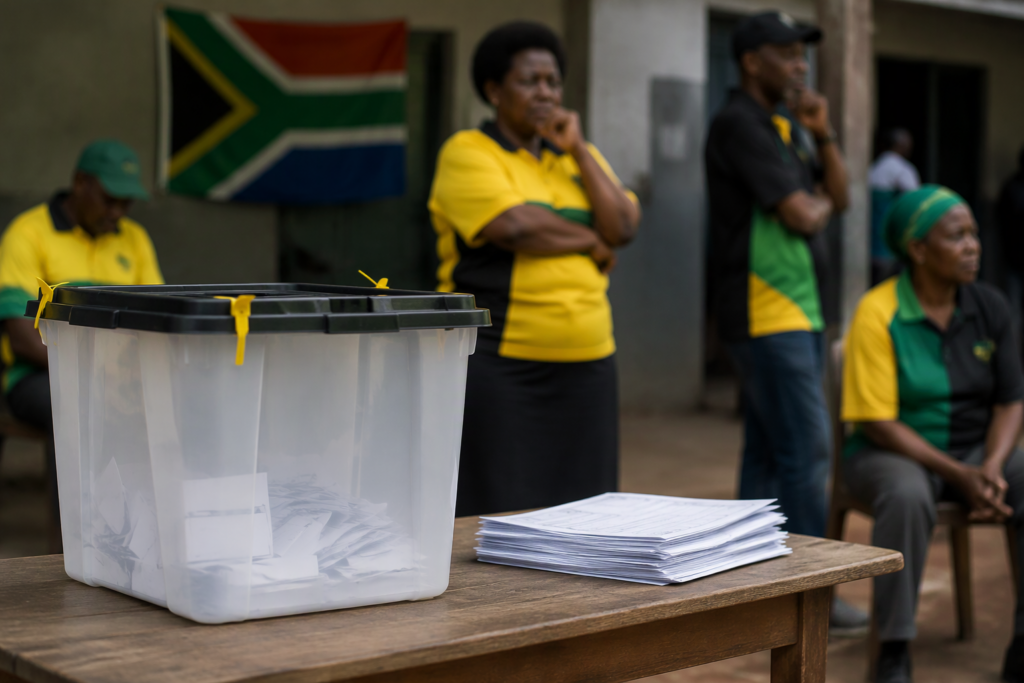

South Africa’s ANC appears headed for historic declines in local government elections as public discontent and political fragmentation continue to weaken the governing party’s traditional stronghold on the electorate.
Recent polling and electoral projections suggest that the African National Congress faces unprecedented setbacks across several key municipalities. The trend reflects a steady decline in voter confidence that has accelerated across consecutive electoral cycles.
Also read: Five Arrested After South African Farmer Attack Leaves Victim Shot and Tortured
Growing Dissatisfaction Reshapes Local Contests
Voter sentiment in urban and rural municipalities increasingly points away from the governing party. Citizens have consistently voiced frustration over inadequate basic services, prolonged power interruptions, water shortages, and deteriorating municipal infrastructure.
Persistent economic pressure, marked by elevated unemployment rates and sluggish growth, has amplified voter disillusionment. In many regions, local councils face intense scrutiny over financial mismanagement and administrative dysfunction, compounding the ruling party’s electoral difficulties.
Challenges Facing South Africa’s ANC at the Municipal Level
For South Africa’s ANC, local elections have historically served as early barometers of broader national standing. In previous municipal rounds, the party saw its overall share of the vote slip below crucial majorities in prominent metropolitan centers, forcing complex and often fragile coalition arrangements.
Opposition organizations and independent candidates are capitalizing on these structural vulnerabilities. Political rivals across ideological spectrums are mobilizing disaffected communities, offering alternatives to single-party dominance and further dividing the traditional voting base.
The Rise of Coalition Politics
A further decline in local polls will likely accelerate the era of coalition governance in South Africa. When no single party secures an outright majority, municipalities must navigate delicate power-sharing agreements to form functioning councils.
These arrangements have frequently proved unstable in major cities, leading to frequent leadership changes and policy gridlock. Continued erosion of the governing party’s vote share guarantees that multi-party negotiations will become the norm rather than the exception.
Outlook for South Africa’s Political Landscape
The projected slide in municipal support poses a critical challenge for party leadership seeking to revitalize its grassroots apparatus. Internal organizational divisions and candidate selection disputes have complicated outreach efforts in key battlegrounds.
As election tallies approach and final results materialize, the outcome will provide a clear measure of whether the party can stabilize its core support or whether South Africa’s municipal politics will enter a permanently fractured landscape.
Source: Al Jazeera