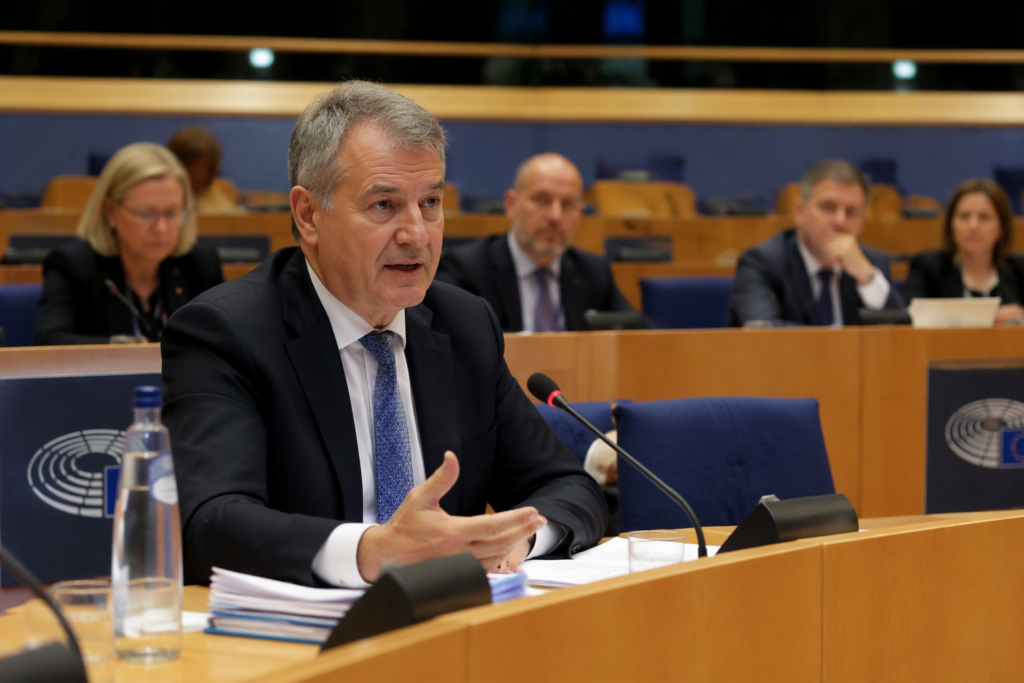

Negotiations over the next multi-annual EU budget face mounting pressure as European Commissioner Serafin cautioned lawmakers against sweeping spending cuts and diminished emergency safeguards. Addressing the European Parliament’s Budget Committee in Brussels, the Commissioner outlined the current state of discussions and warned that reduced funding could impair the bloc’s capacity to confront geopolitical and economic crises.
The European Commission aims to have the long-term financial framework operational by the start of 2028. While negotiations on sectoral files are advancing within both the Parliament and the Council, overarching budget discussions among member states remain contentious following two unsuccessful attempts to secure a consensus.
Also read: Joint List Backs Eisenkot to Form Israel’s Next Government
Council Compromise Risks Shrinking the EU Budget
A central concern raised by the Commission involves the overall ceiling proposed in the negotiating framework prepared by the Irish Presidency of the Council. Excluding debt repayments for NextGenerationEU, the framework sets the budget size at 1.02% of EU Gross National Income, or 1.12% if those repayments are included. Both figures fall below the 1.13% agreed for the 2020 financial package.
Commissioner Serafin noted that scaling back financial resources comes at a time when European nations require stronger coordination across critical areas, including security and defense, industrial competitiveness, energy policy, migration, and climate change. Rather than expanding funding to support common sovereignty projects, current negotiations have imposed some of the steepest cuts on these designated priorities, with several member states advocating for further reductions.
Inflation Protections and Crisis Flexibility Under Threat
The Commission also emphasized the necessity of shielding the EU budget from inflationary pressures. Under the current Multi-Annual Financial Framework, high inflation outpaced the fixed 2% annual deflator, stripping roughly €65 billion in commitments and payments from the budget and directly impacting agricultural producers facing rising operational costs. To prevent a recurrence, the Commission has urged member states to adopt a fixed-but-adjustable deflator as a basic safeguard.
Crisis response tools are another major point of contention. The current financial framework depleted all of its internal flexibility mechanisms by its mid-term point due to unforeseen global emergencies. Despite expectations of continued geopolitical and trade instability, the Irish Presidency’s negotiating text offers only about half the flexibility contained in the previous framework prior to its mid-term review.
Critiquing the reduced buffers, Commissioner Serafin observed that while the executive body planned for a sturdy defense against future shocks, “in the Council text we are left with a small umbrella with holes in it.” Such limitations could leave the Union without adequate resources during regional natural disasters or unexpected market disruptions.
Deadlocks Over New Own Resources and Administrative Funding
Discussions regarding revenue generation for the EU budget remain slow. Although five new own-resource proposals remain under consideration, strong opposition from various member states threatens to stall progress entirely. The Commission warned that if individual capitals continue to veto specific revenue options, the Union could end up without new own resources, driving the budget ceiling down even further.
Proposed reductions to the European public administration also drew sharp criticism. The revised negotiating box includes an almost 9% cut to administrative expenditure, despite institutions handling expanded mandates without proportional staff increases. Commissioner Serafin stressed that “without a well-functioning European public service that works for the interest of our Union all conclusions, statements and decisions adopted at the European level would remain only empty words.”
Tight Timeline for the 2028 Launch
To ensure funding reaches farmers and regional projects on January 1, 2028, key legislative frameworks must be finalized well in advance. Sectoral mechanisms, such as the National and Regional Partnership Plans, require formal approval before the close of 2027.
Meeting that deadline requires lawmakers to adopt the governing regulations during the first half of 2027. Commissioner Serafin urged the European Parliament to establish its negotiating stance quickly and initiate inter-institutional talks with the Council to prevent administrative bottlenecks that could disrupt financial support across member states.
Adapted from European Commission (CC BY 4.0)