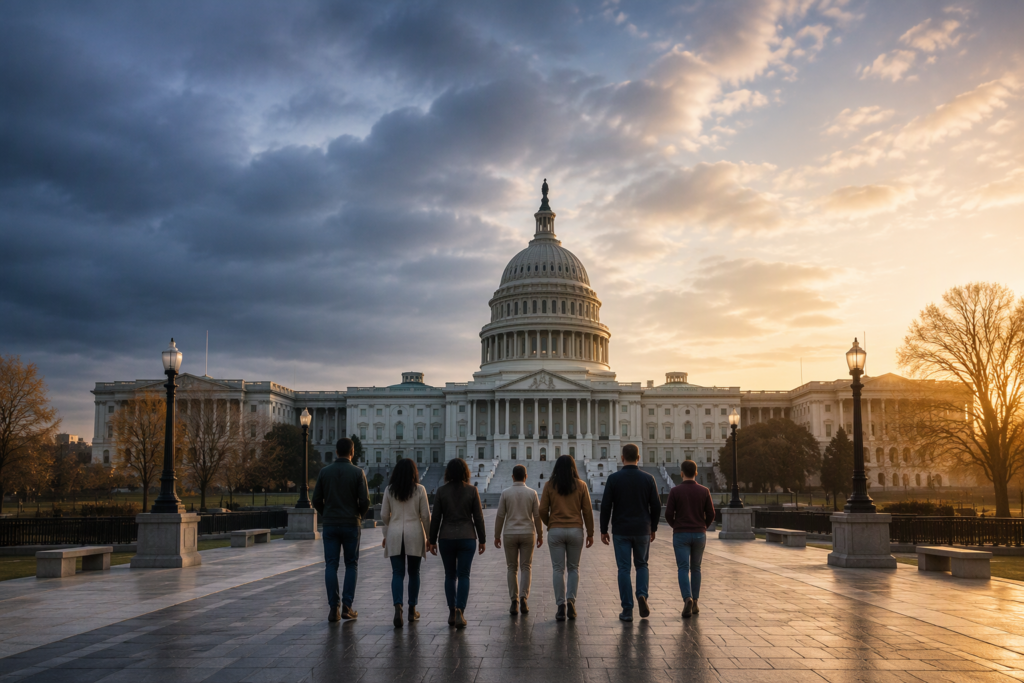

Political analysts and civic observers continue to debate whether the United States can ever realistically return to pre-Trump politics. Over the past decade, American political culture has undergone profound transformations, marked by intensified polarization, shifting party coalitions, and fundamentally altered norms of public discourse.
The Shift Away From Pre-Trump Politics
The era preceding Donald Trump’s entrance into national politics was far from devoid of conflict, yet it operated within widely accepted guardrails. Institutional customs, bipartisan negotiations on key legislation, and established diplomatic practices defined standard Washington operations.
Also read: How America Turned Away from Trump in Historic Democrats Midterms Victory
However, the rapid rise of populist rhetoric and direct-to-voter messaging fundamentally disrupted traditional party apparatuses. Candidates across the political spectrum increasingly bypass conventional gatekeepers, relying on social media and grassroots donor networks. This dynamic has diminished the influence of establishment party leadership and rewarded uncompromising stances over legislative compromise.
Enduring Changes Across the Political Spectrum
The transformation of modern political dynamics extends beyond any single individual. Both major political parties have recalibrated their strategies, messaging, and demographic appeals to match an evolving electorate.
Realignment of Voter Coalitions
Working-class voters, suburban moderates, and rural communities have shifted allegiances in ways that challenge previous electoral assumptions. Trade policy, national sovereignty, and cultural debates have often taken precedence over traditional fiscal conservatism within the Republican platform. Concurrently, the Democratic Party faces internal pressures to address progressive priorities alongside mainstream governance.
The Role of Media and Polarization
Media fragmentation has further accelerated division. The decline of shared information ecosystems has entrenched partisan echo chambers. When opposing sides consume fundamentally different accounts of civic events, finding common ground on basic facts becomes an uphill battle.
Institutional Norms and the Path Forward
Restoring past political conventions faces substantial structural hurdles. Congressional procedures, judicial appointments, and electoral processes have all become central battlegrounds in the struggle for institutional authority. While some lawmakers advocate for a return to traditional decorum and cross-aisle cooperation, the electoral incentives to adopt adversarial tactics remain strong.
Ultimately, American political life rarely moves backward. Rather than reverting to previous decades, the political landscape is adapting to a permanent structural realignment. Whether this evolution fosters renewed democratic resilience or deeper division remains a defining question for the nation’s future.
Source: Al Jazeera