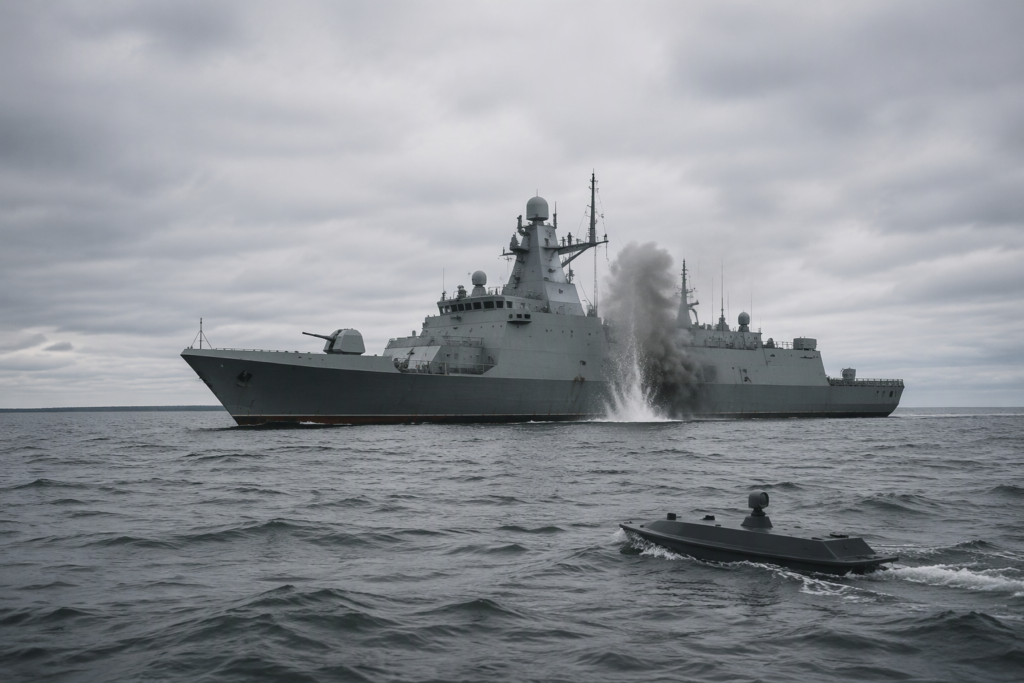

Smoke rose into the dawn sky as the Russian missile corvette Naro-Fominsk turned around and limped back toward St Petersburg on Wednesday morning. The confirmation that a Russian warship hit by long-range drones took place in the Gulf of Finland marks an unprecedented shift in Ukraine’s maritime campaign, thousands of kilometers from the battlefields of the south.
For more than two years, the Baltic Sea fleet remained untouched by direct combat. That quiet zone ended when Ukrainian drones reached deep into northern waters, targeting Russian military assets and energy infrastructure along an international maritime route.
Also read: Israeli Strike on Nasser Hospital Kills at Least Six, Officials Say
The strike matters because it brings active naval warfare into a narrow corridor shared by commercial shipping and Western allies. If you track the geography of this conflict, Ukraine has now proven it can threaten Russian naval operations far outside the Black Sea.
How the Russian warship was hit off the coast
Ukraine’s SBU security service confirmed it targeted the Naro-Fominsk during a coordinated drone assault on Wednesday. The vessel is a Buyan-M class small corvette, built to fire Kalibr and Oniks cruise missiles against land and sea targets.
Estonian Defence Minister Martin Herem stated that the vessel took a hit at approximately 05:30 local time (03:30 GMT). While Moscow rarely discloses damage or casualties from Ukrainian strikes, Estonian monitoring confirmed visible consequences.
“We know that smoke came from the ship afterwards. The ship itself went back towards St Petersburg.”
Unconfirmed reports also suggested combat helicopters may have suffered damage during the wider strike. The exact extent of the destruction aboard the corvette remains unclear, but the ship was forced to break off its mission and retreat eastward.
Flames light up the Ust-Luga oil depot
The naval hit was not an isolated operation. It formed part of a massive nighttime drone barrage aimed at Russia’s Ust-Luga oil depot on the Baltic coast.
Ust-Luga serves as a primary export terminal for Russian crude and fuel, funneling energy shipments out through northern channels. Several storage tanks caught fire overnight as waves of Ukrainian drones pressed into the port area between midnight and 06:00.
Residents across the border in Estonia could see thick black smoke and bright flames burning across the water. The sustained assault proves that Kyiv intends to strangle Russian fuel exports at the point of departure, disrupting revenue streams that fund the war effort.
Why Baltic allies are watching the waterway
The attack took place in an open stretch of the Baltic Sea frequented by civilian tankers, cargo vessels, and passenger ferries. Finnish and Estonian officials closely monitored the event as it unfolded near their territorial borders.
Finnish defence officials stressed to Kyiv that the Gulf of Finland is an unusually tight body of water. Aside from heavy commercial traffic, the seabed carries critical infrastructure, including high-speed subsea data cables and energy pipelines.
Finnish Foreign Minister Elina Valtonen moved quickly to calm public fears after the news broke. She stated that the regional maritime situation remains stable and safe, with no active threat to commercial traffic. Finnish authorities characterized the strike as an inevitable byproduct of Russia’s war of aggression.
Military analyst Emil Kastehelmi, co-founder of the Black Bird monitoring group, explained that Ukrainian forces spotted an operational opening and took it. While he described the strike as historic for the region, he said it does not represent an uncontrolled escalation of the conflict.
Drone flight paths and cross-border tension
The geography of the Baltic region creates complicated airspace questions during long-range drone raids. Moscow was quick to accuse Kyiv of launching attacks from inside Baltic states, an allegation Ukrainian officials firmly rejected.
Ukrainian foreign ministry spokesman Heorhiy Tykhyy called the Russian claims baseless. He explained that Russian electronic warfare units frequently scramble guidance signals, causing uncrewed aircraft to stray off course as they approach target zones.
Estonian tracking revealed that the vast majority of drones flew entirely within Russian airspace, hugging the border as they advanced north. Herem confirmed that one drone crossed briefly into Estonian airspace from Latvia before turning back into Russia.
Nato patrol jets stationed in the Baltic states were airborne during the raid to safeguard sovereign skies. Allied commanders decided against shooting the drones down, determining that firing over civilian zones presented unnecessary risks.
The strike on the Naro-Fominsk proves that the Russian Baltic fleet is no longer shielded by distance. Western maritime observers and regional militaries are now monitoring repair docks near St Petersburg to see how long the damaged corvette remains out of service.
Source: BBC