
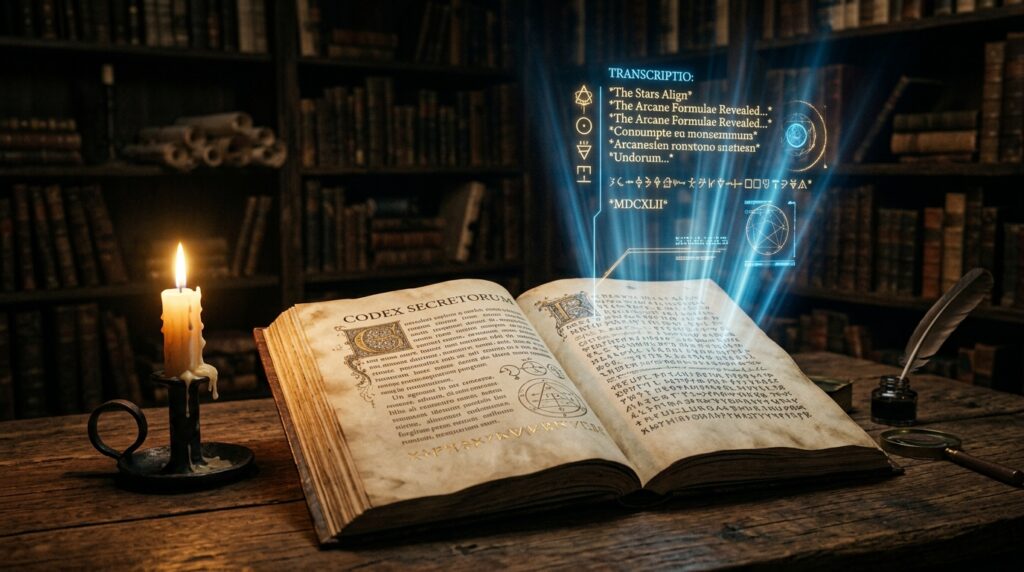
Buried in the world’s greatest archives are hundreds of thousands of coded documents — love letters, royal conspiracies, secret remedies, and spy dispatches. AI is finally breaking them open.
Introduction
For centuries, libraries and archives around the world have harboured a remarkable secret of their own: vast collections of handwritten documents that nobody can read. Not because they are damaged or faded — but because they were deliberately written in code.
From the shadowy vaults of the Vatican to the dusty shelves of Scandinavian universities, these encrypted manuscripts contain an extraordinary range of hidden knowledge — royal conspiracies, secret medical remedies, wartime intelligence, declarations of love, and the rituals of clandestine societies. Now, artificial intelligence is beginning to unlock them, and the revelations are rewriting history one symbol at a time.
The Scale of the Secret
The sheer volume of encrypted material sitting in the world’s archives is staggering. Experts estimate that as many as 1% of all documents held in libraries and archives globally are either fully or partially written in code. Given the billions of pages held in institutions worldwide, that represents an enormous treasure trove of hidden history.
Some of the earliest known ciphers trace their origins back to Ancient Greece and Rome, meaning that the human impulse to conceal information in writing is nearly as old as writing itself. The reasons for encryption varied: protecting sensitive medical knowledge from accusations of witchcraft, hiding diplomatic intelligence during wartime, concealing personal relationships, or preserving the rituals of exclusive secret societies from prying eyes.
The Vatican’s 400-Year-Old Mystery
One of the most compelling examples of AI-assisted code-breaking centres on a mysterious manuscript held deep within the Vatican Library — known as the Borg Cipher. The 408-page document, written in 34 obscure symbols mixed with scattered Roman letters and an Arabic front page, had sat completely unread for more than 400 years.
The book’s cover hinted at its contents — references to secret healing remedies “for affections of the human body.” Such medical knowledge was kept deliberately hidden at the time, as unconventional healing practices could invite accusations of witchcraft and serious danger for those who practised them.
Using machine learning, researchers were able to crack the cipher and reveal the manuscript’s extraordinary contents: thousands of unusual treatments and remedies, including instructions to drink multiple glasses of high-quality red wine or ferment nutmeg in dough as a cure for dysentery.
Professor Beáta Megyesi, a computational linguistics expert at Stockholm University in Sweden, who led the decoding effort, described the process as remarkably similar to detective work — where every symbol and pattern discovered brings researchers closer to unlocking a lost world.
Royal Secrets, Wartime Plots, and Love Letters
The encrypted documents being unearthed span an extraordinarily wide range of human experience:
👑 Mary Queen of Scots
Among the most significant recent breakthroughs was the decoding of a collection of letters written by Mary Queen of Scots during her long imprisonment in England. The decrypted texts revealed her active involvement in plots to reclaim her throne, as well as the deeply strained nature of her relationship with her son, the future King James I of England — details that had remained hidden for centuries.
⚔️ Emperor Charles V and the Assassination Plot
A painstaking six-month effort by Dr Cecile Pierrot, a cryptologist at the French National Institute for Computer Science Research (INRIA), cracked a 500-year-old coded letter written by Charles V — Holy Roman Emperor and King of Spain — using 120 different cipher symbols across just three pages. The decoded letter revealed one of the most powerful rulers of his era gripped by fear: he had received intelligence that an Italian mercenary warlord serving the French king, Francis I, was planning to assassinate him.
🪖 Intelligence from the 30 Years’ War
A secret letter written by nobleman Sigismund Heusner von Wandersleben to Swedish Lord High Chancellor Axel Oxenstierna in 1637 — at the height of one of Europe’s most devastating conflicts — was decoded using AI transcription tools. Behind the cipher lay urgent battlefield intelligence: warnings about a conspiracy among Sweden’s own Protestant allies, including Lord Franz Heinrich of Saxony, that had forced dangerous strategic retreats.
💌 Victorian Love Letters in Code
Researchers have also uncovered a collection of 400 mysterious postcards from the late 1800s, all written in cipher script. The few that have been decoded so far turn out to be love letters written in German — intimate messages whose authors took extraordinary lengths to keep their feelings private.
How AI Is Transforming the Code-Breaking Process
Breaking historical ciphers has traditionally been an extraordinarily slow and painstaking process. Before any decoding can begin, researchers must manually transcribe every handwritten symbol into a digital format — a task made even harder by fading ink, damaged pages, and the unfamiliar scripts of centuries past. Dr Pierrot notes that transcribing just two pages of an unfamiliar cipher typically takes her an entire working day.
🤖 AI Transcription Tools
One major breakthrough has come from tools like Transkribus, an AI-powered platform trained across multiple languages, scripts, and handwriting styles spanning several centuries. When a document is uploaded, the system automatically detects blocks of text and scans each line character by character, converting handwritten symbols into machine-readable digital text.
Professor Michelle Waldispühl of the University of Oslo used the platform to transcribe Von Wandersleben’s wartime letter, noting that while some manual corrections were needed, the tool performed impressively on the partly encrypted document.
🧠 The Descrypt Project
Existing transcription tools, however, still struggle with particularly unusual characters such as invented signs, astrological symbols, or strangely formed numbers. To address this, Megyesi, Waldispühl, and their international colleagues are developing a purpose-built AI system as part of the Descrypt Project — a multinational research initiative creating more adaptable AI models trained across a far broader range of scripts, alphabets, and symbolic systems than any existing tool.
⚡ Skipping Transcription Entirely
Perhaps the most exciting development is the prospect of bypassing the transcription stage altogether. Megyesi’s team has been testing a system that analyses photographs of manuscript pages directly, without any intermediate transcription step. When tested on the Copiale Cipher — a 105-page document detailing the rituals and rules of an 18th-Century German secret society — the AI was successfully trained to decipher portions of the text it had never encountered before, simply by learning from images of already-decoded sections.
The AI Chatbot That Reads Ancient Codes
The most ambitious development to emerge from this research is an AI chatbot-style tool that combines transcription, decryption, and translation into a single seamless step.
The system brings together several powerful components:
- Decryption algorithms trained on pairs of cipher characters and their decoded equivalents
- Large language models trained on historical texts from multiple time periods to provide contextual clues
- Image recognition algorithms trained on annotated historical handwriting
- Expert feedback loops that allow the AI to continuously improve based on corrections from specialists
When the team tested the chatbot on the Borg Cipher, the results were remarkable. The AI successfully translated and decoded a 500-symbol extract in just over 29 minutes — a task that would have taken human researchers days — and even provided a full English translation. Crucially, the system also documented its reasoning process, explaining why each solution was plausible, helping researchers verify that the AI was not fabricating interpretations.
The ultimate vision, says Megyesi, is to make this tool accessible not just to professional researchers, but to the general public — allowing anyone to submit a photograph of a coded historical document and receive a decoded translation.
What Could Still Be Unlocked?
The implications of this technology extend well beyond the documents already being studied. Researchers are now looking at some of history’s most enduring unsolved puzzles:
- The Phaistos Disc — a 4,000-year-old artefact from Crete covered in undeciphered symbols
- Linear B — an early form of Greek that remains only partially understood
- Countless other manuscripts in archives that have never been studied due to the sheer cost and time required for manual analysis
As Megyesi puts it, the goal is not simply to solve one historical puzzle — it is to build methods capable of assisting researchers across thousands of different cases simultaneously.
Why This Matters
The secrets hidden inside these encrypted manuscripts are not merely historical curiosities. They have the potential to fundamentally reshape our understanding of some of history’s most important figures and events. They can reveal the fears of emperors, the passions of lovers, the strategies of generals, and the knowledge of healers who were silenced by the threat of persecution.
For historians, this represents nothing less than the gradual recovery of a lost layer of human experience — one that was deliberately hidden and has remained out of reach for centuries.
Conclusion
Artificial intelligence is doing something genuinely extraordinary: it is giving us back history that was deliberately taken away. The coded manuscripts sitting in libraries and archives around the world are no longer impenetrable — they are, slowly but surely, beginning to speak. And what they have to say is reshaping everything we thought we knew about the past.
Tags: AI History, Medieval Ciphers, Historical Cryptography, Borg Cipher, Copiale Cipher, Mary Queen of Scots, Artificial Intelligence, Ancient Manuscripts, Descrypt Project, Vatican Library, Code Breaking, Digital Humanities