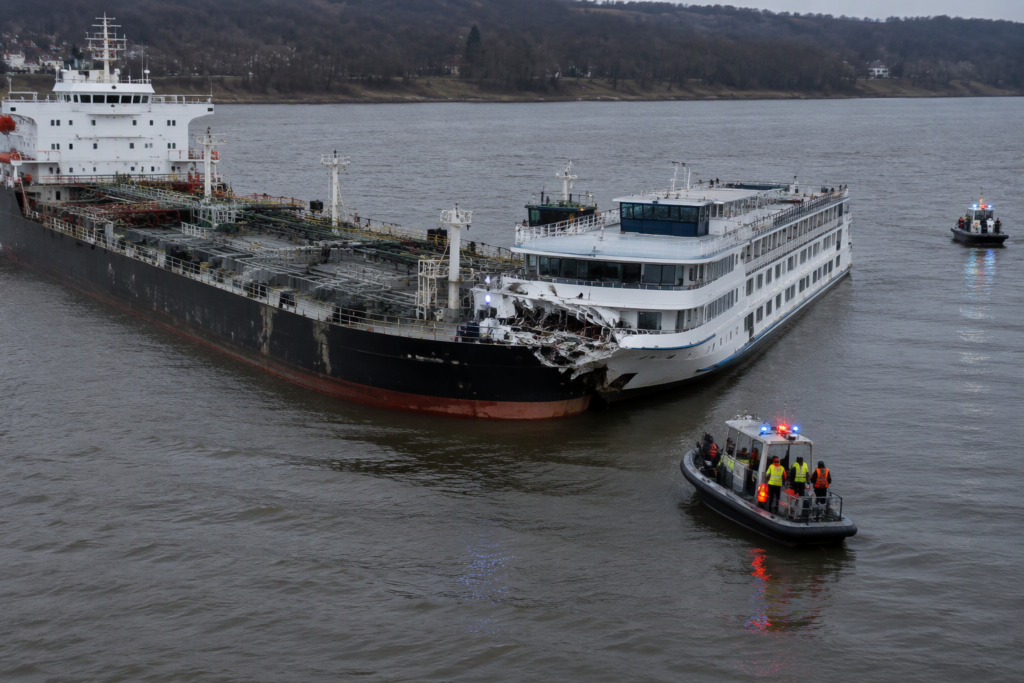

A routine afternoon disembarkation turned into chaos on the Mississippi River when an out-of-control industrial vessel rammed directly into a tourist paddleboat carrying 129 passengers. The incident occurred in New Orleans after a tanker strikes cruise boat American Heritage while it sat moored at the dock, forcing dozens of people into the water as the vessel overturned.
Emergency crews rushed to pull passengers from the river, and medical teams sent 32 people to area hospitals. Local officials confirmed that everyone on board has been accounted for, and none of the injured suffered critical harm.
Also read: Educator Warns Teachers Union Priorities Shift Toward Strikes Over Education
The impact halted maritime movement along one of the busiest commercial waterways in the country. With river traffic shut down, federal and local maritime authorities are working to determine how a massive cargo carrier lost control and crushed a passenger vessel broad daylight.
How the tanker strikes cruise boat at the dock
The collision took place at roughly 12:30 p.m. local time on Friday along the riverbank in New Orleans. The American Heritage paddleboat had arrived and tied up approximately two hours earlier to begin offloading its passengers.
Without warning, the Atlantic Asphalt tanker drifted off course and slammed into the moored riverboat. Video footage from the riverfront captured the bulk carrier crunching through the side of the smaller vessel, shattering glass and shearing through metal decks.
New Orleans Mayor Helena Moreno stated that the commercial ship lost steering or propulsion before drifting into the terminal. She confirmed that the tanker lost control and collided directly into the paddleboat while families were still walking off the gangway.
Fifteen minutes to capsize in the Mississippi
The impact destabilized the five-deck riverboat almost instantly. Water rushed into the damaged compartments, causing the paddleboat to lean sharply toward the river.
Mayor Moreno explained that passengers were actively disembarking when the craft began to sink, toppled over, and flipped completely. The sudden rollover threw passengers and remaining crew members into the river current.
Jamie Holford, a witness who watched the disaster unfold from shore, described the scene as surreal. Holford noted that barely 15 minutes passed between the initial impact and the moment the entire boat rolled over onto its side.
Water temperatures in the Mississippi River hovered around 19 degrees Celsius, or 66 degrees Fahrenheit, at the time of the wreck. More than a dozen people floating in life jackets were pulled onto nearby vessels, while others clung tightly to exterior railings until help arrived.
Evacuation, triage and hospital transports
First responders mounted an immediate rescue effort along the riverfront. Officers from the port police, local fire crews, paramedics, and the U.S. Coast Guard converged on the pier within minutes of the alarm.
Responders set up an emergency triage clinic inside the Port of New Orleans administration building to assess survivors pulled from the water. Paramedics treated dozens of passengers on scene for exposure, cuts, and shock before transporting 32 patients to regional medical centres.
American Cruise Lines, which owns and operates the American Heritage, confirmed that all guests and crew were evacuated from the wreckage. Company officials issued a statement expressing deep concern for everyone caught in the collision.
The American Heritage is a 150-passenger paddlewheel vessel built in 2015. It was completing an eight-day regional tour across historical river ports in Louisiana and Mississippi when the tanker strikes cruise boat at the finish of its itinerary.
Unanswered questions about the Atlantic Asphalt
The vessel responsible for the Mississippi River collision is the Atlantic Asphalt tanker, a 160-metre ship sailing under the flag of the Marshall Islands. Marine tracking data indicated that the vessel was bound for New Orleans when the incident occurred.
Maritime registries indicate the carrier is built specifically to transport high-temperature liquid cargo such as asphalt and bitumen. Authorities have not confirmed whether the vessel was carrying cargo at the time or travelling in ballast.
Officials closed the surrounding stretch of the river to all commercial traffic following the capsizing. Marine safety investigators will inspect both vessels, examine engine logs, and interview the pilot to determine why the tanker strikes cruise boat at the riverfront terminal.
Source: Al Jazeera