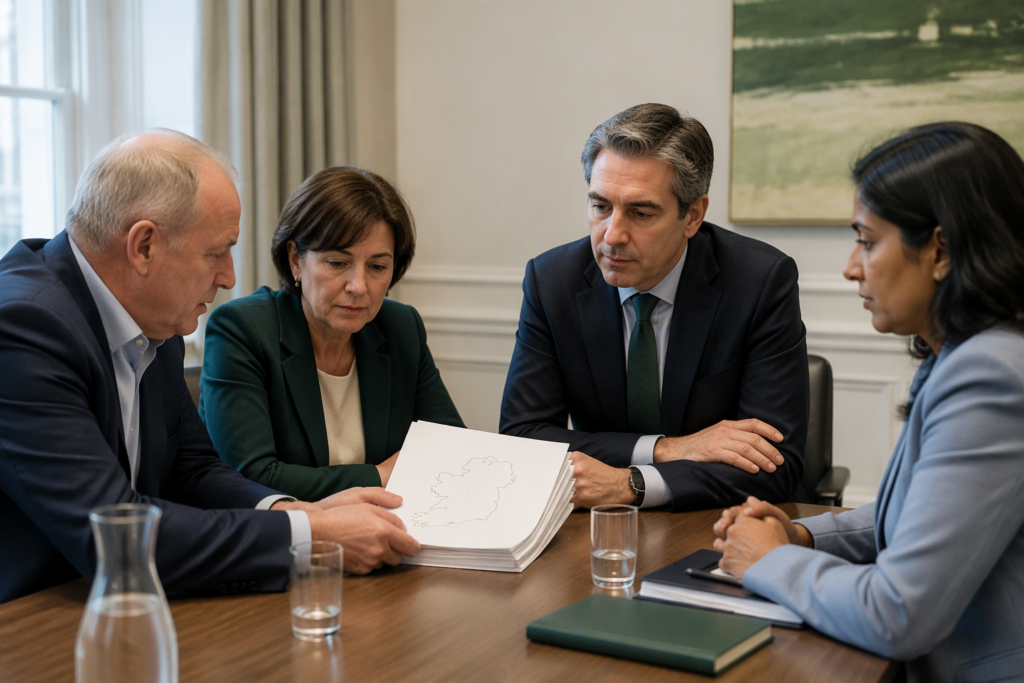

Reunifying Ireland could cost Dublin anywhere between €3 billion and €25 billion in its opening year alone, according to financial estimates tied to a new Irish unity blueprint released by Tánaiste Simon Harris.
The Irish deputy prime minister sent his party’s Irish unity blueprint directly to party leaders on both sides of the border this week. He asked politicians across the island to review the plan, identify common ground, and flag areas requiring deeper study.
Also read: Alaska Governor Election: Democrat Flips Mansion After Feud
The move puts constitutional planning directly onto the desks of unionist and nationalist party chiefs alike. Rather than leaving the debate to campaigning groups, the proposals demand formal political engagement on how an integrated Ireland would actually function.
Inside the Fine Gael proposals
Fine Gael published the blueprint as a working framework for practical preparation. The party argues that preparing public services for constitutional change requires dedicated political oversight.
Among the core proposals is the creation of a junior minister post within the Irish government specifically focused on north-south relations. The document also calls for establishing an official forum on Irish unity to examine how public systems would combine.
Alongside administrative reforms, the publication includes economic modeling on what constitutional change could mean for the Irish exchequer. An assessment by an economist advising Harris suggests first-year reunification costs could range from €3bn (£2.5bn) to €25bn (£20.8bn).
Harris reaches across the border to unionists and nationalists
Harris delivered the document to leaders across Northern Ireland, including unionists who oppose constitutional change entirely. Letters went to Democratic Unionist Party leader Gavin Robinson, Ulster Unionist Party leader Jon Burrows, and Traditional Unionist Voice leader Jim Allister.
Alliance leader Naomi Long and Social Democratic and Labour Party leader Claire Hanna also received the papers. In his correspondence, Harris stressed that the discussion cannot belong to one political faction.
“That is why I believe this must be an inclusive conversation, informed by evidence, respectful of different constitutional perspectives and grounded firmly in the Good Friday Agreement and the principle of consent,” he wrote.
He told northern leaders that while conversations will be difficult, complexity cannot serve as an excuse for inaction.
Rival documents stir Dublin politics
The push by Harris also lands amid political rivalry within Dublin’s coalition government. Just days before Fine Gael released its paper, the Taoiseach, who leads Fianna Fáil, circulated his own private memo on unity preparations to his parliamentary party.
Harris sent the Fine Gael plan directly to the Taoiseach, as well as to Sinn Féin leader Mary Lou McDonald. Other leaders in the Republic receiving the submission include Ivana Bacik of Labour, Peadar Tóibín of Aontú, Roderic O’Gorman of the Green Party, Cian O’Callaghan of the Social Democrats, Michael Collins of Independent Ireland, and Richard Boyd-Barrett of People Before Profit.
Harris told recipients he hopes parties will read the text in a constructive spirit and help identify shared policy priorities.
How the Irish unity blueprint builds on the Good Friday Agreement
Harris anchored the entire initiative in the principle of consent established under the 1998 Good Friday Agreement. He reiterated that no single party can dictate when or how constitutional change happens.
The Irish unity blueprint deliberately avoids setting arbitrary dates for a border poll. Instead, it seeks detailed policy answers on infrastructure, trade, civil administration, and public finances before any vote occurs.
Political leaders in Belfast and Dublin are expected to deliver their formal replies to Harris ahead of scheduled party meetings in the coming weeks.
Source: BBC