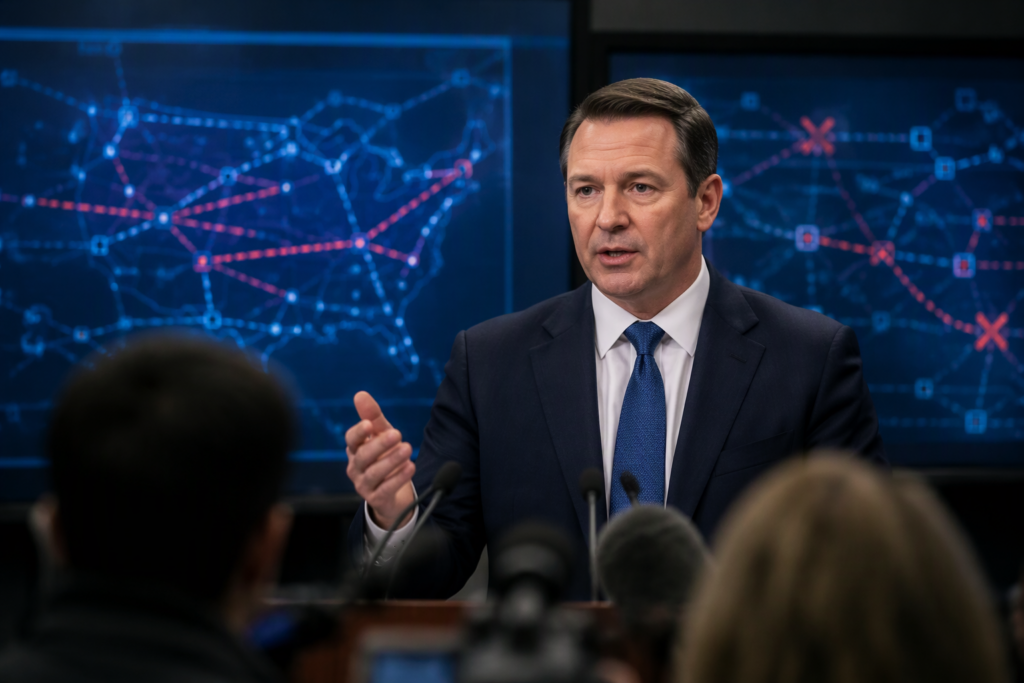
Homeland Security Secretary Markwayne Mullin told anxious Americans to take a breath on Monday night, insisting that the wave of cascading digital failures knocking out bank accounts, airline departures and email systems across the country is not the work of foreign hackers. Speaking on Fox News, Mullin said federal investigators are 98 percent certain that the recent US tech outages were caused by independent technical breakdowns rather than coordinated cyber warfare.
Instead, Mullin pointed to a mix of brittle computer networks and a briefing he received from an unnamed tech expert who blamed self-coding artificial intelligence for overrunning older software. The explanation comes after millions of people found themselves unable to board planes, access cash or send routine work messages over four chaotic days.
Also read: FAA Ground Stop Prompts Duffy to Seek $50B for Aging Tech
For everyday Americans, the disruptions brought sudden gridlock to core services that usually hum along invisibly. When airlines cannot clear flights and major lenders cannot display account balances, routine business grinds to an immediate halt.
A four-day wave of digital gridlock
The trouble began late last week when Microsoft suffered a widespread system problem that knocked out access to Outlook email accounts. Before businesses could fully recover, the Federal Aviation Administration issued a nationwide ground stop on Friday, halting air traffic across the country and triggering hundreds of flight delays and cancellations.
Transportation investigators traced part of that aviation halt to two faulty network routers, finding no evidence of outside tampering. Flights slowly resumed over the weekend, but travel networks barely had time to stabilize before Monday brought a new round of failures.
United Airlines suffered an internal system crash early Monday that briefly froze departing flights nationwide. Hours later, customers trying to log into digital accounts at JPMorgan Chase, Wells Fargo, Bank of America and U.S. Bank found error screens instead of their financial balances.
Why DHS says hackers are not to blame
Despite public alarm that a foreign adversary had launched a coordinated assault on American infrastructure, Mullin told host Sean Hannity that evidence points entirely away from a cyberattack.
“We’re not seeing the footprints going in. We’re not seeing the footprints going out,” Mullin said. “And so, nothing points to it being connected.”
JPMorgan Chase backed up that view in a statement, confirming that its account access problems were not tied to any cybersecurity incident. The bank noted that customers retained access to their funds and underlying accounts while engineers worked to restore the digital interfaces. Mullin categorized the breakdowns as individually unrelated events that happened to strike in close succession.
“Well, breathe. The homeland is secure. Our banking system is secure and when something like this happens, we’re able to react and react fast.”
The theory of self-writing code and older hardware
Rather than foreign sabotage, Mullin argued that the country’s computer backbone is simply cracking under modern strain. Legacy systems built decades ago are struggling to handle the sheer volume of data and modern tools now forced upon them.
“We just have a lot of technology thrown at us and our world runs on technology now,” Mullin said. “We used to have backup systems and the backup systems are overwhelmed by the new systems now.”
He then shared a theory presented to him earlier that day by an industry specialist regarding advanced software and automated code writing. The expert suggested that automated artificial intelligence programs, referred to as super intelligence, might be outpacing the structural limits of corporate infrastructure.
Mullin explained that when modern software attempts to patch its own bugs automatically, it risks destabilizing everything connected to it. He compared the chain reaction to an unpredictable residential construction project.
“When they put in a program that’s able to write codes, and it goes in and it self-fixes itself, as it starts self-fixing itself, it’s like doing a change order on a house,” Mullin said. “When you change one thing in a house, everything else starts changing. That’s a ripple effect. It causes these systems to be overrun that weren’t designed to run as fast as the SI technology is today.”
What the federal government plans to do next
The string of failures has placed fresh scrutiny on federal oversight of private networks that keep society moving. Because airlines, banks and cloud providers operate on proprietary platforms, federal authorities often rely on private corporate teams to diagnose their own internal glitches.
Mullin defended the Trump administration’s response to the disruptions, promising that homeland security agencies will coordinate closely with private firms to stabilize their servers. He insisted that federal resources remain ready to assist any company struggling to keep critical platforms operational.
Federal regulators and corporate engineering teams are now monitoring server stability as banks and airlines finish rolling out fixes for Monday’s system errors.
Source: Fox News