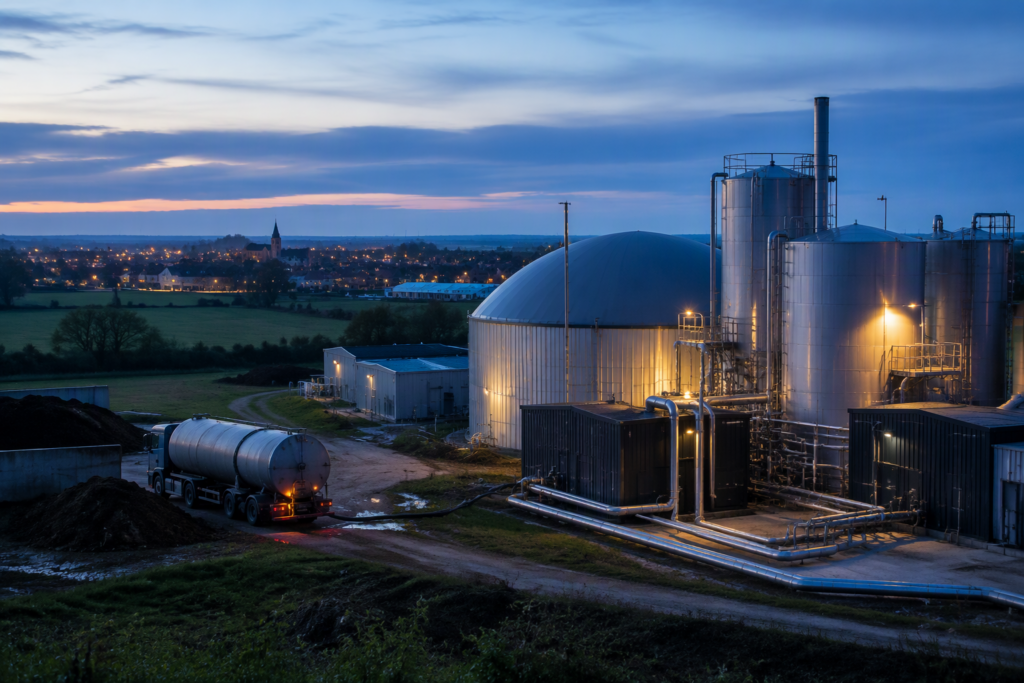
Denmark now has more than double the number of breeding pigs than human residents, and that livestock surplus is transforming the country’s energy grid. Rather than letting millions of tonnes of waste decompose into heat-trapping methane, the rapid expansion of Denmark biogas infrastructure has turned animal slurry into a primary fuel source for domestic heating, electricity and regional industry.
The shift carries direct stakes for European energy security and farm economics. With fossil gas supplies destabilized by conflicts in Ukraine and Iran, Denmark has pushed the share of biogas in its national gas network to about 40 percent, the highest proportion anywhere in Europe. By 2030, Danish farmers will also face the world’s first agricultural carbon tax of roughly 16 euros ($18) for every tonne of carbon dioxide emitted, creating urgent financial pressure to capture farm emissions before the penalties hit.
Also read: Leonid Meteor Shower 2026: Peak Times and How to Watch
What began a decade ago as a smattering of localized test plants has grown into an industrial network of around 150 processing sites. Up to 70 percent of their intake comes directly from pig and cattle waste, turning a long-standing environmental headache into a domestic power supply.
Turning 17 million tonnes of slurry into power
Pork production accounts for a quarter of Denmark’s total food exports. At any given moment, farms house roughly 12 million breeding pigs, while producing another 30 million animals annually for slaughter and live export.
That volume generates massive logistical problems. Figures from the Danish Agriculture and Food Council show the pig sector produces more than 17 million tonnes of manure each year, mostly liquid slurry. Left untreated in holding tanks and fields, that slurry releases large quantities of nitrous oxide and methane, a greenhouse gas far more potent than carbon dioxide.
Modern digestion facilities solve part of that problem by sealing the waste in oxygen-free tanks where bacteria break down the organic matter. The resulting biomethane is cleaned and injected into the pipeline network, while the leftover digestate is recycled back onto fields as low-odour fertiliser.
How Sonderborg reached complete gas independence
In the southern coastal town of Sonderborg, the model is already running at regional scale under ProjectZero, a local decarbonization drive set up in 2007. The initiative set a deadline to establish a carbon-neutral energy system across the municipality by the end of 2029.
By pairing biogas with industrial waste heat, wind power and solar arrays, Sonderborg has already cut its energy-related carbon emissions by 79 percent. Two large industrial facilities, Glansager and Kvaers, process roughly 850,000 tonnes of organic material annually, relying primarily on livestock slurry supplemented by crop residues and commercial food waste.
Together, those two plants produce enough renewable natural gas to supply the entire region’s annual gas demand. Allan Pilgaard-Jensen, the chief executive of ProjectZero, pointed out that the setup protects the community from international energy price shocks while cutting emissions.
“In a world marked by geopolitical uncertainty, energy has become an even more critical infrastructure,” ProjectZero CEO Allan Pilgaard-Jensen said.
The debate over Denmark biogas and factory farming
Despite its efficiency in the pipeline, the strategy faces sharp resistance from environmental groups. Critics argue that building an energy system dependent on pig waste incentivizes the agricultural sector to keep animal populations artificially high.
A joint report by Foodrise and NOAH Friends of the Earth Denmark warned that heavy biogas subsidies create an industrial trap. NOAH representative Jacob Sorensen argued that spending public capital on gas digesters diverts money away from solar panels, wind turbines, geothermal installations and energy efficiency measures.
Sorensen stated that Denmark must reduce herd sizes to protect biodiversity, public health and the climate, rather than using waste management tech to preserve high herd numbers. Biogas props up factory farming of pigs and locks in pollution instead of driving a transition toward plant-based farming, he argued.
Industry association Biogas Denmark rejects that view, countering that agricultural emissions exist today and require immediate mitigation. Without rapid processing, the slurry continues to vent greenhouse gases into the air regardless of long-term dietary shifts.
Capturing carbon in the farmyard
At Grasten Agricultural College near Sonderborg, staff and students are testing how smaller farms can survive the incoming 2030 carbon levies without offloading their herds. The campus operates as an active training farm with 200 dairy cows and 400 breeding sows.
Manure collected from the barns is piped straight to an on-site biogas plant. The gas runs generators that supply electricity to the farm and hot water to campus classrooms and dormitories.
Instead of venting the combustion exhaust into the air, the college installed a carbon capture unit that scrubs carbon dioxide directly from the flue gas. The collected CO2 is compressed into on-site storage tanks and sold for industrial use, including food processing, beverage carbonation and refrigeration systems.
College principal Bjarne Ebbesen explained that the installation turns a regulatory liability into a tradeable commodity. If scaled nationally, farmers could soon sell captured carbon alongside milk, grain and pork.
Danish farming organizations and municipal planners are now watching the 2030 carbon tax rollout date to see whether other European nations adopt Denmark’s agricultural levies and manure-driven grid model.
Source: Al Jazeera