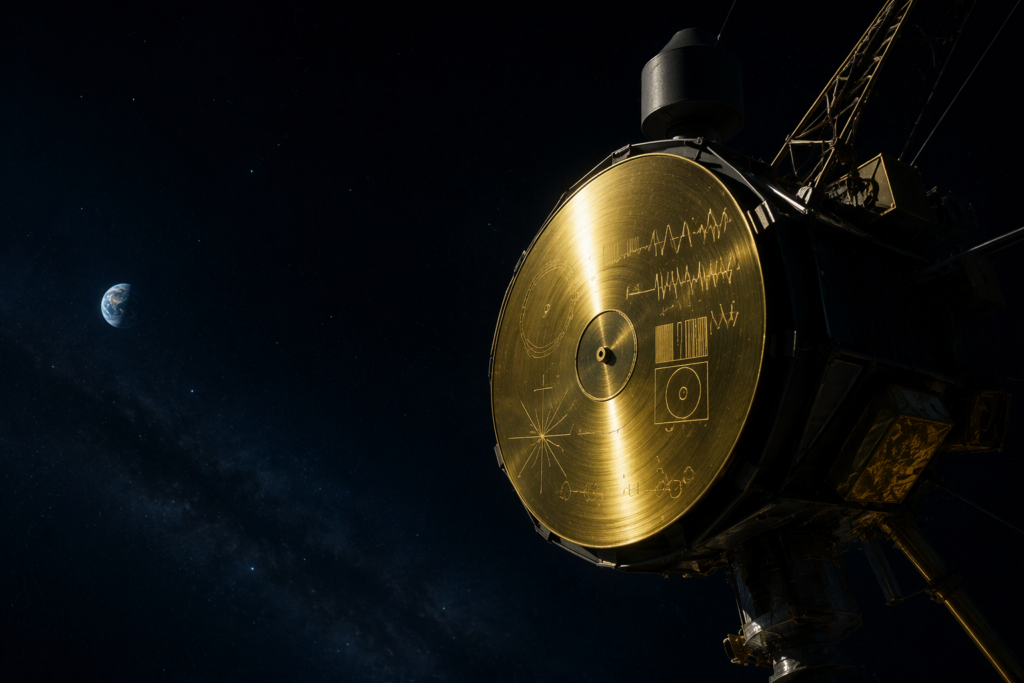
A billion years from now, Earth will be unrecognisable, but humanity’s greeting on the voyager golden record will still drift through deep space. Science author Ann Druyan, who helped assemble that artifact nearly five decades ago, still views the creation as an enduring portrait of who we were when we first reached out to the cosmos.
Speaking with broadcaster Kaine Pieri, Druyan reflected on what the twin robotic probes represent as they push further into the unknown than any machines built before them. While human life on Earth will inevitably change or fade, the metal discs bolted to both probes will outlast our cities, oceans, and civilizations.
Also read: Pakistani Astronaut to Join Upcoming China Space Station Mission
“I like to think of it as a kind of love poem to our home planet. And if you think about what’s a billion years from now, Earth would be unrecognisable. Everything we love will have either left for parts unknown or be gone… but the Voyagers will still sing for us.”
Curating the voyager golden record in 1977
In 1977, Druyan served as Creative Director of NASA’s Voyager Interstellar Message Project. Her assignment was both poetic and daunting: assemble an audio-visual time capsule capable of speaking for an entire planet.
The project produced the gold-plated copper discs mounted on both Voyager 1 and Voyager 2. Each disc carries spoken greetings in dozens of languages, natural sounds such as thunder and wind, diagrams, photographs, and musical selections spanning various cultures. NASA designed the records for any extraterrestrial intelligence that might cross paths with the silent probes eons from now.
How twin probes far outlived their original goals
NASA did not initially build the spacecraft to wander the galaxy forever. Engineers launched Voyager 1 and Voyager 2 to conduct flybys of Jupiter and Saturn, gathering close-up data on their rings and moons.
The spacecraft completed that primary assignment with flying colors, but they had plenty of life left. Voyager 2 took advantage of a rare planetary alignment to swing past Uranus and Neptune a decade later, giving scientists their only close looks at those ice giants. After finishing their grand planetary tour, both probes continued speeding toward the outer fringes of the solar system.
Entering interstellar space and a 26-billion-kilometer mark
Nearly 50 years after leaving Florida launchpads, both spacecraft have crossed the heliopause into interstellar space. They hold the record as the most distant human-made objects in history, sending faint signals back across the void.
Now, Voyager 1 is approaching another historic threshold: reaching one light day away from Earth. That milestone puts the spacecraft roughly 26 billion kilometers away, a distance so vast that radio commands traveling at the speed of light need a full 24 hours just to reach its receiver. As Voyager 1 crosses that line, it pushes our technological presence into an entirely new scale of distance.
Source: BBC