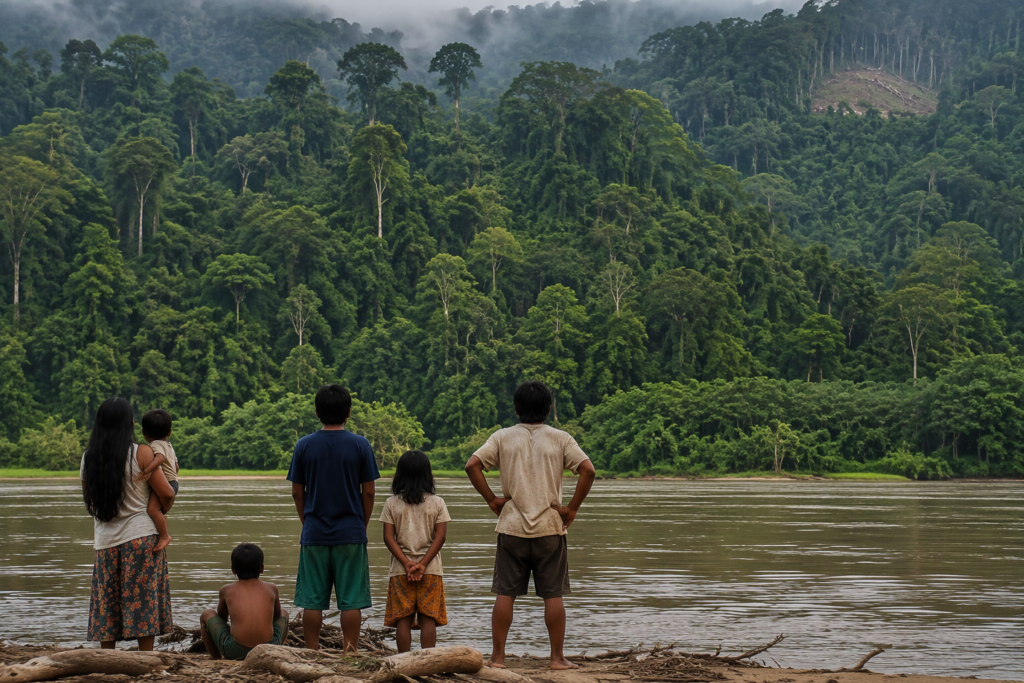
Twenty people walked out of the dense forest canopy in northeastern Brazil with a desperate plea: they needed food. The group belonged to the uncontacted Awa people, an isolated population living deep within the state of Maranhao. Their emergence from voluntary isolation points directly to a worsening crisis along the borders of their ancestral homeland.
Illegal logging, hunting, and land clearing continue to shrink the perimeter of their forest. For outside observers and local Indigenous leaders, the encounter signals that environmental destruction has reached an acute tipping point where isolated families can no longer feed themselves.
Also read: Pope Leo Cancer Surgery: Pontiff Speaks on Health, Peru Rosary
The encounter at Tawari village
The meeting unfolded on a Monday near a government access control post and the village of Tawari. Tawari is home to members of the Guajajara Indigenous group, who live inside the protected Arariboia Indigenous Land.
Guajajara residents recorded the scene as the group of about 20 Awa approached their community. Survival International, a UK-based Indigenous rights advocacy organisation, distributed the recorded video footage on Tuesday. The organisation explained that it published the clips after an explicit request from the Guardians of the Amazon.
The Guardians of the Amazon is a grassroots Indigenous patrol group that monitors the forest and campaigns against illegal loggers and ranchers. Brazil’s Ministry of Indigenous Peoples verified that the encounter occurred near the Tawari village checkpoint. Official monitoring teams witnessed the uncontacted Awa people approaching and asking for immediate supplies of food.
Why the uncontacted Awa people face mounting pressure
Commercial intruders have pushed deeper into Maranhao for decades, cutting valuable timber and establishing illegal cattle ranches. Miners, hunters, and logging crews frequently trespass across protected borders, severing the natural corridors that Indigenous families rely on for sustenance.
Survival International director Caroline Pearce stressed that outside intrusions have cornered the isolated families into dangerously small zones.
“The uncontacted Awa are under extreme pressure as intruders encroach from all sides of their territory, driving them into an ever-smaller island of the Amazon rainforest, surrounded by destruction,” said Caroline Pearce, Survival International’s director.
Teresa Mayo, a senior researcher at Survival International, explained that habitat loss strikes at the very existence of forest dwellers. “If there is no forest, there are no uncontacted peoples,” Mayo said. Without vast, undisturbed woodland for hunting and gathering, isolated communities face immediate starvation.
Funai maintains strict non-contact policy
Following the release of the videos, Funai, Brazil’s federal Indigenous affairs agency, initiated an official review. Funai told news agencies it is evaluating the recordings and accounts shared on social media showing the isolated Awa interacting with the village inside Arariboia.
The agency reiterated that the Brazilian state is not attempting to establish contact with the group. Official policy maintains a strict non-contact stance designed to respect voluntary isolation and prevent catastrophic harm.
The Awa are a Tupi-Guarani people based in northwestern Maranhao. While several Awa communities live in settled villages, others maintain total isolation in the deep forest. Funai focuses on protecting territory boundaries so these groups can survive without outside interference.
The deadly risk of infectious disease
Beyond territorial loss, physical contact carries an immediate biological danger. The Maranhao Indigenous people’s organisation, known as COAPIMA, warned that unplanned encounters create grave risks for the uncontacted Awa people.
Isolated populations lack immunity against common pathogens like influenza, measles, and respiratory infections. An ordinary cold carried by an outsider can devastate an entire isolated settlement within weeks.
History across the Amazon basin proves how quickly contact turns lethal. During the 1980s, outside contact with the isolated Nukak people in Colombia triggered fatal epidemics. Around 40 percent of the entire Nukak population died from disease within years of initial contact.
Federal officials and Guajajara leaders are maintaining watch around Arariboia Indigenous Land to protect the borders and prevent further unplanned contact.
Source: Al Jazeera


