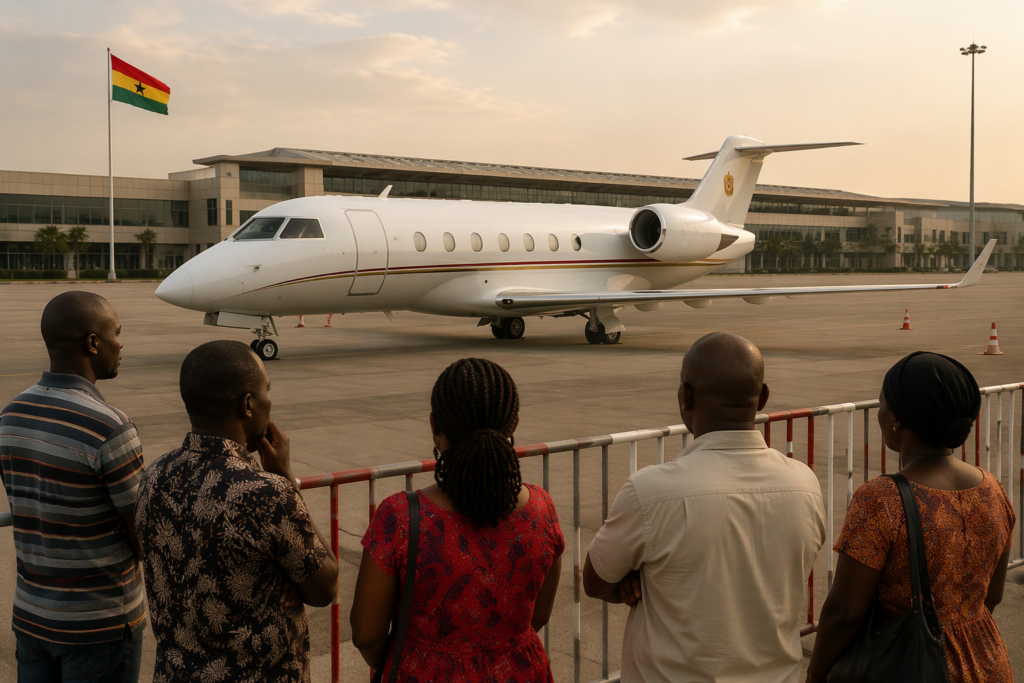
Ghana received a brand-new $61 million French-built Falcon 6X on Monday, greeting the aircraft on the tarmac with a ceremonial water salute while public anger flared across the country over the cost. The arrival of the Ghana presidential jet immediately ignited a fierce political dispute over state spending during an ongoing cost-of-living squeeze.
Critics say the purchase shows detached priorities at a time when ordinary households struggle with daily expenses and youth unemployment stays high. The acquisition puts President John Mahama under intense scrutiny, particularly because he fought against purchasing a state aircraft when he led the political opposition.
Also read: COP31 Draft Deal Sparks Fierce Clash Over Fossil Fuel Phaseout
Government ministers insist the country can now afford the plane because national finances have stabilised following years of crisis that required a $3 billion International Monetary Fund bailout. The debate highlights the tension between upgrading state security equipment and addressing everyday economic pain.
The clash over timing and hypocrisy
Opposition lawmakers were quick to denounce the delivery, arguing that the administration has abandoned the principles it campaigned on. Opposition MP Samuel Abu Jinapor openly challenged the governing National Democratic Congress over its sudden change of heart.
“What was unacceptable in opposition cannot suddenly become acceptable in government merely because the occupants of power have changed.”
Jinapor demanded full transparency regarding the procurement process, the exact financing terms, and the official justification for spending tens of millions of dollars on executive travel. Online reaction was equally blunt, with citizens questioning why millions were spent on luxury aviation instead of public services. One user on X noted that the funds could have employed more than 100,000 nurses and 200,000 teachers.
Why the government says it bought the Ghana presidential jet now
Administration officials reject claims of bad timing or wasteful spending. Peter Lanchene Toobu, chairman of parliament’s defence committee, explained that the party never opposed buying an aircraft in principle, but rather opposed doing so while begging international lenders for financial rescue packages.
According to Toobu, the state paid for the aircraft without taking on fresh loans, pointing to a stronger Ghanaian cedi and broader macroeconomic stability that made imports cheaper. Parliament had already approved the purchase last December as part of a wider fleet overhaul for the Ghana Air Force, which also covers four helicopters from Airbus.
Government spokesperson Kwakye Ofosu also pushed back against critics, arguing that basic consumer indicators show the economy is turning a corner. He cited the cost of building supplies as tangible proof of recovery, noting that a bag of cement dropped from 115 cedis in 2024 to 80 cedis today.
Beds, baths and the truth about the cabin
Rumours spread quickly after Monday’s arrival that the Falcon 6X featured high-end amenities, including a private bedroom and a dedicated bathroom for executive use. Officials moved quickly to squash those stories before they gained further political traction.
Ofosu dismissed the claims as false, telling local media that the president has no plans to bathe in the sky. He clarified that the aircraft has reclining seats designed to convert into sleeping berths for long journeys, but confirmed it has no dedicated bedroom suite.
For the administration, the operational facts mattered far more than the interior design. Officials say the plane provides the extended flight range needed to reach distant summits without frequent refuelling stops, cutting down travel time and security vulnerabilities.
What happens to the ageing Falcon 900EX
The new arrival replaces a 16-year-old Falcon 900EX that military officials say had become unreliable and expensive to maintain. The older plane suffered recurring technical faults, including structural corrosion and persistent fuel tank leaks.
Those defects left the previous jet grounded in France for several months in 2025 for extensive maintenance. The government argued that keeping the old jet airborne posed safety hazards and drained public funds through emergency repair bills.
Lawmakers will now turn their focus to parliamentary scrutiny as opposition members push for a formal review of the procurement records and military contracts in the coming weeks.
Source: BBC


