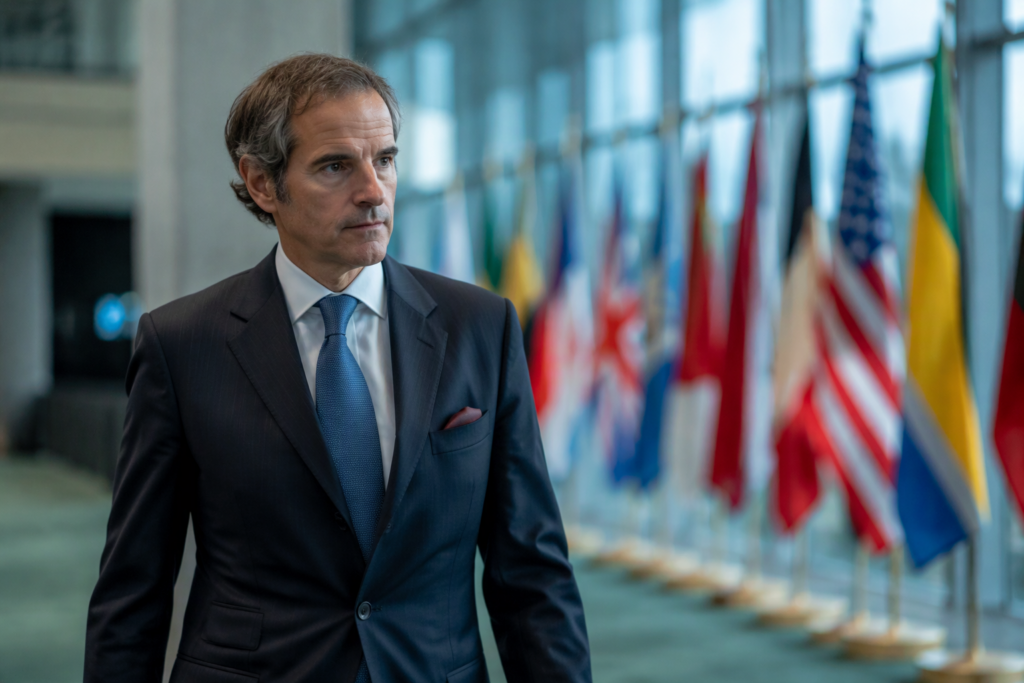
Rafael Grossi walked through artillery fire to inspect Ukraine’s besieged Zaporizhzhia nuclear plant, but his toughest diplomatic test is happening behind closed doors in New York. The 65-year-old head of the International Atomic Energy Agency is making a bold play in the UN secretary-general race, yet his growing ties to right-wing populists in Washington and Buenos Aires threaten to sink his campaign before it reaches a final vote.
Grossi finished second in the latest United Nations Security Council straw poll, picking up nine “encourage” and four “discourage” votes among eight remaining contenders. He trails Costa Rica’s Rebeca Grynspan at a moment when current leader Antonio Guterres must step down on December 31. With the clock ticking, the contest to run the world body has turned into an ideological clash over what the United Nations should actually do.
Also read: Who Will Be the Next UN Secretary-General? Grynspan Leads
The outcome matters for every global conflict zone. The secretary-general shapes peacekeeping priorities, human rights investigations, and billions of dollars in humanitarian aid. A victory for Grossi could dismantle major parts of the institution’s current structure, while a veto from Beijing or Moscow would stop his bid instantly.
Walking through war zones to the world stage
Since taking charge of the Vienna-based nuclear watchdog in 2019, Grossi has built his reputation on high-stakes crisis management. He did not sit behind a desk when Russian troops seized radioactive sites across Ukraine in 2022. Instead, he led technical teams directly into Chernobyl and Zaporizhzhia to keep monitoring systems running.
Jan Wouters, a professor of international law at KU Leuven in Belgium, pointed out that Grossi changed how the agency functions during wartime. Grossi focused on basic plant safety rather than arguing about territorial borders, which allowed him to arrange eight local ceasefires between Russian and Ukrainian forces to carry out urgent repairs.
That frontline style won praise in Western capitals, but it also ruffled feathers. Ezequiel Jimenez Martinez, an adjunct law professor at Pompeu Fabra University in Barcelona, said Grossi’s aggressive visibility angered Moscow, which felt the atomic inspector repeatedly stepped outside his formal mandate.
The Milei and Trump baggage in the UN secretary-general race
Winning the job requires at least nine votes from the 15-member Security Council and zero vetoes from the five permanent members: the United States, Britain, France, Russia, and China. Grossi’s campaign platform calls for aggressive reform, lower operating costs, and eliminating duplicate agencies. That language sounds appealing to United States President Donald Trump and Argentinian President Javier Milei, but it raises immediate alarm across the 193-member General Assembly.
Milei has been one of the world’s harshest critics of international bodies, calling the United Nations “useless” and describing its diplomats as parasites. Since taking office in 2023, Milei has also reopened a bitter fight with London over the Falkland Islands, insisting self-determination should not protect the British territory’s residents. Trump has similarly pulled Washington out of key treaties, slashed global budgets, and sidestepped the Security Council when launching military strikes against Iran in February.
Alvina Hoffmann, a senior lecturer at SOAS University of London, observed that Grossi prefers quiet backroom talks and bureaucratic streamlining over public defense of international norms. If you reduce the job to administrative management, she warned, the world loses a moral voice capable of calling out clear violations of the UN Charter.
Why Moscow, Beijing, and Tehran are pushing back
Geopolitics presents an even steeper hill for Grossi to climb. China has already indicated it will not back a candidate seen as an instrument of American foreign policy. Reports from the South China Morning Post indicate Beijing has ruled out Grossi and prefers Grynspan for the top job.
Iran has also campaigned fiercely against Grossi, even though Tehran does not hold a council vote. Iranian foreign ministry spokesman Esmaeil Baghaei recently accused the atomic watchdog of issuing biased reports tailored to Washington and European allies. Before Israeli and American air strikes hit Iranian nuclear sites in June 2025, the agency estimated Iran held 440.9 kilograms of uranium enriched up to 60 percent, enough material for roughly ten nuclear warheads if refined to weapons grade.
Jimenez Martinez believes Western council members will brush off Tehran’s complaints because most agency governors supported Grossi’s inspections. The real danger for Grossi lies with Russia and China, who hold the power to kill any nomination with a single negative vote.
The growing push for a woman to lead the UN
Diplomatic tradition dictates that the post should rotate to Latin America next, but geography is only half the equation this year. Five women are running in this UN secretary-general race, and international advocacy groups argue the institution can no longer justify an unbroken line of male leaders.
“The United Nations has existed for 80 years without ever appointing a woman as secretary-general.”
Ben Donaldson, an adviser to the 1 for 8 Billion campaign, stressed that selecting a female leader aligns directly with the body’s founding principles of equality. He noted that member states have passed clear resolutions demanding gender balance in top leadership posts, making Grynspan’s frontrunner status a powerful symbol for delegates who want historical change.
The Security Council will hold its next round of straw polls in the coming weeks before sending a single recommended name to the General Assembly for confirmation before the December 31 deadline.
Source: Al Jazeera


