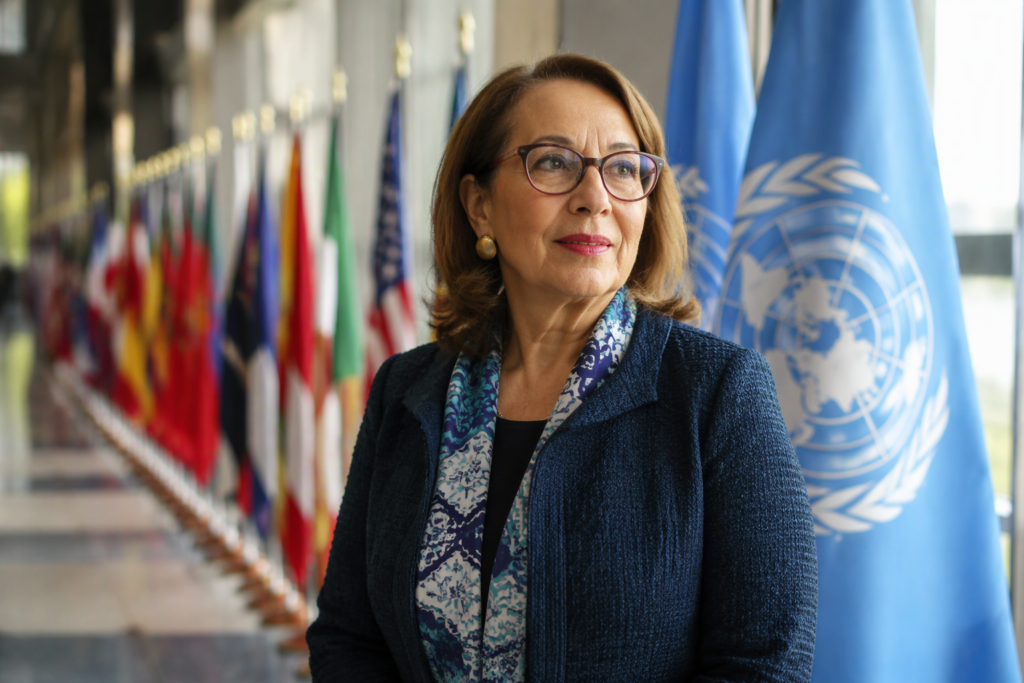
Rebeca Grynspan negotiated the Black Sea grain deal while undergoing breast cancer treatment, convincing warring nations to let food ship out even as bombs fell. Now, the 70-year-old Costa Rican economist is the frontrunner to become the next UN secretary-general, leading straw poll after straw poll inside the United Nations Security Council.
If she wins the race before the Dec. 31 deadline to replace Antonio Guterres, Grynspan will make history twice over. She would be both the first woman and the first Jewish person to head the global body in its 80-year existence.
Also read: EU Syria Deal Revived as Ministers Move to Normalise Ties
Yet holding the lead in informal ballots does not guarantee the office. Eight candidates are competing for the post, and at least one permanent member of the Security Council has cast a secret veto against her, throwing the succession into uncertainty.
The veto puzzle facing the next UN secretary-general
Winning the leadership of the United Nations requires surviving the gauntlet of the five permanent council members: the United States, Russia, China, France and the United Kingdom. Any single permanent member can kill a candidacy with one negative vote. Because the straw polls use secret ballots, no one outside the room knows with certainty which capital blocked Grynspan.
Her track record carries complicated baggage across multiple global capitals. In Moscow, officials remember her blunt criticism when Russia pulled out of the Black Sea grain agreement in 2023. That pact, which she helped broker alongside Turkey, moved 32 million tonnes of grain and helped drop world food prices by 22 percent. Russia’s exit damaged the initiative, and her public pushback may cost her Moscow’s vote, according to Richard Gowan, an analyst at the International Crisis Group. Grynspan traveled to meet Russian Foreign Minister Sergey Lavrov in April to plead her case directly.
Beijing has signaled an interest in seeing a Latin American take the post, which works in her favor, though China has stopped short of an official endorsement. Reports also suggest the race is far from settled among the Western powers. Diplomats have indicated that the United States and Russia both gave early backing to Lana Nusseibeh of the United Arab Emirates, though Nusseibeh picked up six negative votes out of 15 council members in a recent straw poll.
Walking a tightrope on Gaza and Israeli ties
Grynspan’s personal identity and diplomatic work place her under intense scrutiny regarding the Middle East. She is the daughter of Polish Jewish refugees who escaped the Holocaust to Central America. Her sister lives in Israel, her relatives describe themselves as Zionists, and her niece and nephew served in the Israeli military.
Yet as head of the UN Conference on Trade and Development (UNCTAD), Grynspan oversaw research that documented the devastating human and economic cost of Israeli military operations. A major UNCTAD report revealed that Israeli occupation policies stripped an estimated $212.2 billion from the Palestinian economy between 2000 and 2024. She also sounded the alarm after Gaza’s annual per capita income plummeted 83 percent down to just $161.
“What my identity gives me is empathy, not bias. I am the daughter of peace. My parents were refugees of the Second World War. I know what war takes away and I know what peace makes possible.”
She condemned Hamas for the Oct. 7, 2023 attacks and has repeatedly demanded an immediate ceasefire in Gaza, aligning herself with official UN findings. Israeli officials have stayed silent publicly on her candidacy, while her balanced stance leaves diplomats on both sides examining every word she speaks.
Can an insider sell reform to Donald Trump?
The steepest hurdle between Grynspan and the top floor of UN headquarters sits in Washington. Donald Trump has spent years criticizing multilateral institutions, often expressing a desire to scale back American funding and influence inside the United Nations. Grynspan has spent decades working within international organizations, serving as second vice president of Costa Rica in the 1990s, managing regional debt talks, and running UN development programs before taking over UNCTAD in 2021.
Can a lifelong institutional diplomat convince a skeptical White House that she is prepared to overhaul the bureaucracy? Esther Brimmer, a former US assistant secretary of state now with the Council on Foreign Relations, pointed out that insider candidates face a double standard. They must work twice as hard to persuade Washington that they will cut waste and reorganize agencies rather than protect the status quo.
Grynspan insists she does not want to protect old habits. She has openly called for the United Nations to shed its fear of failure and intervene directly in difficult ceasefires.
“Any mediator knows that 10 ideas may fail before the 11th succeeds,” she said. “Few governments can afford the political cost of so many rejections. The secretary-general can.”
What the Security Council must decide next
The race to choose the next UN secretary-general comes down to whether world powers want a cautious administrator or a determined dealmaker willing to absorb public hits. Grynspan argues that playing safe is the fastest way for the organisation to lose its purpose entirely.
Her pitch rests on five decades of surviving crises, from Latin American debt restructurings in the 1980s to wartime agricultural shipments in 2022. You can see her strategy clearly: frame her deep institutional knowledge as the exact tool needed to shake the building awake.
Security Council members face a Dec. 31 deadline to pick their nominee before Guterres steps down, with final formal votes expected in New York in the coming weeks.
Source: Al Jazeera


