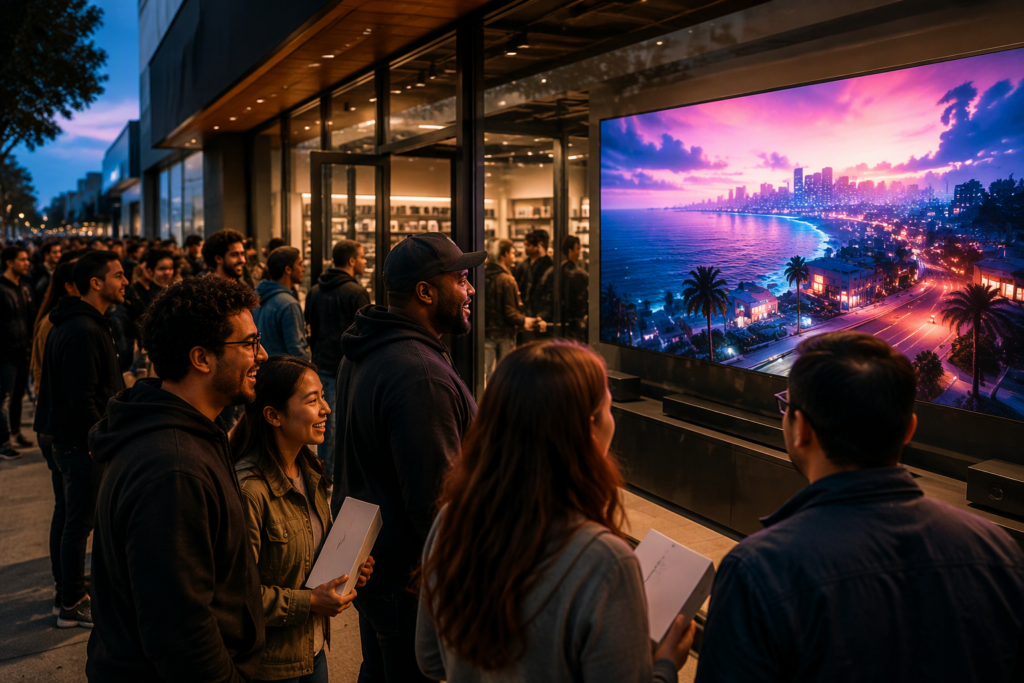
Before Thursday arrived, fans had poured more than $1.5 billion into pre-sales alone, turning the long-awaited GTA VI release into an economic juggernaut that dwarfs the rest of the entertainment world. Players waited more than 13 years for this sixth instalment, driving continuous social media buzz ahead of its debut.
The staggering financial haul proves how thoroughly video games have outpaced traditional media. While Hollywood studios scramble to pull audiences back into theatres, a single video game launch now commands global attention and billions of dollars before anyone even boots up a console.
Also read: From Pong to GTA VI: Tracing 50 Years of Video Games
Mark DeLoura, vice president of strategy for the GDC Festival of Gaming, described the launch as clear proof that games sit squarely at the center of modern popular culture rather than existing as a fringe hobby.
Inside Vice City after a 13-year wait
The new title puts players in control of two lead characters, Jason and Lucia. Their story unfolds across the criminal underworld of Vice City, a fictional setting modeled after Miami, Florida.
Critical reception has matched the thirteen-year build-up. Reviewers have praised the title almost universally, making it the best-reviewed video game in history. That warm reception leans on deep worldbuilding, iconic soundtrack selections, and detailed environments, alongside the familiar dark humor of causing havoc in heavy vehicles.
Critics also noted that the writing engages seriously with American life, touching directly on the hardships faced by immigrants and minority communities. That thematic depth sits alongside the freewheeling street crime that made the series famous.
How politics and culture embraced the chaos
The cultural standing of the franchise looks completely different today than it did twenty years ago. When earlier editions hit shelves, politicians, parents, and television pundits routinely condemned the series for showing carjackings, armed robbery, and police shootouts.
That moral panic has almost vanished from modern public life. Everyone from the White House and the Weather Channel to the US military has joined the online conversation around the game.
Military publication Task and Purpose reported that 43 soldiers recently used an official reenlistment incentive to secure a four-day weekend just to play the title at launch.
A few political figures still voice sharp criticism. Representative Tim Burchett, a Tennessee Republican, took to TMZ to denounce the title for glorifying violent crime.
“They’ll have a documentary on how best to steal a car at gunpoint or shoot a cop. I mean, what in the world!”
A recent commentator on Fox News echoed similar worries, questioning whether the product harms American society. Yet most political figures have abandoned that fight, eager to stay connected with younger voters who grew up playing the series.
Dwarfing Hollywood at the box office
Data from the Entertainment Software Association shows that roughly two-thirds of the American population plays video games. In 2025, consumer spending on video games in the United States topped $60 billion, pushing total economic activity from the sector past $95 billion.
Those numbers make the film industry look small by comparison. Across the whole of 2025, total North American box office revenue came in just shy of $9 billion. A single game release can now generate in days what film studios take months to collect.
DeLoura pointed out that when a release commands this level of worldwide attention, it reflects the enormous size of the industry and its everyday role in people’s routines.
Layoffs and closures shadow the GTA VI release
Behind the historic sales numbers sits a deeply fractured industry. Counterintuitively, the historic GTA VI release arrives during one of the most painful contractions developers have ever faced.
Industry tracker Gaming Layoffs recorded that 40 studios shut down during 2026, cutting nearly 13,000 jobs. That represents an increase of nearly 150 percent compared to the same period in 2025.
Joost van Dreunen, an adjunct assistant professor at NYU Stern and author of the SuperJoost Playlist newsletter, explained that developers expanded aggressively during the pandemic but met stagnant consumer demand after 2022. Production costs continued to spiral upward, with the average top-tier game now costing $440 million to produce, compared to $47 million in 2000.
Van Dreunen noted that Rockstar Games spent $1 billion and used thousands of staff to build Vice City, proving this ultra-expensive development strategy works for practically only one studio. Can any other studio survive spending hundreds of millions on a single project?
Worker sentiment reflects that stress. A 2026 state-of-the-industry survey from the GDC Festival of Gaming revealed that 39 percent of American respondents had been laid off at least once in the past two years. In that same survey, 77 percent reported feeling pessimistic about where the industry is heading, and 30 percent admitted they were thinking about quitting the sector entirely.
DeLoura acknowledged the severe toll on creative talent, but he argued that broadening access across smartphones and personal devices still points to sustained long-term expansion. Publishers and rival studios will now watch holiday sales figures and early revenue updates to see whether the GTA VI release lifts the wider market or simply absorbs the spending of everyone else.
Source: Al Jazeera