
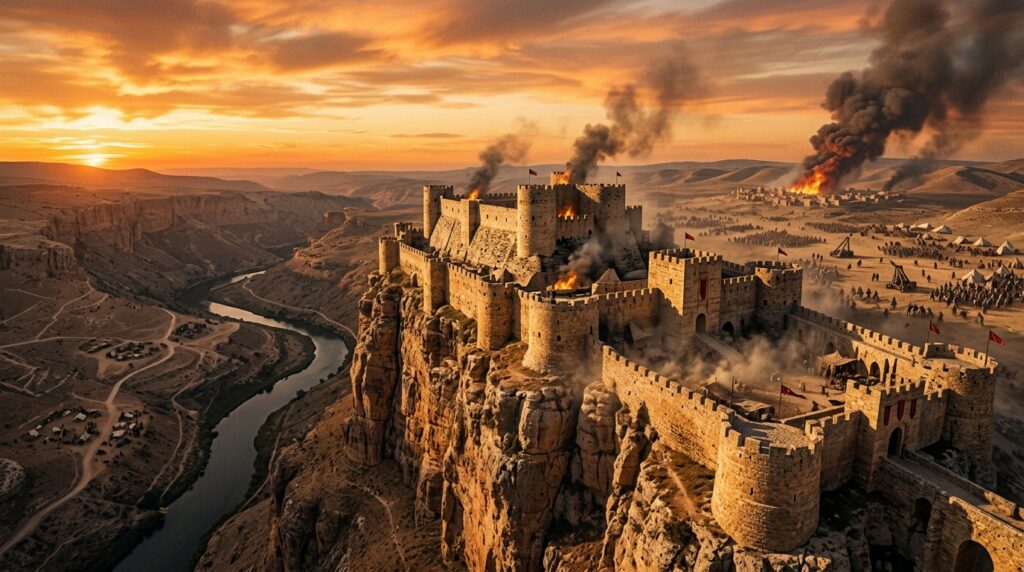
A 900-year-old crusader fortress has become the latest flashpoint in a rapidly escalating military campaign that is pushing deeper into Lebanese territory — and drawing sharp condemnation from the international community.
Introduction
Israel’s military campaign against the Iranian-backed militant group Hezbollah has entered a significant new chapter, with Israeli forces seizing control of Beaufort Castle — a strategically vital and historically iconic fortress perched high above the Litani River in southern Lebanon. The capture marks one of the most symbolically charged moments of the current conflict and signals a clear deepening of Israel’s ground operations well beyond previously established boundaries.
The development has triggered urgent international calls for restraint, a fresh round of mass evacuation orders for Lebanese civilians, and a defiant statement from Israeli Prime Minister Benjamin Netanyahu, who described the move as a defining shift in his country’s military posture.
The Capture of Beaufort Castle
Rising dramatically above the Litani River on a commanding rocky ridge, Beaufort Castle has dominated the landscape of southern Lebanon for nearly a thousand years. Originally constructed by Crusader forces around 900 years ago, the fortress has changed hands many times throughout history and has long held deep strategic value due to the sweeping vantage point it provides over the surrounding region.
Israeli forces confirmed the castle’s capture as part of an ongoing expansion of ground operations in southern Lebanon. Israeli Defence Minister Israel Katz noted that the Golani Brigade — the same unit that fought for the fortress 44 years ago — had returned to raise the Israeli flag above it once more, lending the moment a powerful historical resonance for the Israeli military.
Prime Minister Netanyahu framed the capture in dramatic terms, declaring that Israel had “broken the barrier of fear” and was now taking the initiative across multiple theatres of operation simultaneously. Katz added that control of the castle and the strategic ridge on which it sits was an important step toward securing Israeli communities on the other side of the border from Hezbollah threats.
Expanding Ground Operations and Evacuation Orders
The seizure of Beaufort Castle forms part of a broader and accelerating pattern of Israeli military expansion inside Lebanese territory. The Israel Defense Forces issued sweeping evacuation warnings urging all residents south of the Zahrani River to leave immediately, warning that anyone in proximity to Hezbollah personnel, infrastructure, or military equipment was placing their life at serious risk.
This marks the second such large-scale evacuation order issued within just a few days, and represents a clear indication that Israeli ground forces are pushing considerably further into Lebanon than their original operational boundary along the Litani River line. Military officials confirmed that a significant number of IDF ground soldiers were actively involved in operations that were simultaneously expanding into additional areas.
The city of Nabatieh, located further north of the Litani line, is also reported to be increasingly in the crosshairs of Israeli military planning — a development that would represent yet another escalation in the geographic scope of the campaign.
Casualties and Military Losses
The human cost of the conflict continues to mount on both sides. Lebanese authorities have reported that more than 3,300 people have been killed since the current phase of fighting resumed in early March 2026. On the Israeli side, military officials confirmed the death of another soldier, bringing the total number of Israeli military fatalities to 25.
In addition to the ground offensive, an airstrike in the vicinity of Hiram hospital in the southern Lebanese city of Tyre left 13 hospital staff injured and caused significant structural damage to the facility — a development that drew swift condemnation from humanitarian observers.
Schools in Israeli border communities were closed as a precautionary measure following a barrage of approximately 25 projectiles fired by Hezbollah toward those areas on the previous day.
What Sparked the Current Escalation?
The current round of fighting reignited in early March 2026 after Hezbollah fired rockets into Israeli territory in retaliation for the killing of Iranian Supreme Leader Ayatollah Ali Khamenei. Since that flashpoint, both sides have dramatically intensified their operations.
Israel says its escalating campaign is a direct response to Hezbollah’s increasing use of explosive drones and missiles against both Israeli military personnel operating inside Lebanon and civilian communities across the Israeli border. Hezbollah, meanwhile, has been observed adopting new tactical approaches — including the use of fibre-optic guided drones, a technology borrowed from lessons observed during the war in Ukraine — to strike Israeli targets with greater precision.
International Condemnation Grows
The international response to Israel’s expanding ground operations has been swift and sharply critical. France, which maintains deep historical and cultural ties with Lebanon dating back generations, formally requested an emergency meeting of the United Nations Security Council to address the situation.
French Foreign Minister Jean-Noël Barrot described Israel’s continued military operations as a “major mistake,” stating that nothing could justify the prolongation of the campaign or what he characterised as an increasingly deep occupation of Lebanese territory.
Lebanese Prime Minister Nawaf Salam echoed this condemnation in a national televised address, accusing Israel of pursuing a “scorched-earth policy and collective punishment” against the people of southern Lebanon.
Diplomatic Efforts Continue Amid the Fighting
Despite the battlefield escalation, diplomatic channels remain open. A fourth round of negotiations between Israeli and Lebanese government delegations is scheduled to take place in Washington this week — talks that Lebanese Prime Minister Salam has described as his country’s only viable path away from continued conflict.
However, the talks face a significant structural limitation: Hezbollah — the principal armed party to the conflict on the Lebanese side — is not participating in the negotiations. As a result, the Lebanese government and military are left largely as observers to a war being fought on their soil, with limited ability to influence its course or conclusion.
The Broader Regional Picture
Israel’s military activity is not confined to Lebanon alone. Prime Minister Netanyahu has made clear that the country is simultaneously conducting operations across multiple fronts — including in Gaza and Syria — framing this as part of a comprehensive strategic initiative against what Israel characterises as a coordinated network of Iranian-backed threats.
This multi-front posture, combined with the symbolically charged capture of Beaufort Castle, suggests that Israel’s current military campaign is entering a more ambitious and assertive phase — one that is drawing increasing scrutiny from the international community and raising urgent questions about where the boundaries of this conflict ultimately lie.
Conclusion
The capture of Beaufort Castle is more than a military footnote — it is a powerful signal of how dramatically and rapidly Israel’s ground campaign in Lebanon is evolving. As evacuation orders expand, casualties rise, and diplomatic protests multiply, the situation on the ground is becoming increasingly difficult to contain. With Washington talks scheduled and international pressure mounting, the coming days may prove critical in determining whether this conflict finds a path toward de-escalation — or continues its dangerous deepening into Lebanese territory.