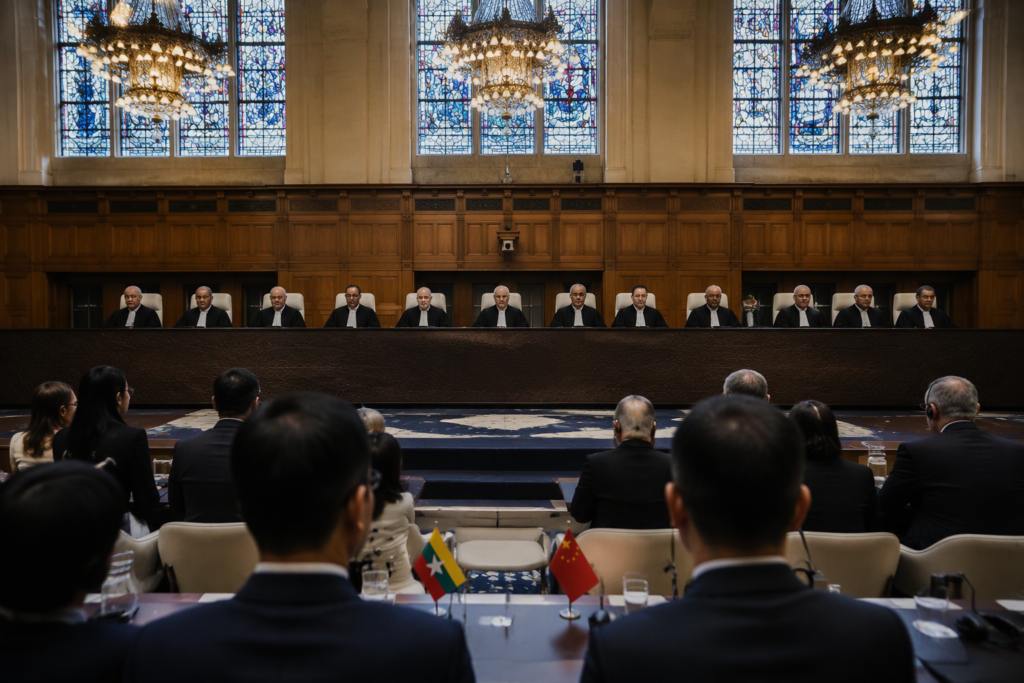
For the first time in the 80-year history of the International Court of Justice, the United Nations’ top legal body has declared a state guilty of genocide. Yet the response from the generals in Naypyidaw and their partners in Beijing was swift and defiant, rejecting the landmark finding within hours of its release.
The court determined on Thursday that Myanmar’s military conducted state-sponsored genocide against its Muslim Rohingya minority during military clearance operations launched nine years ago. The decision directly impacts hundreds of thousands of displaced people waiting for justice, but Myanmar’s military government immediately branded the Rohingya genocide ruling as fundamentally unfair.
Also read: Myanmar Genocide Ruling: UN Court Finds State Guilty
Spokesperson Khaing Khaing Soe rejected the judgement during a press briefing on Friday, arguing that Myanmar’s authorities were the ones being wronged. China, an ally of the military junta, quickly echoed those complaints and warned international courts against overstepping their boundaries.
A divided bench and an unprecedented finding
The judges reached their conclusion after hearing evidence of systematic atrocities carried out during the 2017 military campaign. The court found that security forces executed Rohingya men and boys en masse, subjected women to widespread rape and sexual assault, and burned hundreds of villages to the ground across Rakhine state.
The bench split sharply on the final decision. Nine judges voted to declare genocide, while six voted against. Myanmar seized on that margin to question the legitimacy of the entire proceeding.
“Our country was unjustly accused. This decision is not a unanimous decision by everyone; it is not fair.”
A Chinese judge sitting on the 15-member panel voted in Myanmar’s favour on all counts except one. Myanmar pointed directly to that division as proof that the court acted on political pressure rather than impartial law.
Myanmar claims victimhood while Beijing pushes back
China mounted a public defence of Myanmar right after the judgement was handed down. Chinese foreign ministry spokesperson Guo Jiakun told reporters in Beijing that such verdicts do little to resolve ongoing conflicts.
Guo stated that rulings from the UN court are “not conducive to the settlement of disputes” and urged foreign governments to step back. “The international community should make joint efforts in this direction to avoid complicating this issue,” Guo said.
The Chinese statement came just a day after Beijing joined Russia and the United States in issuing a joint statement that cautioned international bodies against abusing their judicial power. That joint position provided diplomatic cover for Myanmar to dismiss the court’s authority outright.
Reparations, returns and the reality in Rakhine
Beyond the genocide finding, the court issued sweeping orders targeting Myanmar’s obligations to the survivors. The judges ruled that the government must pay financial compensation for its wrongful acts, with the exact figure to be settled in future proceedings.
The court also ordered Myanmar to allow the safe and dignified return of Rohingya who were expelled from their homelands. Yet enforcing such orders remains nearly impossible under current conditions on the ground.
Myanmar is locked in an intense, multi-fronted civil war across multiple regions, including Rakhine state where most Rohingya once lived. The junta’s loss of control over large swathes of territory leaves little prospect of immediate repatriation or formal compensation payments.
The regional fallout from Bangladesh to Malaysia
The brutal 2017 campaign drove roughly 700,000 Rohingya across the border into neighbouring Bangladesh. Years later, those refugee camps remain crowded, while thousands of other Rohingya took dangerous sea routes to Southeast Asian countries such as Malaysia.
The crisis continues to strain governments across the region. Rohingya refugees account for two-thirds of the 190,000 Myanmar refugees and asylum seekers registered in Malaysia, according to United Nations figures.
Malaysia announced on Friday that it plans to resettle 10,000 Rohingya refugees in Turkiye as part of a push to manage the humanitarian pressure within its own borders. That bilateral agreement shows how other nations are forced to handle the fallout while Myanmar refuses to accept the court’s orders.
Can legal declarations from The Hague force real change on an armed regime fighting for its survival? For now, the ICJ must begin the separate legal process to calculate the exact financial compensation Myanmar owes to the victims.
Source: Al Jazeera


