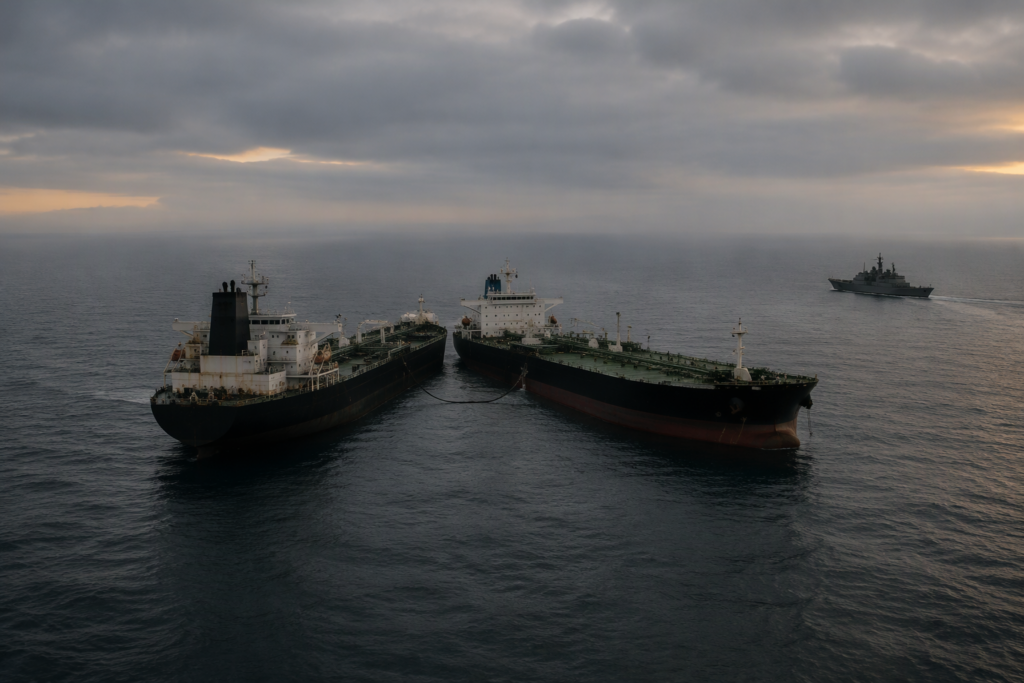
Any commercial vessel caught taking on cargo from Iranian waters can now be boarded, diverted or seized by American warships on the high seas. The order from US Central Command turns the contested waters around the Persian Gulf into an immediate flashpoint, directly warning international merchant fleets that mid-ocean handoffs will no longer shield them from military action.
By expanding enforcement beyond Iranian coastlines, Washington is attempting to seal the remaining cracks in the Iran naval blockade that cut off Tehran’s crude exports in July. For global energy markets and regional shipping lines, the directive eliminates the legal grey zone that allowed illicit tankers to quietly move fuel across the Middle East.
Also read: US Memo Warned Iran Blockade Was Driving Up Gulf Shipping Premiums
The move also pushes Tehran closer to a dangerous calculation. With its oil revenues drying up and American warships patrolling nearby sea lanes, Iranian officials face a stark choice between accepting financial asphyxiation or mounting an armed challenge that could spark a wider war.
How CENTCOM intends to choke ship-to-ship transfers
CENTCOM issued its maritime advisory on Wednesday, clarifying that ships do not need to drop anchor at an Iranian terminal to violate the quarantine. Simply meeting an Iranian-loaded vessel at sea is now grounds for an armed interception.
“Any ship that receives cargo via a ship-to-ship transfer with a vessel subject to the blockade and carrying cargo loaded at an Iranian port or coastline may be considered to be evading the blockade, even if it has not entered Iranian ports or the Iranian coastline,” CENTCOM stated.
The command warned that non-compliant crews could face direct armed force. Naval boarding teams have been authorized to halt suspect hulls, take control of their bridges, and force them to sail back to the Iranian berths where their illicit cargo was first pumped.
The current embargo has a rocky timeline. The White House first put the cordon in place on April 13, paused it in June during tentative diplomatic talks, and reinstated the clampdown on July 14 after negotiations fell apart.
Tehran’s threats to hit regional energy
Iran’s military leadership insists it will not back down. While top officials have not issued a formal diplomatic response to the CENTCOM advisory, state media and military commanders have made their intentions clear.
Earlier this month, Islamic Revolutionary Guard Corps spokesman Brigadier General Hossein Mohebi brushed aside the American operation. He warned that if US forces strike any Iranian craft, Tehran will hit back harder.
A commentary published Wednesday by Iran’s semi-official Fars News Agency went further, floating a plan to send a dedicated flotilla of crude carriers directly through the blockade lines. The commentary warned that if American forces try to stop those tankers, Iranian forces could retaliate against energy targets across the Persian Gulf, singling out United Arab Emirates oil facilities.
Can Iranian forces actually break the cordon? Andreas Krieg, an associate professor in security studies at King’s College London, argues that Tehran cannot defeat the US Navy in open water, but it can make enforcement painfully expensive.
Krieg warned that targeting tankers carries immense danger because an attack that kills crew members could drag Gulf neighbours into the crossfire. If Iranian vessels go down, Tehran could strike energy facilities across the region to prove that nobody else will ship oil while its own economy suffocates.
The shadow fleet and the Gulf trade
Before the US-Israeli conflict erupted in February, Iran exported between 1.5 million and 2 million barrels of crude oil every day, with Chinese refineries buying the bulk of those volumes. The quarantine stopped that flow, though illicit tankers quickly began probing for blind spots.
In October, maritime intelligence revealed that at least eight tankers hauling Iranian liquefied petroleum gas slipped out of the Gulf of Oman after July. Another vessel managed to haul jet fuel all the way to Myanmar in September.
Just this week, maritime tracking service TankerTrackers.com identified a ship loading crude through a ship-to-ship transfer in the Gulf. If that tanker reaches an overseas port, it would mark Tehran’s first successful crude delivery since the July enforcement began.
Yet stopping these operations remains a tactical headache for the Pentagon. Halting a supertanker at an Iranian port is straightforward, but tracking disguised commercial networks across open water creates political headaches with Gulf allies whose local trade hubs often overlap with these clandestine routes.
Why the Iran naval blockade raises escalation risks
The strategic standoff now centers on two vital maritime chokepoints: the Strait of Hormuz and the Bab el-Mandeb. Roughly 20 percent of global oil and a fifth of liquefied natural gas passed through Hormuz before the fighting began, while another 5 percent passed through Bab el-Mandeb toward the Red Sea.
Tehran has already choked off passage through the Strait of Hormuz in retaliation for military strikes. Meanwhile, Houthi forces in Yemen continue to threaten commercial passages through Bab el-Mandeb, raising the specter of a coordinated closure of both straits.
The fundamental problem is that Washington considers the containment strategy effective, while Tehran finds the resulting economic pain unbearable. As the clampdown tightens, Iranian leaders have fewer incentives to show restraint and stronger reasons to gamble on a confrontation.
Keep an eye on the Gulf of Oman over the coming days, where tracking data shows the latest tanker attempting its ship-to-ship crude run toward foreign buyers. If US boarding parties move to intercept that vessel, Tehran’s response will show whether this maritime standoff stays economic or turns into an armed exchange.
Source: Al Jazeera


